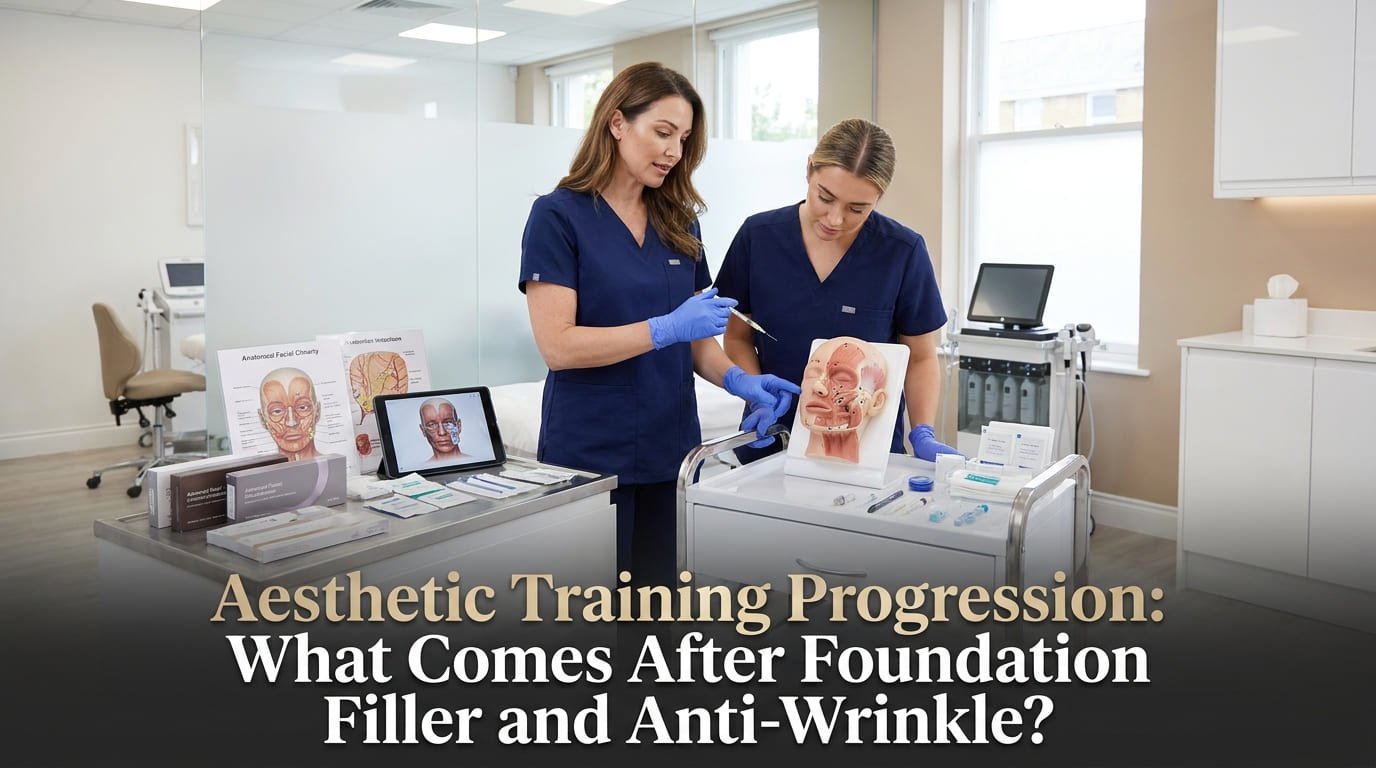
Foundation training in filler and anti-wrinkle treatment is the point at which most aesthetic practitioners enter the field. It provides the qualification, the initial hands-on experience, and the clinical governance knowledge needed to begin seeing patients. It does not provide the full range of skills, treatment areas, or clinical depth that a practising aesthetic practitioner needs to build a comprehensive and sustainable career.
The question of what comes next is one that most training providers do not address particularly clearly. Courses are marketed and sold. The progression pathway that would help a practitioner make good decisions about what to prioritise, in what order, and why is rarely mapped out as a coherent whole.
This article does that. It covers the logical progression from foundation training, what the priorities should be at each stage, and how to think about building a treatment menu that grows with your clinical confidence rather than ahead of it.
The Priority That Comes Before Any Advanced Treatment: Complications Management
Before discussing which treatment areas to train in next, the honest and clinically responsible answer to what comes after foundation training is complications management. Not because it is the most commercially exciting next step, but because it is the most important one.
Foundation training covers complications as a component of a broader curriculum. It introduces vascular occlusion, infection, asymmetry, and the other adverse outcomes associated with the treatments covered at foundation level. It does not and cannot provide the depth of training in complications recognition and management that dedicated specialist training delivers.
A practitioner who has completed their foundation training and is now seeing patients is at the stage of their career where complications are most likely to arise. Clinical experience is still limited. Patient assessment skills are still developing. The pattern recognition that allows experienced practitioners to identify early warning signs quickly has not yet accumulated. This is precisely the stage at which dedicated complications management training produces the most protective effect on patient outcomes.
Completing a specific complications management course before moving into advanced treatment areas is the right priority for the majority of new practitioners. The complications management course article on this blog covers what is involved in detail.
The First Natural Progression: Consolidating Foundation Areas
After completing foundation training and complications management, the next priority is not adding new treatment areas as quickly as possible. It is developing genuine clinical confidence and refined technique in the treatment areas already qualified for.
The gap between completing a training course and being genuinely skilled in a treatment area is measured in patient experience, not in qualifications. Most practitioners need to treat a meaningful number of patients in their foundation areas before their technique, their patient assessment, and their outcome consistency reach the level that justifies expanding to more complex treatments.
Anti-wrinkle in the three standard areas, filler in the common foundation zones, and the consultation and patient management skills that support them all develop through repetition and reflection rather than through additional certificates. Practitioners who move rapidly through training courses without consolidating what they have already learned often find that their foundation skills remain underdeveloped while their treatment menu grows well beyond their reliable competence.
Using model patients consistently during this consolidation phase, reflecting seriously on outcomes, maintaining thorough documentation, and seeking informal peer feedback or supervised assessment where possible are what turn foundation training into genuine clinical competence.
Advanced Anti-Wrinkle Training: Expanding Beyond the Three Standard Areas
Once confidence in the foundation anti-wrinkle areas is established, advanced anti-wrinkle training opens a significantly broader scope of practice.
Advanced anti-wrinkle applications include the lower face and perioral region, where treatment addresses vertical lip lines, the depressor anguli oris for marionette line improvement, the mentalis for chin dimpling, and the platysmal bands of the neck. The masseter muscle for jaw slimming and bruxism management is one of the most in-demand advanced anti-wrinkle treatments and one that requires specific training and careful patient selection. Hyperhidrosis treatment for excessive sweating in the axillae, palms, and feet is an increasingly popular extension of anti-wrinkle practice.
The anatomy for these advanced areas is more complex, and the risk profile is higher than the three standard foundation areas. Lower face anti-wrinkle treatment sits in close proximity to the smile muscles and the lip depressors, where incorrect placement produces visible asymmetry during expression that is very difficult to conceal until the treatment wears off. Masseter treatment requires confident assessment of muscle bulk and a clear understanding of how the product behaves in this large muscle. Advanced training in these areas rather than extending foundation knowledge without formal training is the correct approach.
Advanced Filler Training: Expanding Beyond Foundation Zones
Foundation filler training typically covers the lips and the nasolabial folds as the core treatment areas. Advanced filler training extends this to the mid and lower face structural areas, the periorbital zone, and the more technically demanding applications that require a higher level of anatomical knowledge and clinical experience.
Cheek and midface filler is one of the most impactful advanced areas because midface volume restoration is the structural foundation that improves the appearance of multiple surrounding concerns simultaneously. The anatomy of the deep midface, the correct planes of injection, the products appropriate for structural volumisation, and the assessment skills needed to plan midface treatment appropriately are all covered at advanced filler level.
Jawline and chin filler extends the structural work of the face to the lower structural zones. Jaw definition, chin projection, and prejowl volume correction are treatments with significant patient demand and with a specific anatomy that needs formal training rather than informal extension of foundation technique.
Tear trough and periorbital filler is one of the most anatomically complex and highest-risk advanced filler areas. The periorbital vasculature, the specific product requirements for this delicate zone, and the significantly higher risk of serious complications from incorrect product or placement make formal advanced periorbital training non-negotiable before this treatment is offered.
Temple and brow filler, non-surgical rhinoplasty, and lip enhancement beyond basic technique all form part of a comprehensive advanced filler training programme and may be covered in a single advanced course or in specialist workshops depending on the provider.
Skin Quality Treatments: The Natural Complement to Injectable Training
Skin quality treatments are not typically covered in injectable training programmes and represent a distinct training category that significantly broadens the scope of what a practitioner can offer patients.
Profhilo training covers the specific BAP injection technique for both face and neck, appropriate patient assessment, the clinical evidence base for the treatment, and the aftercare protocols specific to this product. Practitioners who have injected filler and anti-wrinkle will find the technique fundamentally different and the training specific rather than transferable from their existing injectable skills.
Polynucleotide training covers the mechanism of action, the periorbital-specific application of products like Lumi Eyes, the facial and neck injection technique, patient selection, and the growing evidence base for PDRN treatments. The training for polynucleotides is more product-specific than some other aesthetic training because the formulations and their specific indications vary between products.
Mesotherapy and biorevitalisation training covers the multi-injection technique used for these treatments, the ingredient science behind specific product formulations, patient selection across different skin types and concerns, and how to position these treatments within a broader skin quality programme.
Skin quality treatments complement injectable structural and muscle treatments because they address a different dimension of aesthetic concern, the quality and condition of the skin itself rather than its volume and movement. Practitioners who offer only injectables can address structure and expression but not skin quality. Practitioners who add skin quality treatments can address the full range of concerns that patients present with and build more comprehensive treatment plans.
BioRePeel and Chemical Peel Training: Adding Surface Treatment
BioRePeel and chemical peel training addresses skin quality from the surface rather than from within the dermis, as skin boosters and polynucleotides do. The two approaches address different layers of skin concern and are genuinely complementary rather than duplicative.
Peel training covers skin assessment including Fitzpatrick classification and Glogau scale, the mechanism of action for different peel agents, contraindications and precautions including skin tone considerations, the application technique for each peel type, and post-peel management. Getting the selection and application right matters for patient safety as much as for clinical outcome, particularly when treating patients with medium to deeper skin tones where the risk of post-inflammatory hyperpigmentation from an inappropriate peel is real.
BioRePeel training specifically covers the biphasic formulation, the massage application technique that distinguishes it from standard peels, the specific aftercare requirements, and how to position it within a broader skin quality programme.
Specialist Training Areas Worth Considering
Beyond the main progression pathway, several specialist training areas are worth considering as a practice develops in specific directions.
Fat dissolving training is relevant for practitioners who want to address submental fat and localised fat deposits. The technique is specific, the product requires careful dilution and injection mapping, and the aftercare management including the significant post-treatment swelling is something patients need to be prepared for with realistic information.
Polynucleotides for hair loss and scalp treatment is a growing area with emerging evidence and significant patient demand. Training specific to scalp polynucleotide treatment covers the injection technique for the scalp environment, patient selection for different types of hair thinning, and how to build a programme that produces meaningful results over a course of treatment.
Hyaluronidase training, specifically as a dedicated course beyond what is covered in foundation training, is relevant for practitioners who want to develop expertise in filler reversal and correction, including managing their own complication cases and seeing patients referred to them from other practitioners.
Wellness injectables including NAD+ and vitamin B complex training is relevant for practitioners who want to extend their practice beyond aesthetic treatments into the wellness and longevity space.
How to Prioritise What to Train in Next
With the range of training options available, deciding what to prioritise next is a question that deserves careful thought rather than simply booking the next available course.
The most useful question to ask is which treatment your current patients most frequently ask about that you cannot yet offer. The answer to this question identifies the training that would produce the most immediate clinical value for your existing patient base rather than training in an area that adds theoretical scope without addressing real patient demand.
The second question is which of your current treatment areas you feel least confident in. Training that develops confidence and refined technique in an existing area often produces more clinical value than expanding to a new area while existing areas remain underdeveloped.
The third question is whether your current training adequately prepares you to manage the complications that could arise in the treatments you are already offering. If the honest answer is no, complications management training takes priority over any treatment expansion.
Frequently Asked Questions
Is there a recommended order for foundation filler and anti-wrinkle training?
Either order is clinically defensible. Many practitioners train in anti-wrinkle first because the technique is less complex and the patient demand is very high, which means they can build early clinical experience quickly. Others train in filler first because their specific patient interest is in structural treatment. The order matters less than ensuring both are completed to a proper standard before advancing to more complex techniques.
How long should I spend consolidating foundation skills before doing advanced training?
This is specific to the individual. Most practitioners benefit from treating a meaningful number of patients in their foundation areas before advancing, and most experienced trainers suggest this consolidation period is at least six months of active practice. The right time to advance is when your foundation technique is consistent and your patient management is confident, not simply when enough time has passed.
Can I train in all the advanced areas at the same time?
Technically yes. Practically, training across multiple advanced areas simultaneously means you are developing foundation-level knowledge across many techniques without consolidating any of them. Sequential training with consolidation periods between each advanced area generally produces better clinical outcomes than rapid simultaneous expansion.
Does the order of advanced training affect my insurance coverage?
Each treatment area you qualify for through training may need to be specifically listed in your specialist insurance policy. Informing your insurer each time you add a new treatment area to your scope through training is part of maintaining appropriate coverage. Your insurer can confirm whether a specific training course qualifies you for coverage of the treatment it teaches.
How do I know when I am ready to train in tear trough filler?
Tear trough filler is one of the most technically demanding and highest-risk advanced filler areas. Most experienced trainers and practitioners recommend having a solid foundation of filler experience across multiple other areas before approaching the periorbital zone. A genuine understanding of facial vascular anatomy, confident cannula technique in other areas, hyaluronidase always available, and specific training focused on periorbital anatomy are all prerequisites rather than optional additions.
If you want to discuss your training progression and identify the most appropriate next step for where you are in your aesthetic career, get in touch with the Angel White Aesthetics training team.
Explore Advanced Courses or Contact the Training Team