Written by Dr Irina Prikulis, founder of Angel White Aesthetics, with over 14 years of clinical aesthetic practice.
There is a version of the hyaluronidase conversation that positions this training as a nice addition to a filler practitioner's skill set. Something to consider once you are more experienced. An advanced topic that comes after you have built your foundation.
That framing is wrong, and it has caused real patient harm.
Hyaluronidase is not an advanced topic. It is a clinical prerequisite. Any practitioner who injects hyaluronic acid filler and does not carry hyaluronidase, does not know how to use it, and has not specifically trained in its clinical applications is not equipped to manage the most serious complication associated with the treatments they are already performing. That is the clinical and ethical reality, regardless of how the hyaluronidase training market sometimes positions this course.
This article explains why hyaluronidase training belongs at the very beginning of an aesthetic injector's education, what it genuinely needs to cover, and why the question of whether to do it is not one that admits a reasonable answer of no.
The Clinical Case for Hyaluronidase Training Before Independent Practice
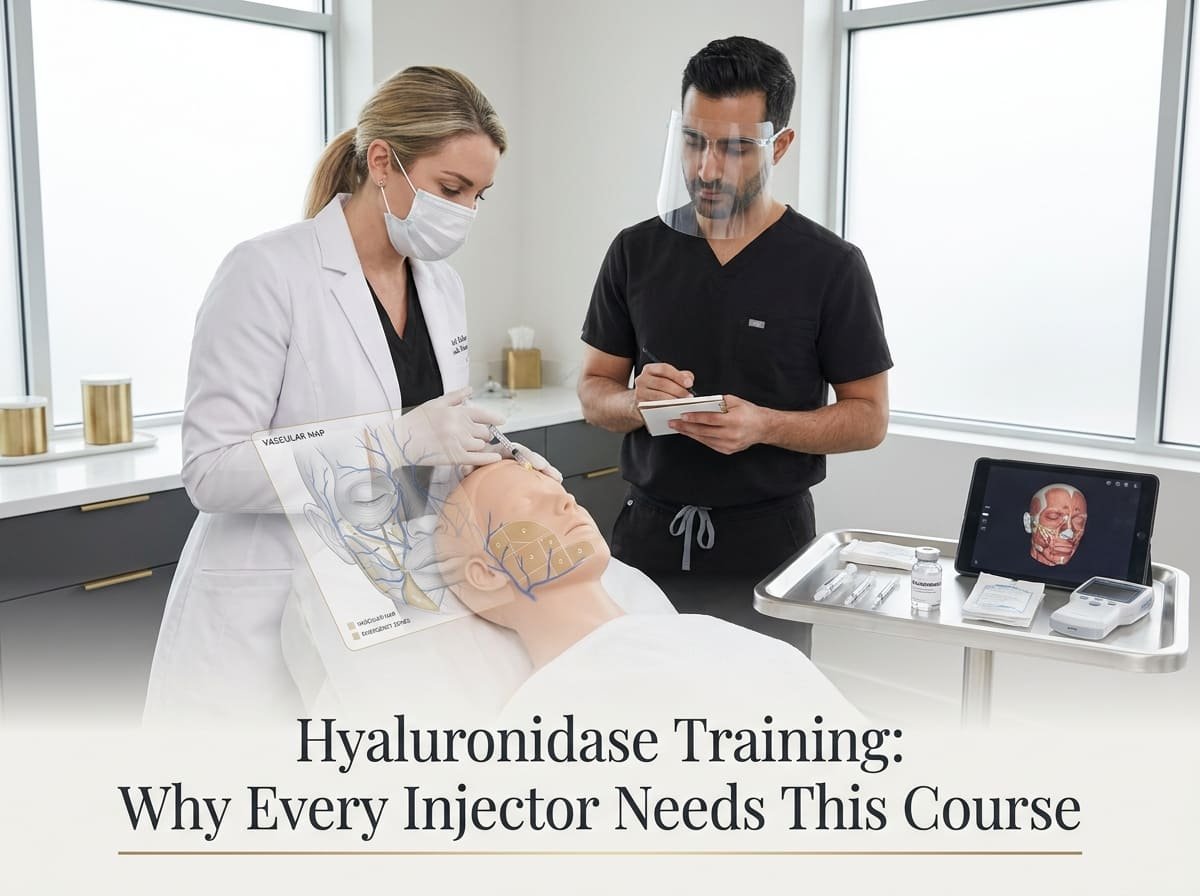
Vascular occlusion is the complication that makes hyaluronidase training non-negotiable for any practitioner offering HA filler. It occurs when filler is accidentally injected into or compresses a facial blood vessel, obstructing blood flow to the tissue downstream. The tissue begins to be deprived of oxygen immediately. Without prompt intervention, the result is progressive tissue ischaemia and, if the occlusion is not resolved in time, permanent tissue necrosis.
The critical window for intervention in a vascular occlusion event is narrow. Published clinical guidance on vascular occlusion management consistently emphasises that the speed and appropriateness of the initial response determines the clinical outcome more than almost any other factor. A practitioner who recognises the early signs, has hyaluronidase immediately available, and has trained specifically in the emergency injection protocol for a vascular event is positioned to intervene in the minutes when intervention makes a genuine difference to the outcome.
A practitioner who does not carry hyaluronidase, or who carries it but has not trained in its use, faces a vascular occlusion event without the tools or the knowledge to respond appropriately. The time spent sourcing hyaluronidase from another provider or working through an unfamiliar protocol under emergency pressure is time in which the tissue damage is progressing. This is not a theoretical risk. It is the mechanism by which preventable tissue necrosis occurs in real clinical practice.
The position that hyaluronidase training can wait until a practitioner is more experienced is clinically incoherent. A vascular occlusion does not wait for experience. It can occur in a first treatment. It can occur in an experienced practitioner's thousandth treatment. Experience reduces the likelihood through better technique and better anatomical knowledge but it does not eliminate the risk. The emergency response capability must be in place from the first appointment.
What Hyaluronidase Actually Is and How It Works
Understanding what you are working with clinically is the foundation of being able to use it safely and effectively. Hyaluronidase training that begins with mechanism gives practitioners the knowledge they need to make clinical decisions rather than simply follow a protocol without understanding why each step matters.
Hyaluronidase is an enzyme that catalyses the breakdown of hyaluronic acid by hydrolysing the glucosaminidic bond in the HA chain. In practical terms, this means it breaks down the HA molecule at a specific chemical bond, converting the cross-linked gel structure of HA filler into smaller fragments that are then cleared by the body through normal metabolic processes. The dissolution is rapid. In a vascular occlusion emergency, hyaluronidase injected into the affected area begins to dissolve the obstructing filler within minutes, with meaningful dissolution occurring over the first hour of treatment.
Hyaluronidase does not distinguish between injected HA filler and the body's own naturally occurring hyaluronic acid. When injected into tissue, it breaks down whatever HA is in its immediate vicinity, including the structural HA in the surrounding tissue. This is why dosing and placement matter and why the temporary disruption to surrounding tissue HA is accepted as a known and manageable consequence of emergency treatment in a vascular occlusion scenario. The effect on surrounding tissue HA is temporary because the body continuously produces new HA through normal cellular processes.
The enzyme is derived from bovine or ovine testicular tissue in most pharmaceutical preparations. This is the source of its most clinically significant risk. Patients with allergies to bee or wasp venom carry a known cross-reactivity risk with hyaluronidase because the venom of these insects contains a hyaluronidase enzyme. The cross-reactivity does not affect every sensitised patient, but the risk is real and requires specific management at the consultation stage before any HA filler treatment. Training must cover this allergy consideration as a routine pre-treatment assessment point rather than as an afterthought.
The Clinical Applications That Training Must Cover
Hyaluronidase training that focuses only on its emergency use in vascular occlusion is covering the most important application but not the full scope of what practitioners will encounter in real clinical practice.
Elective dissolution is the most frequently used application in day-to-day aesthetic practice. Patients who are unhappy with a filler result, who have experienced migration of product over time, who have developed nodules or lumps in previously treated areas, or who want to dissolve existing filler to reassess before a new treatment plan all present for elective hyaluronidase. Managing these cases requires specific assessment skills beyond the emergency protocol.
Assessing the volume of filler present, estimating how old it is, identifying whether the lump is filler-related or a tissue response, choosing an appropriate dose for the specific presentation, and counselling the patient accurately about what dissolution will and will not give them are all clinical skills that belong in hyaluronidase training and that practitioners encounter repeatedly in elective practice.
Overcorrection dissolution is a specific scenario within the elective category that requires particular care. When a result is subtly asymmetric or slightly overfilled, dissolving a precise amount to achieve correction without over-dissolving the surrounding tissue is a more technically demanding application than dissolving a larger nodule or clearing a migrated area. Dosing precision and injection placement in overcorrection management are skills that require specific teaching rather than assumption that the emergency protocol scales directly to fine elective correction.
Treating filler placed by other practitioners is a significant proportion of hyaluronidase practice in busy aesthetic clinics. Patients who have had treatment elsewhere and who present with concerns about the result, with suspected migration, or with nodules that have developed months or years after their original treatment require careful assessment of what product was used, at what volume, and in what areas. Not all of this information is available. The practitioner using hyaluronidase must be able to make a clinical judgement about how to proceed with incomplete information, which is a different and more demanding scenario than managing a result from their own practice.
Dosing: The Element That Most Training Covers Inadequately
Dosing is one of the most variable and most consequential elements of hyaluronidase practice and the element where the gap between good training and inadequate training is most clearly expressed in clinical outcomes.
The dose required to dissolve a given volume of HA filler depends on the specific filler product being dissolved, its degree of cross-linking, how old it is, how deeply it is placed in the tissue, and the specific hyaluronidase product being used. Higher cross-linking in the filler makes it more resistant to dissolution and requires either a higher dose or multiple treatment sessions to achieve full dissolution. Older filler that has already partially integrated into surrounding tissue responds differently from recently placed product. These are not academic variables. They produce clinically different outcomes when a fixed dose is applied without adjusting for them.
The reconstitution of hyaluronidase from its lyophilised powder form requires specific training. The concentration of the reconstituted solution, the choice of diluent, and the volume used to reconstitute to a target concentration all affect the dose delivered per injection and therefore the clinical outcome. Practitioners who have not specifically trained in reconstitution are at risk of delivering inconsistent doses without knowing it.
The appropriate dose for emergency vascular occlusion management is significantly higher than the dose used for elective correction and requires urgent, high-volume injection into the affected area rather than the cautious, conservative approach appropriate for elective dissolution. Using an elective dose approach in an emergency or applying emergency doses to an elective correction scenario are both errors that inadequately trained practitioners make. Understanding why the protocols differ and how to apply the appropriate one in each clinical context is a fundamental learning objective that training must achieve.
Managing the Patient Through Hyaluronidase Treatment
Clinical competence in hyaluronidase use involves more than knowing the dose and the injection technique. How the patient is managed before, during, and after treatment significantly affects both the clinical outcome and the patient experience.
Before elective dissolution, the consultation must include a realistic discussion of what dissolution will achieve. Patients who expect dissolving filler to return them to an idealised pre-treatment baseline need to understand that dissolving filler removes the product but does not restore tissue that has aged, does not replace volume that was present before they started filler several years ago, and does not produce the smooth, even result they may be expecting if the lump or migration they want dissolved is surrounded by tissue of variable quality.
The skin punch test, performed by gently pressing on the area of concern to assess tissue resilience and the presence of firm gel-like material beneath the skin surface, helps a practitioner assess whether what they are dealing with is filler, a tissue reaction, or a combination of both. Relying on injection alone without this assessment step is less precise and less informative than a complete clinical evaluation.
After treatment, the patient needs clear guidance on the expected timeline of dissolution, what it will look like and feel like in the first 48 hours, when to return for assessment, and whether a repeat session is likely to be necessary. Patients who are not prepared for post-dissolution swelling and who are not told when to return for evaluation experience the dissolution process as a new source of anxiety rather than a managed clinical intervention.
The review appointment at two weeks post-dissolution is a standard of care that good training makes explicit. The full extent of dissolution is not assessable in the first 48 hours because post-injection swelling masks the result. Assessing whether the dissolution is complete and discussing the next steps, whether that is a period of observation, retreatment with a further hyaluronidase session, or planning new filler once the area has fully settled, belongs at the two-week point rather than on the same day as the dissolution.
What to Look for in a Hyaluronidase Training Course
The market for hyaluronidase training includes everything from a brief module appended to a filler day to comprehensive standalone courses with significant clinical time dedicated to each application. Knowing what the course you are evaluating actually covers is the only way to assess whether it will equip you for real practice.
Ask whether the emergency vascular occlusion protocol is covered as a distinct and detailed element rather than a brief mention. Ask whether elective dissolution and overcorrection management are taught separately from the emergency protocol with their own dosing guidance. Ask whether reconstitution of hyaluronidase from lyophilised powder is covered practically rather than assumed. Ask whether the allergy risk and the pre-treatment assessment for bee venom sensitivity are explicitly included.
Ask whether the practical element includes live patient treatment under direct supervision. Practising hyaluronidase injections on a patient in a controlled teaching environment produces different learning from studying the technique on paper. The resistance of real tissue, the assessment of real lump characteristics, and the patient communication surrounding real dissolution are all elements that only real patient contact provides.
Ask whether the course provides ongoing access to the trainer for clinical questions after the course is complete. The first time a practitioner encounters a vascular occlusion or an unusual dissolution presentation in independent practice, the ability to contact their trainer for immediate guidance is a genuine clinical safety support that good training providers build in as standard.
The Insurance and Governance Position
Most specialist aesthetic insurance providers require evidence of specific hyaluronidase training before covering hyaluronidase as part of a practitioner's policy scope. Some providers require this as a standalone documented training element rather than accepting it as assumed coverage under a general filler policy.
Confirming the specific requirements of your insurance policy before treating patients with hyaluronidase is not optional. Using hyaluronidase in an emergency without appropriate insurance coverage is a governance failure that no experienced practitioner should allow to occur. Ensuring coverage is in place before the emergency is when it matters, not after one has occurred.
The governance position on carrying hyaluronidase is equally clear. The standard of care for any practitioner offering HA filler requires hyaluronidase to be immediately available at every treatment session, not stored at a pharmacy to be collected in an emergency. The emergency scenarios in which it is most urgently needed do not allow for a thirty-minute delay while product is sourced. It must be in the room.
Frequently Asked Questions
Can I learn hyaluronidase technique from a filler training course that includes a brief module on it?
A brief module covering the basics of hyaluronidase within a filler course is a useful introduction but is not a substitute for dedicated training. The depth of dosing knowledge, the elective dissolution skills, the reconstitution technique, and the emergency protocol specificity required for safe independent practice need more clinical time than a module within a broader course can provide. Standalone dedicated training is the appropriate standard.
How long does hyaluronidase take to work in an emergency?
Hyaluronidase begins to act within minutes of injection, with meaningful dissolution of HA filler occurring over the first one to two hours. In a vascular occlusion emergency, the protocol involves immediate high-dose injection followed by assessment and repeat dosing every hour until signs of vascular compromise resolve. The response continues beyond the immediate appointment and requires careful monitoring over the following hours and days.
Do I need to do a patch test before using hyaluronidase?
In a vascular occlusion emergency, performing a patch test before administering hyaluronidase is not appropriate because the clinical urgency of resolving the occlusion outweighs the risk of an allergic reaction to the enzyme, which can be managed with adrenaline. In elective dissolution, a patch test is appropriate for patients with a known allergy to bee or wasp venom and is best practice for all elective patients where time allows. Training covers the clinical decision-making around patch testing in both scenarios.
How often do I need to refresh my hyaluronidase training?
Most insurance providers require periodic CPD updates rather than complete course repeats. Staying current with published clinical guidance on vascular occlusion management, which continues to be updated as new evidence emerges, is a professional responsibility rather than a box-ticking exercise. Attending complication management updates and hyaluronidase refresher sessions as part of your broader CPD programme is the standard most experienced practitioners adopt.
What happens to tissue after hyaluronidase has dissolved the filler?
The tissue that contained the dissolved filler does not immediately look or feel like it did before treatment. Post-dissolution swelling, a temporarily deflated appearance as the volume is removed, and occasionally some firmness as the tissue responds are all normal in the days following dissolution. The tissue settles over two to four weeks, and the full post-dissolution appearance is assessable at the two-week review. For elective dissolution, this is when the decision about further treatment is most usefully made.
If you are a practitioner offering HA filler who does not yet hold specific hyaluronidase training, this is the course that most directly improves the safety of your current practice. Contact the Angel White Aesthetics training team to discuss enrolling.
View the Hyaluronidase Course or Contact the Training Team