When skin starts to look dull, tired or less firm than it used to, choosing the right treatment can be confusing. There are plenty of options available, from professional facials and chemical peels to injectable skin rejuvenation treatments. They all aim to improve the appearance of the skin, but they do not work in the same way.
Some treatments focus on the skin's surface. Others are designed to address concerns involving hydration, elasticity, fine lines and changes in skin quality. Choosing between them depends on what you want to improve, how your skin behaves and the type of treatment that is appropriate for your needs.
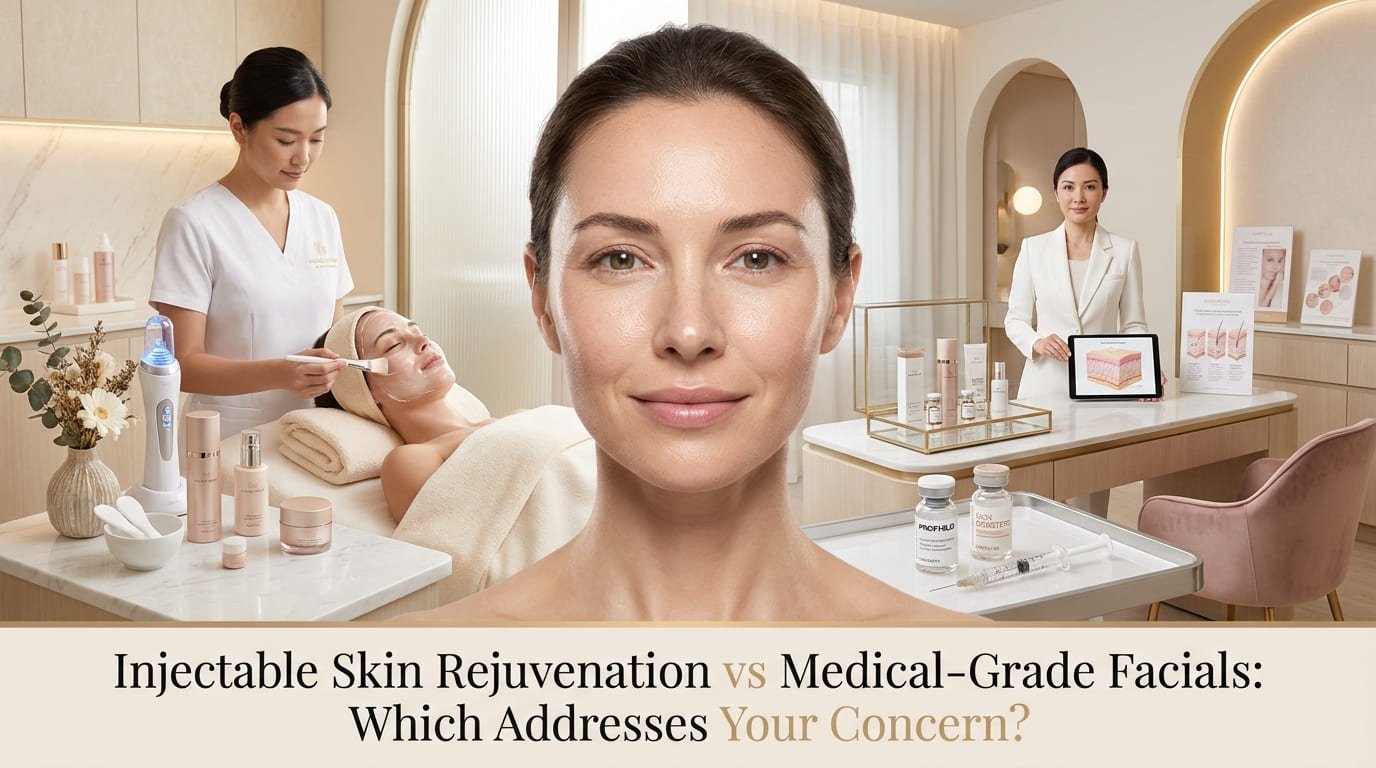
A medical-grade facial may be a sensible starting point for someone concerned about congestion, rough texture or a lack of radiance. Someone experiencing persistent dehydration, early signs of skin ageing or changes in skin quality may wish to explore injectable options such as Profhilo, skin boosters or polynucleotides.
Neither approach is automatically better. The important thing is understanding what each can realistically achieve.
At Angel White Aesthetics, patients can explore different skin rejuvenation options in the context of their individual concerns, with treatment choices guided by professional assessment.
What Is the Difference Between Injectable Skin Rejuvenation and Medical-Grade Facials?
The main difference is how these treatments work and which layers or aspects of the skin they are designed to address.
Medical-grade facials are professional skincare treatments that generally work on the skin's surface. Depending on the procedure, they may involve cleansing, exfoliation, carefully selected active ingredients, hydration or other techniques intended to improve skin appearance and texture.
Some treatments, including professional chemical peels and BioRePeel, are designed to encourage controlled exfoliation and improve the appearance of uneven texture, dullness and certain pigmentation concerns.
Injectable skin rejuvenation takes a different approach. Products are administered into specific areas of the skin using injections. Depending on the formulation, they may be intended to support hydration, improve the appearance of skin quality or address changes associated with ageing.
Examples include Profhilo, skin boosters and polynucleotides. These treatments have different formulations and purposes, so they should not be treated as interchangeable.
One important distinction is that injectable rejuvenation is not necessarily about adding facial volume. Many patients are interested in improving the overall appearance of their skin rather than changing their facial shape.
What Can Medical-Grade Facials Help With?
Medical-grade facials are particularly useful when the main concerns involve the skin's surface.
Daily exposure to sunlight, environmental pollution, skincare products and natural changes in skin cell turnover can affect how the complexion looks and feels. Professional treatments can provide a more targeted approach than a basic home skincare routine.
Dull and uneven-looking skin
A lack of radiance can develop for several reasons, including surface build-up, dehydration and uneven pigmentation.
Professional exfoliation can help remove accumulated dead skin cells and improve the appearance of the complexion. Treatments such as BioRePeel may be considered where appropriate, depending on skin condition and suitability.
The aim is to improve the appearance of the skin's surface rather than alter facial structure or restore lost volume.
Rough texture and congested pores
When the skin feels uneven or looks congested, professional exfoliation may help improve its appearance.
Treatments containing suitable exfoliating ingredients can help remove surface build-up. Some professional facials also include methods designed to clear congestion and support a more refined-looking complexion.
The choice depends on whether the concern is related to excess oil, blocked pores, dead skin accumulation or another underlying skin condition.
Mild pigmentation and uneven tone
Sun exposure and inflammation can contribute to uneven pigmentation. Dark marks may also remain after acne or other skin irritation.
Certain professional peels can help improve the appearance of superficial pigmentation, although results depend on the type and depth of the pigment.
Not every dark mark responds to the same treatment. Melasma, post-inflammatory hyperpigmentation and sun spots have different causes and may require different management approaches.
A proper skin assessment is important before choosing an exfoliating treatment, particularly for anyone with a history of pigmentation.
Skin dehydration
Some professional facials focus on restoring surface hydration and improving skin comfort.
Hydrating ingredients can help the skin feel softer and temporarily appear smoother. This may be useful when the complexion looks tired because of dryness or environmental factors.
However, surface hydration and deeper changes in skin quality are not the same thing. This distinction becomes important when comparing facials with injectable skin rejuvenation.
What Can Injectable Skin Rejuvenation Help With?
Injectable skin rejuvenation is generally considered when concerns extend beyond surface texture or temporary dryness.
Different products are designed for different purposes. The right option depends on the individual's skin, treatment history and expectations.
Profhilo for skin quality and hydration
Profhilo is an injectable hyaluronic acid treatment used to improve the appearance of skin quality.
Unlike traditional dermal fillers that are primarily used to restore or adjust facial volume, Profhilo is not intended to create prominent facial contours. It is used as part of a skin rejuvenation approach for concerns such as reduced hydration and changes in skin quality.
It may be considered for areas including the face and neck, depending on clinical suitability.
Patients should understand that it is not a replacement for every type of facial treatment. It does not remove surface congestion or provide the same type of exfoliation as a chemical peel.
Skin boosters for hydration and skin appearance
Skin boosters are injectable formulations designed to improve aspects of skin hydration and appearance.
Their composition and intended use vary. Some contain hyaluronic acid, while others use different ingredients or formulations.
They may be considered for skin that appears dehydrated or lacks a smooth, refreshed appearance. However, they should not be confused with conventional fillers used to create volume or reshape specific facial areas.
A consultation helps establish whether the concern is primarily related to hydration, texture, elasticity or something else.
Polynucleotides for skin rejuvenation
Polynucleotide treatments are another option within injectable skin rejuvenation.
They are used in aesthetic practice with the aim of supporting skin quality and addressing certain signs of ageing. Their use is based on the formulation and treatment area, and they are not suitable for everyone.
Patients should also understand that the evidence and expected outcomes vary between products and indications. A practitioner should explain what the treatment is intended to achieve and what remains uncertain.
Polynucleotides do not replace treatments designed specifically for surface exfoliation, acne management or significant pigmentation.
Mesotherapy for targeted skin concerns
Mesotherapy involves administering selected substances into the skin through multiple small injections.
The ingredients and protocols vary considerably between practitioners and products. It may be offered as part of a skin rejuvenation plan, but the term itself does not describe one standard treatment.
Before choosing mesotherapy, patients should ask which formulation is being used, what concern it is intended to address and what evidence supports its use.
Injectable Rejuvenation vs Medical-Grade Facials: A Direct Comparison
Understanding the differences becomes easier when the treatments are compared by the concerns they are intended to address.
| Skin concern | Medical-grade facials | Injectable rejuvenation |
| Dull complexion | Professional exfoliation may improve radiance | May improve overall skin appearance depending on the product |
| Surface congestion | Often suitable for selected congestion concerns | Not generally the primary approach |
| Rough skin texture | Can help improve surface smoothness | May support skin quality but does not replace exfoliation |
| Dehydrated skin | Helps improve surface hydration | Selected treatments may address skin hydration more directly |
| Fine lines | May temporarily improve the appearance of superficial lines | Certain injectables may improve aspects of skin quality |
| Uneven pigmentation | Selected peels may help with appropriate pigmentation concerns | Not usually the primary treatment for pigmentation |
| Reduced skin elasticity | Limited ability to address significant changes | Some treatments may be considered for skin quality, depending on suitability |
| Facial volume loss | Does not restore lost volume | Skin rejuvenation injectables are not necessarily volume-restoring treatments |
This comparison is a general guide rather than a guarantee of results. Treatment effects depend on the individual, the product, the technique and the condition being treated.
Which Treatment Should You Choose for Your Skin Concern?
There is no universal answer. A treatment that works well for one person may not be the right choice for someone with a different skin concern.
The best starting point is identifying what you actually want to change.
If your main concern is dullness
If your complexion looks tired and lacks radiance, a professional facial or suitable exfoliating treatment may be worth discussing.
Surface build-up can make the skin look less bright. Improving exfoliation and hydration may help create a fresher appearance.
If your skin feels persistently dehydrated
When dryness and dehydration remain concerns despite a consistent skincare routine, it may be worth exploring whether an injectable skin rejuvenation treatment is appropriate.
A practitioner can help distinguish between surface dryness, reduced skin hydration and other factors affecting skin quality.
If you are noticing fine lines and changes in skin quality
The appearance of fine lines can be influenced by several factors, including repeated facial movement, sun exposure, dehydration and natural ageing.
A professional facial may improve surface texture and hydration, while selected injectable treatments may be considered for broader skin quality concerns.
The correct approach depends on the cause of the lines. Not every fine line needs an injectable treatment.
If pigmentation is your main concern
A facial or chemical peel may be considered for certain forms of superficial pigmentation. However, treatment selection should follow an assessment of the pigmentation type.
Using the wrong exfoliating treatment can aggravate some pigmentation conditions, particularly in people prone to post-inflammatory dark marks.
For persistent or changing pigmentation, a medical assessment may be more appropriate than proceeding directly with an aesthetic treatment.
If you are concerned about ageing skin
Ageing affects more than one aspect of the face. Skin may become drier, lose elasticity, develop uneven texture and show changes in volume.
A combination of appropriate skincare, professional facials and selected injectable treatments may be considered where clinically suitable.
It is important to avoid choosing several procedures simply because they are available. A focused plan based on actual concerns is often more appropriate.
Can Injectable Skin Rejuvenation and Medical-Grade Facials Be Combined?
Yes, certain treatments can be included in the same broader skincare or aesthetic plan. However, combining them does not mean they should be performed at the same appointment or without considering recovery.
For example, someone may benefit from professional exfoliation to address surface texture while also considering an injectable treatment for skin quality.
The timing matters.
After injectable procedures, the skin may have temporary redness, swelling, tenderness or small injection marks. Introducing an exfoliating facial too soon may increase irritation or discomfort.
Similarly, after a chemical peel, the skin may be more sensitive while it recovers. Proceeding with injections before the skin has settled may not be appropriate.
There is no single spacing rule that applies to every combination. The interval should depend on the products, the intensity of the facial, the injection technique and the patient's response.
Always discuss planned treatments with your practitioner before combining procedures. This is particularly important if you have sensitive skin, a history of pigmentation or previous reactions to aesthetic treatments.
Are Injectable Treatments Better Than Facials for Long-Term Skin Health?
It is tempting to compare treatments by asking which produces longer-lasting results. However, this does not provide the full picture.
Facials and injectable treatments have different purposes, so their effects should be assessed against the concern being treated.
A professional facial may provide improvements in skin smoothness, hydration and radiance. Its benefits can be influenced by ongoing skincare habits, sun exposure and the condition of the skin.
Injectable treatments may offer benefits that are not achievable through surface skincare alone, depending on the product and its intended use. However, they also involve injections, potential side effects and individual suitability considerations.
Neither treatment can stop the natural ageing process.
Long-term skin health also depends on everyday habits. Consistent sun protection, a suitable moisturising routine, avoiding smoking and using active ingredients appropriately can all contribute to maintaining the appearance of the skin.
Professional treatments should complement these habits rather than replace them.
What Should You Consider Before Booking a Treatment?
Before choosing between a medical-grade facial and injectable skin rejuvenation, consider the following questions:
What is my main concern? Dullness, congestion, dehydration, fine lines and pigmentation are different issues. Identifying the main concern helps narrow down suitable options.
Is my skin currently healthy enough for treatment? Active irritation, infection, certain skin conditions and recent procedures may affect suitability.
What results are realistic? Ask what the treatment can reasonably improve and what it cannot address.
What products or techniques will be used? Understanding the treatment is important, particularly with injectable formulations that vary in composition.
What does recovery involve? Some facials involve temporary dryness or peeling, while injectables may cause swelling, bruising or tenderness.
Will I need ongoing maintenance? Discuss the expected treatment schedule and whether the proposed plan fits your needs.
A responsible consultation should explain alternatives as well as the benefits and limitations of the recommended treatment. You should never feel pressured to choose an injectable procedure when a less invasive option may be more appropriate.
Choosing the Right Approach at Angel White Aesthetics
At Angel White Aesthetics, skin rejuvenation options include treatments such as Profhilo, skin boosters, polynucleotides, mesotherapy and BioRePeel.
Each has a different purpose, which is why treatment selection should begin with an understanding of your skin rather than a particular product or procedure.
Someone concerned about surface dullness may benefit from discussing a professional exfoliating treatment. Another person experiencing changes in hydration or skin quality may wish to explore injectable options.
For some patients, a combination of approaches may be appropriate, with careful attention to treatment timing and recovery.
Whether you are considering skin rejuvenation in Littlehampton or Hove, the most useful first step is a consultation to discuss your concerns, skin condition and expectations.
Final Thoughts
Injectable skin rejuvenation and medical-grade facials can both play a role in improving the appearance of the skin, but they are not competing versions of the same treatment.
Facials generally focus on the skin's surface, helping address concerns such as dullness, congestion and uneven texture. Injectable treatments such as Profhilo, skin boosters and polynucleotides are used for different aspects of skin quality and rejuvenation.
The right choice depends on the concern you want to address, your skin's condition and what each treatment can realistically achieve.
Good skin rejuvenation is not about choosing the most advanced procedure or having the greatest number of treatments. It is about understanding what your skin needs and selecting an appropriate approach with professional guidance.