Dry skin and dehydrated skin are used as synonyms by most people describing their skin concerns. In skincare marketing, they are treated almost identically. On ingredient labels, they are often addressed with the same active components. The assumption running through most skincare advice is that if your skin feels tight, looks dull, or shows surface texture, it is dry, and the answer is to moisturise more.
This assumption is wrong often enough to matter clinically. Dry skin and dehydrated skin are genuinely different conditions. They have different causes, different tissue characteristics, and they respond to different treatments. Applying the solution for one to the other produces partial results at best and, in some cases, worsens the original concern by introducing the wrong ingredients to skin that was already struggling.
Understanding the real difference is not just interesting clinical background. It is the starting point for choosing products, treatments, and clinical interventions that actually work for the skin you have rather than the category your skin has been assigned to by default.
What Dry Skin Actually Is
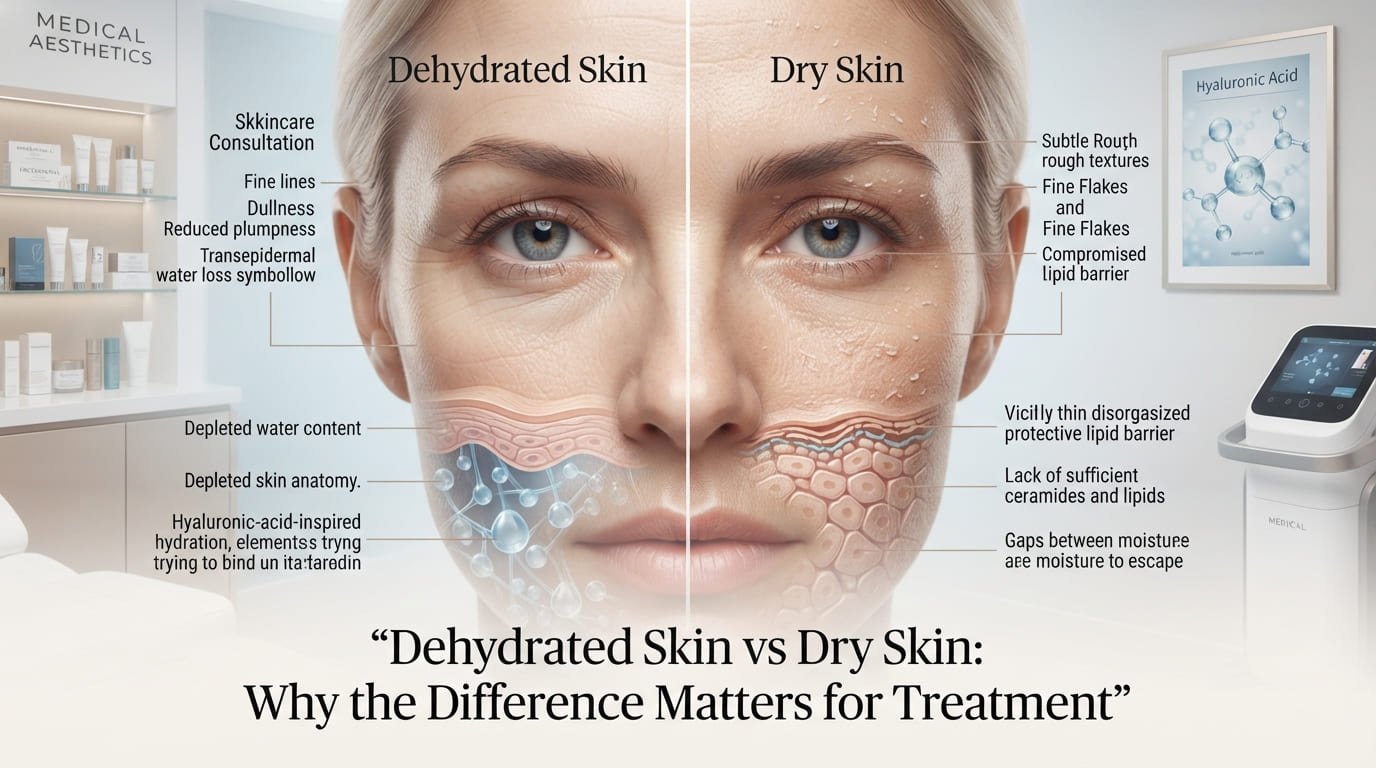
Dry skin is a skin type. It is a constitutional characteristic of the skin rather than a temporary state. Dry skin produces less sebum than normal or oily skin types because the sebaceous glands in the skin are less active. Sebum is the natural oil produced by the skin that forms the lipid barrier on the surface, sealing moisture into the tissue below and protecting it from environmental aggressors.
When sebum production is insufficient, the lipid barrier is incomplete. The skin surface loses moisture more readily because the seal that retains it is not functioning as effectively as it does in skin with adequate sebum production. This ongoing moisture loss at the surface is what produces the characteristic tightness, flaking, rough texture, and occasional sensitivity of dry skin.
Dry skin is not caused by a lack of water in the tissue. It is caused by insufficient oil on the surface. The distinction is important because it determines what you need to address it. The primary solution for dry skin is replenishing the lipid component of the skin barrier using emollient-rich moisturisers containing oils, ceramides, fatty acids, and other barrier-supporting ingredients. These ingredients do not add water to the skin. They seal it in and reduce the rate at which the skin naturally loses it.
Dry skin is a permanent skin type. Patients who have dry skin have always had dry skin and will always have it to some degree, though the severity can be managed well with appropriate skincare. It also tends to become more pronounced with age as sebum production declines further across all skin types. This means a patient who had normal skin in their twenties may develop characteristics of dry skin in their forties and fifties as their sebaceous gland activity reduces.
What Dehydrated Skin Actually Is
Dehydrated skin is a temporary skin condition rather than a permanent skin type. Any skin type can become dehydrated. Oily skin can be dehydrated. Combination skin can be dehydrated. Even skin that produces adequate sebum and has an intact lipid barrier can be dehydrated if the water content within the skin cells themselves is insufficient.
Dehydration in skin refers specifically to a lack of water in the tissue rather than a lack of oil on the surface. The water content of skin cells, particularly the keratinocytes that make up the epidermis, determines the plumpness, resilience, and surface smoothness of the skin. When this water content is low, the cells do not have the volume they need to maintain a smooth, even surface, and the skin takes on a dull, tired, slightly sunken appearance with fine surface lines that appear and disappear depending on how well hydrated the body is overall.
The causes of skin dehydration are numerous and often temporary. Inadequate water intake is the most obvious but not the only one. Excessive caffeine or alcohol consumption, climate-controlled environments with low humidity, seasonal cold weather that draws moisture from the air and the skin, use of skincare products with a high alcohol content that disrupts the skin surface, overuse of exfoliating acids that compromise the barrier, certain medications, and illness all deplete the water content of the skin at the cellular level.
The key characteristic of dehydrated skin that distinguishes it most clearly from dry skin is that it responds immediately and visibly to hydration. Drink two litres of water consistently for a week and skin that was dehydrated looks noticeably better. Apply a hyaluronic acid serum and the fine surface lines that dehydration produces reduce visibly within hours. Skin that does not respond to this kind of direct hydration is more likely to be dry than dehydrated.
How to Tell the Difference on Your Own Skin
There are a few practical ways to assess whether what you are dealing with is predominantly dry skin or predominantly dehydration.
The pinch test is one of the most commonly used, and it is useful when interpreted correctly. Gently pinch a small amount of skin on the cheek between two fingers, hold it for a second, and release. Skin that springs back immediately and smooths out fully suggests adequate water content in the tissue. Skin that takes a moment to settle back or that shows a brief dimpled appearance after release suggests reduced water content and points toward dehydration rather than dryness.
Surface texture is another indicator. Dry skin tends to produce a rough, slightly scaly texture that persists regardless of time of day, fluid intake, or the environment. Dehydrated skin tends to produce a duller, more crepey surface texture that varies in severity. It often looks worse in the morning before adequate fluid intake and better by the afternoon. It worsens in centrally heated or air-conditioned environments and improves in more humid conditions.
Oiliness combined with dullness is one of the most commonly missed signs of dehydration. Many patients with oily skin assume their skin cannot also be dehydrated because the two seem contradictory. In reality, skin that is dehydrated can overproduce sebum as a compensatory response to the loss of moisture at the surface, creating a presentation of oily skin with a dull, flat quality beneath that layer of surface oil. Treating this skin as purely oily and using stripping or drying products worsens the dehydration and drives further compensatory oil production. Addressing the underlying dehydration often reduces the oiliness as a secondary benefit.
Why Treating the Wrong Condition Fails
This is where the practical consequence of the confusion becomes clear. Treating dry skin with hydrating ingredients addresses the water content of the tissue without addressing the lipid barrier that is failing to retain that water. The skin feels temporarily better after applying a hyaluronic acid serum, but the improvement fades quickly because without a functioning lipid barrier, the water drawn into the tissue by the HA evaporates just as readily as it did before. Adding water to a leaking container does not fix the leak.
Treating dehydrated skin exclusively with heavy occlusive moisturisers and oil-rich barrier creams addresses the surface seal without addressing the water deficit in the tissue. The skin feels less tight and may look slightly less dull, but the cellular water content remains insufficient, and the underlying dehydration does not resolve because no water has actually been added to the tissue. Sealing a near-empty container does not fill it.
This is why the most effective approach for many patients is to address both simultaneously. For dry skin with a secondary dehydration component, a layered approach that applies a humectant such as hyaluronic acid to slightly damp skin first and then seals it with an emollient-rich moisturiser addresses both the water and the barrier component together. For dehydrated skin in a patient who does not have inherently dry skin, a standalone hyaluronic acid serum used consistently alongside adequate fluid intake addresses the actual concern without the heavy barrier creams that an oily or combination skin type may find too occlusive.
Where Clinical Treatments Come In
Topical skincare addresses the surface and the immediate sub-surface environment. It is the foundation of skin health management, and it is genuinely effective for both dry and dehydrated skin when the right products are chosen for the right condition. But topical products cannot penetrate to the deeper dermal layers where the most clinically significant hydration and structural changes occur.
This is where injectable skin quality treatments become relevant for patients whose dehydration or dryness is expressing itself in a way that surface skincare is not fully resolving.
Profhilo is the most direct clinical treatment for skin dehydration at the dermal level. The high-concentration non-cross-linked hyaluronic acid in Profhilo spreads through the dermal tissue after injection and creates a deep, sustained hydration environment that topical HA cannot reach. It also stimulates fibroblast activity that improves the skin's own capacity to produce and retain the structural components that support hydration from within. Patients whose surface skin looks dull and dehydrated despite adequate topical skincare often find that the tissue simply cannot respond to the surface input because the deeper structure is insufficiently hydrated and resilient. Profhilo addresses this from the inside out in a way that topical products cannot.
Skin boosters using lightly cross-linked hyaluronic acid address dehydration at a slightly different level. The controlled placement of HA in a fine grid pattern through micro-injections delivers consistent hydration across the mapped area and keeps it at the level where it is most useful for surface texture improvement. Skin boosters are particularly well suited to patients whose primary visible concern is surface dullness and texture irregularity rather than deeper structural dehydration.
Biorevitalisation treatments using high-concentration HA formulations provide a more concentrated hydration input at the dermal level alongside the supporting ingredient complex that most biorevitalisation products include. For patients where dehydration is one of several concurrent skin quality concerns, the multi-targeted approach of biorevitalisation addresses the hydration need alongside cellular nutrition and collagen support in a single treatment.
Mesotherapy delivers a cocktail of hydrating and nutritive ingredients directly into the skin tissue, addressing dehydration from a cellular nutrition perspective as well as a water content perspective. The vitamins, amino acids, and hyaluronic acid in a standard mesotherapy formulation create a more optimal cellular environment that supports the skin's own hydration mechanisms from within.
For patients with dry skin as a skin type, the injectable treatments above address the tissue hydration component but do not resolve the lipid barrier insufficiency that is the underlying cause. These patients benefit from the injectable treatments alongside consistent use of barrier-supportive topical skincare rather than as a replacement for it.
Building the Right Treatment Plan for Your Skin
The starting point for any effective treatment plan for dull, dry, or dehydrated skin is an honest assessment of which condition is actually present and to what degree.
A patient in their late twenties with an oily skin type who works in an air-conditioned office, drinks primarily coffee and alcohol, and uses an aggressive exfoliating routine has dehydrated skin. The clinical solution is lifestyle modification, hydration-focused skincare, and possibly a course of skin boosters or biorevitalisation if topical measures are not producing adequate improvement. Heavy barrier creams and oil-based emollients are not the answer and may worsen the compensatory oil production.
A patient in their mid-fifties whose skin has always been dry and is now significantly more so following the hormonal changes of menopause has dry skin with a secondary dehydration component. The clinical solution involves barrier-supportive skincare alongside injectable treatments that address both the tissue hydration deficit and the collagen and elastin decline that has occurred simultaneously.
A patient in their forties whose skin looks dull, feels neither dry nor oily, but has a flat, tired quality that does not respond consistently to topical products likely has a tissue hydration and early structural quality concern at the dermal level. Injectable skin quality treatment alongside a review of their skincare routine and lifestyle factors addresses this more effectively than any topical product alone.
Frequently Asked Questions
Can oily skin be dehydrated at the same time?
Yes. This is one of the most commonly misunderstood skin presentations. Oily skin can be significantly dehydrated at the cellular level while the surface produces excess sebum. The two conditions exist in different layers of the skin, and addressing the dehydration does not worsen the oiliness. In many cases, it reduces it by removing the trigger for compensatory oil production.
How quickly does dehydrated skin respond to treatment?
Surface dehydration responds very quickly to the right topical approach, often within days of consistent hydration-focused skincare. Deeper tissue dehydration, where the cellular water content in the dermis is insufficient, responds more slowly and may need several weeks of consistent treatment, or injectable intervention, before a meaningful visible improvement occurs.
Can injectable treatments replace a skincare routine for dry skin?
No. Injectable treatments address the deeper tissue environment that topical products cannot reach. A consistent and appropriate skincare routine addresses the surface and immediate sub-surface layers. Both are needed for comprehensive skin health. Injectable treatment without appropriate skincare support has a shorter-lived result. Skincare without addressing the deeper tissue environment leaves the most significant drivers of dehydration and dullness untouched.
Is dehydration related to age?
Dehydration can affect any age and skin type. However, the skin's own production of hyaluronic acid declines with age, which means older skin is less able to retain water in the tissue without external support. This is why dehydration tends to become more visible and harder to manage with topical products alone from the mid-thirties onward, and why injectable hyaluronic acid treatments become more relevant in this age group.
My skin feels tight after cleansing. Is that dryness or dehydration?
Tightness after cleansing is most commonly a sign that the cleanser is stripping the skin surface, which can occur in both dry and dehydrated skin. In dry skin, stripping removes the already insufficient sebum layer and exposes the barrier compromise. In dehydrated skin, stripping removes the slight surface moisture and exposes the lack of tissue water content beneath. Switching to a gentle, non-stripping cleanser is one of the first practical steps for both conditions and helps clarify which underlying issue is dominant once the cleansing-induced tight feeling is eliminated.
Will my injectable treatment results last longer if I address the underlying dehydration with skincare?
Yes meaningfully. Injectable treatments that improve tissue hydration and stimulate collagen production work in a tissue environment that is either supported or undermined by the daily skincare and lifestyle choices around them. Patients who follow their injectable treatment with consistent daily SPF, appropriate hydration-focused skincare, and adequate fluid intake consistently report their results feeling better maintained than those who treat the injection as a standalone fix.
If your skin looks dull or feels dehydrated and you are not sure whether topical skincare is enough or whether clinical treatment would make a meaningful difference, book a consultation at our Littlehampton or Hove clinic. We will assess your skin properly and recommend an approach that addresses what your skin actually needs.
Book a Consultation in Littlehampton or Book a Consultation in Hove