Written by Dr Irina Prikulis, founder of Angel White Aesthetics, with over 14 years of clinical aesthetic practice.
First aid training in aesthetics is one of those requirements that practitioners sometimes treat as administrative rather than clinical. It is on the checklist. It needs to be completed to satisfy an insurance requirement or a training provider's prerequisite. So it gets done, the certificate goes in the folder, and the thinking about it largely stops there.
This approach misunderstands what first aid training in an aesthetic context is actually for and what it asks of the practitioner who holds it. A medical emergency in an aesthetic clinic setting is not a theoretical possibility. It is a clinical reality that every practitioner will encounter at some point in a sustained aesthetic career, and the way that emergency is managed in the first minutes determines whether the outcome is resolved or becomes catastrophic.
Generic first aid training covers the basics of emergency response in a general context. First aid training designed specifically for aesthetic practice covers the emergencies that are most likely to occur in a clinic setting, the specific agents and protocols relevant to those emergencies, and the decision-making that allows a practitioner to act correctly under the acute pressure of a real emergency rather than freezing at the moment they are most needed.
The Emergencies That Aesthetic Practitioners Actually Face
Understanding what first aid training in aesthetics is preparing you for requires clarity about the specific emergencies that occur in clinical aesthetic practice. These are not abstract possibilities. They are documented, recurring events that any practitioner treating patients with injectable medicines or other clinical procedures needs to be equipped to manage.
Anaphylaxis is the most immediately life-threatening emergency in aesthetic practice and the one with the shortest window between onset and serious harm if it is not recognised and treated correctly. Anaphylaxis is a severe systemic allergic reaction that can occur in response to any substance introduced into the body, including local anaesthetic agents used in aesthetics, injectable products, and topical preparations used before or after treatment. It progresses rapidly. A patient who develops anaphylaxis during or after treatment needs adrenaline administered intramuscularly within minutes. A practitioner who has not been trained in recognising the early signs, who does not have adrenaline on hand, and who has not practised its administration under simulated pressure is not equipped to manage this emergency when it presents.
Vasovagal syncope, which is fainting, is the most commonly encountered medical event in aesthetic practice. Many patients experience significant anxiety before and during injectable treatment. The combination of anxiety, pain stimulus, and the physiological response to sitting or lying still can trigger a vasovagal episode in which blood pressure drops rapidly and the patient loses consciousness briefly. A vasovagal episode in a patient sitting upright who is not positioned and managed correctly can result in a fall and serious injury. Knowing how to recognise the prodromal signs, how to position the patient correctly, and how to manage the recovery phase is practical clinical knowledge that every aesthetic practitioner needs.
Hypoglycaemia is a medical emergency that can present in any patient who is diabetic and has attended their appointment without adequate food intake, or whose blood glucose has dropped due to the physical and physiological stress of the appointment. The signs overlap with other conditions including vasovagal syncope and anxiety, which means a practitioner who does not know what distinguishes hypoglycaemia from these presentations may manage it incorrectly. Hypoglycaemia requires oral glucose administration in a conscious patient or emergency services for a patient who has lost consciousness.
Acute coronary events including angina and myocardial infarction can occur in patients with pre-existing cardiac conditions who attend aesthetic appointments. The stress of anticipation and the physical response to pain or anxiety can trigger cardiac events in susceptible patients. A practitioner who can recognise the symptoms, who has called emergency services promptly, and who can initiate basic life support while waiting is managing the situation at the standard that the emergency requires.
Airway compromise and choking can occur in any clinical setting where patients are in a supine or semi-reclined position during treatment. Practitioners who know how to assess and manage a compromised airway, who can perform the Heimlich manoeuvre correctly, and who understand when and how to position a patient for airway maintenance are equipped for this emergency regardless of the circumstances that produce it.
Basic life support covering cardiopulmonary resuscitation and the use of an automated external defibrillator is a core competency that should be refreshed regularly in all healthcare professionals. In an aesthetic clinic setting where patients may be at any point on the health spectrum and where medical emergencies can occur without warning, a practitioner who is confident and current in their basic life support skills provides a meaningful safety net for every patient in their care.
Why Generic First Aid Training Is Not Sufficient
A general first aid certificate covers the fundamental emergency responses that are applicable across a wide range of settings. It teaches basic life support, wound management, the management of choking, burns, and fractures, and the principles of safe patient management in emergencies.
What it does not cover is the specific clinical context of aesthetic practice. It does not address the drugs and agents that are used in aesthetic treatment and their specific risk profiles. It does not cover the management of anaphylaxis in a patient who has received a prescription injectable medicine rather than being stung by a bee. It does not address the adrenaline administration protocol in the specific context of an aesthetic clinic where no other medical support is immediately available. It does not address vascular occlusion, which is an emergency specific to filler treatment that requires hyaluronidase administration as a primary clinical intervention alongside emergency services being called.
Generic first aid training gives a practitioner a foundation. Aesthetic-specific first aid training builds a clinical framework on top of that foundation that is directly applicable to the environment in which the practitioner works and the emergencies they are statistically most likely to encounter.
This is not a criticism of generic first aid training. It is an accurate description of what each type of training is designed to achieve. Combining a current general first aid certificate with specific aesthetic emergency training is the clinical governance standard that informed practitioners and insurance providers increasingly expect.
What the Insurance and Regulatory Position Actually Requires
The regulatory position on first aid in aesthetic practice in the UK has been evolving and is worth understanding accurately rather than relying on what was true several years ago.
Most specialist aesthetic insurance providers require practitioners to hold a current first aid certificate as a condition of their policy. The specific requirements vary between insurers and some now require that the first aid training be specifically relevant to aesthetic practice rather than a generic certificate alone. Checking the specific requirements of your current or prospective insurance policy before booking any first aid training is the starting point. Do not assume that a first aid certificate you completed three years ago satisfies current requirements, either in terms of currency or in terms of whether the content meets the insurer's specific criteria.
Some training providers, including Angel White Aesthetics, require evidence of current first aid training as a prerequisite for certain courses. This is a clinical governance standard that reflects the reality that a practitioner undertaking aesthetic training who does not have basic emergency management skills in place is beginning their clinical development with a significant gap.
The broader regulatory direction of travel in UK aesthetics, including the recommendations of the Joint Council for Cosmetic Practitioners and the current licensing framework under development following the Keogh Review recommendations, is consistently toward higher baseline safety standards rather than lower ones. First aid training is not going to become less important as regulation evolves. It is going to become more consistently and more specifically required.
What the Aesthetic First Aid Course at Angel White Covers
A first aid course designed specifically for aesthetic practice covers the general emergency management skills that any first aid course provides alongside the specific clinical content that is relevant to the aesthetic treatment environment.
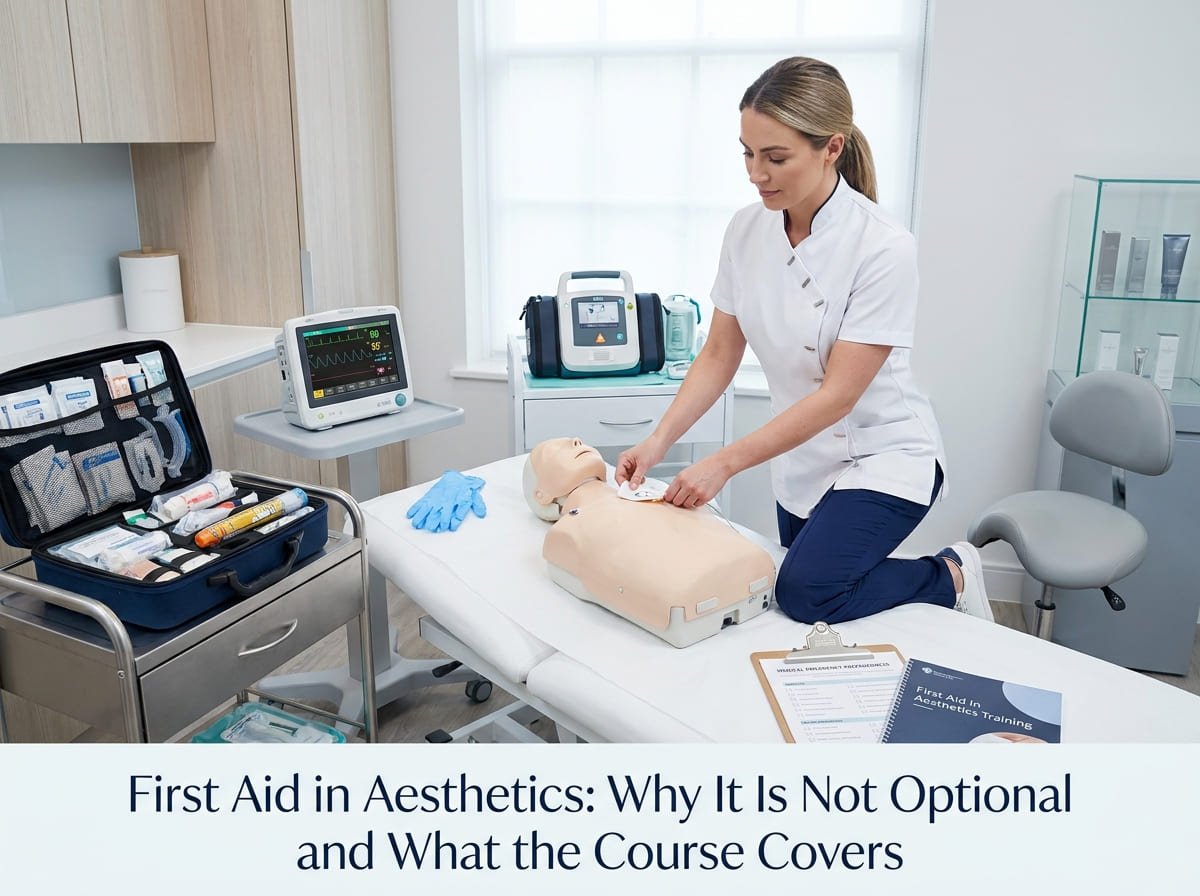
Basic life support, including CPR and AED use, is covered and practiced to a standard that allows practitioners to perform it confidently and correctly in the stress of a real emergency rather than only in the controlled environment of a training room. Regular practice matters here because the physical and cognitive demands of performing effective CPR are significant and competence degrades without refresher training.
Anaphylaxis recognition and management is covered in specific detail. This includes the classification of allergic reactions from mild to severe, the clinical signs that indicate anaphylaxis rather than a less severe reaction, the administration of intramuscular adrenaline using an auto-injector and from a vial with syringe, the position of the patient during and after administration, and the follow-up management while waiting for emergency services.
Vasovagal syncope management is covered as a distinct clinical event with its own recognition and response pathway rather than simply as a subset of loss of consciousness. The prodromal signs that often precede a vasovagal episode, how to position the patient when these signs appear, and how to manage the recovery phase correctly are all part of a thorough aesthetic first aid course.
Hypoglycaemia is covered with the specific recognition challenges it presents in an aesthetic setting where the signs can overlap with other more common presentations. The management pathway for a conscious patient who is hypoglycaemic and the emergency escalation pathway for a patient who has lost consciousness or cannot swallow safely are both included.
Emergency drug management covers the drugs that aesthetic practitioners should have available in their clinical setting and how to use each one. This includes adrenaline for anaphylaxis, oral glucose preparations for hypoglycaemia, antihistamines for mild to moderate allergic reactions, and aspirin in certain cardiac event protocols. Understanding which drug is appropriate for which emergency, at what dose, and administered by which route is clinical knowledge that needs specific teaching rather than being assumed.
Medical history taking and contraindication screening as emergency risk reduction is covered as a preventive element of the course. Many medical emergencies in aesthetic settings are preventable through thorough pre-treatment assessment. Understanding which conditions and medications increase emergency risk and how to screen for them effectively at consultation reduces the probability of an emergency occurring in the first place.
Documentation and emergency escalation protocols cover what needs to be recorded during and after an emergency event, how to communicate with emergency services effectively, what information they will need about the patient and the treatment that has been performed, and how to document the event for clinical governance and insurance purposes.
The use of a defibrillator is practiced on training equipment rather than simply described theoretically. A practitioner who has physically applied pads, followed the verbal prompts of an AED, and performed compressions in coordination with the device during training is meaningfully better prepared to use one in a real emergency than one who has only read about the process.
How Often First Aid Training Needs to Be Renewed
The clinical competence developed through first aid training degrades over time without refresher input. This is not a theoretical concern. It reflects documented patterns in how physical skills and cognitive protocols are retained and activated under stress.
Most aesthetic insurance providers and training bodies require first aid certificates to be renewed every three years at a minimum. Some require annual or biennial refresher training, particularly for higher-risk treatment areas or more senior clinical roles.
The renewal requirement exists because the physical skills involved in first aid, particularly CPR, require regular practice to maintain the quality that makes them effective in a real emergency. A practitioner who completed a first aid course four years ago and has not refreshed their skills since is carrying a certificate that accurately reflects their knowledge at a point in time that has passed. The confidence that certificate provides is not matched by current clinical readiness.
Building first aid renewal into your annual CPD planning rather than addressing it only when a certificate is about to expire is the approach that maintains genuine readiness rather than administrative compliance.
Frequently Asked Questions
Do I need first aid training if I already have a healthcare professional registration?
Yes. Healthcare professional registration demonstrates a baseline of clinical training relevant to your registered profession. It does not demonstrate current competency in the specific emergency management protocols relevant to aesthetic practice, and it does not satisfy insurance requirements for a current first aid certificate. Both are needed.
Can I complete first aid training online?
Some elements of first aid training, including theory, drug protocols, and recognition criteria, can be delivered effectively in an online format. The practical elements, particularly CPR technique, AED use, and emergency drug administration, require in-person practice to develop and maintain the physical competence that makes them effective under real emergency conditions. A fully online first aid course does not meet the practical standard required for most aesthetic insurance purposes.
What equipment do I need to have in my clinical setting before treating patients?
At minimum, an adrenaline auto-injector or adrenaline in vials with syringes, oral glucose preparations, antihistamine, and an AED if the setting does not have guaranteed rapid access to one elsewhere in the building. The specific equipment list appropriate for your clinical setting and treatment scope is discussed as part of the first aid course and should be confirmed with your insurance provider.
How does aesthetic first aid training differ from the first aid training I did as part of my nursing or medical training?
Your nursing or medical first aid training covered emergency management across a broad clinical context with access to clinical teams, equipment, and escalation pathways not available in a standalone aesthetic clinic. Aesthetic first aid training is specifically designed for a lone or small-team clinical setting where the practitioner may be the only person present with any clinical training and where the escalation pathway to additional help is through the emergency services rather than a clinical team in the next room.
Is aesthetic first aid training the same as complications management training?
No. Complications management training focuses specifically on the complications of aesthetic procedures, including vascular occlusion, infection, and adverse reactions to injectable products. Aesthetic first aid training covers the broader range of medical emergencies that can occur in any clinical setting alongside the specific emergency management relevant to the aesthetic environment. Both are needed for comprehensive clinical governance in aesthetic practice. They are complementary rather than overlapping.
How quickly should I complete first aid training after beginning my aesthetic career?
Before treating patients independently. First aid training is not a qualification to accumulate over time. It is a clinical safety requirement that needs to be in place from the first patient appointment. A practitioner who has completed their foundation training but has not yet completed first aid training is not in a position to treat patients safely and should not do so until both are in place.
If you would like to complete aesthetic first aid training through Angel White Aesthetics, or if you want to discuss whether your current first aid certificate meets the requirements for the courses or insurance coverage you are working toward, get in touch with the training team.
View the First Aid Course or Contact the Training Team