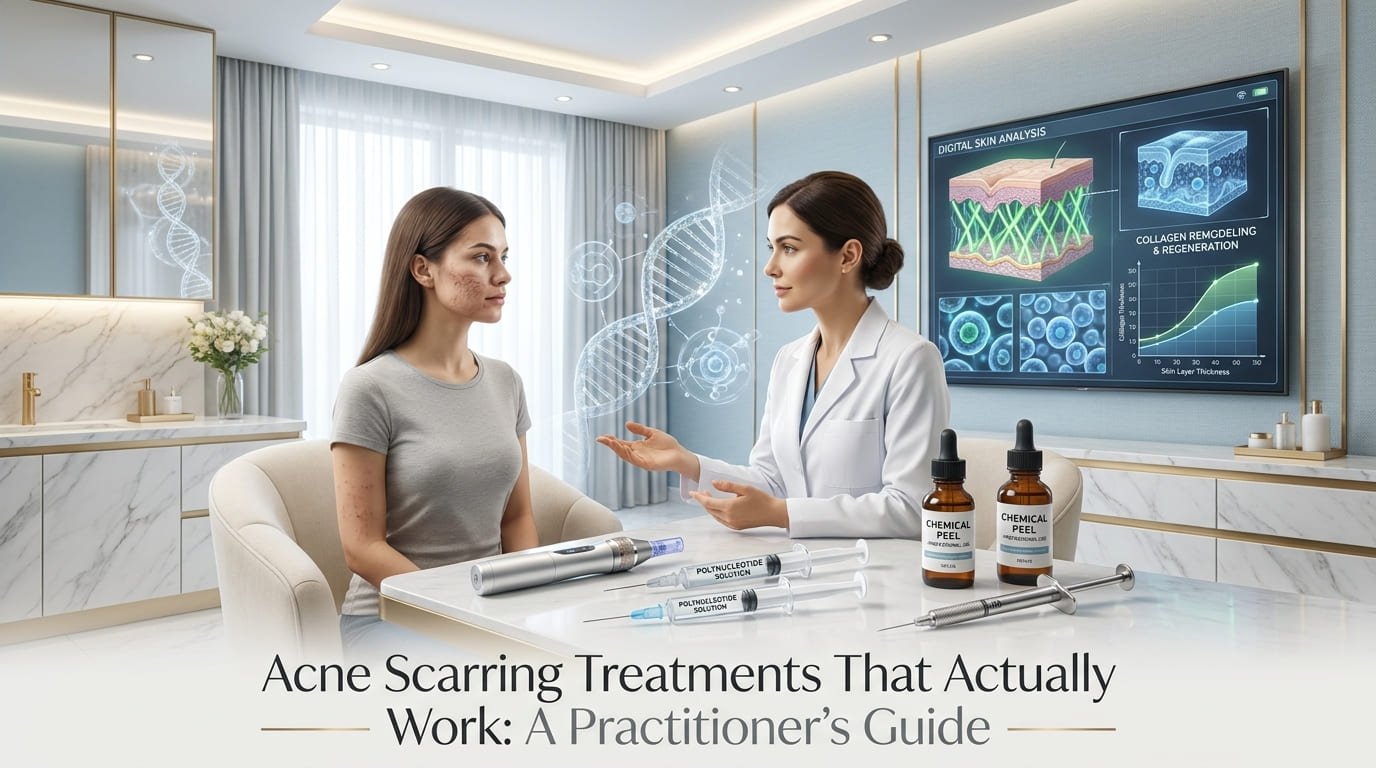
Acne scarring is one of the most emotionally charged skin concerns people bring to the clinic. It is not just a cosmetic issue for most patients. It is something that has often been present for years, sometimes decades, and has been through rounds of products, treatments, and disappointments before ending up at an aesthetics consultation.
That history matters when setting expectations. Because acne scarring is genuinely treatable. Significant, visible improvement is achievable for most patients with the right approach. But the word improvement is doing important work in that sentence. Complete erasure of established scarring is not something any treatment, regardless of how advanced, consistently delivers.
Understanding the difference between treatments that produce meaningful, evidenced improvement and those that promise more than the biology allows is the starting point for making a good decision.
Why Acne Scarring Is Not One Single Problem
The first thing a practitioner assesses is what type of scarring is actually present. Acne scarring is not a uniform condition. It presents in several distinct forms, each with a different tissue structure and a different treatment response.
Atrophic scarring is the most common type, and the one most people think of when they picture acne scars. These are scars that sit below the level of the surrounding skin because tissue was lost or damaged during the healing process. Within atrophic scarring, there are further distinctions that matter for treatment planning.
Ice pick scars are narrow, deep, and sharply defined. They go straight down into the skin like a pinhole and are among the most challenging scar types to treat because of their depth relative to their surface width.
Boxcar scars have a wider base and more defined edges, giving a box-like appearance to the depression. They tend to be shallower than ice pick scars and respond well to treatments that resurface or stimulate collagen remodelling.
Rolling scars have sloping edges that create a wave-like undulation in the skin surface. They are often caused by fibrous bands tethering the skin downward from deeper tissue. Treatments that address this tethering rather than just the surface give the best results for this scar type.
Hypertrophic and keloid scarring are raised rather than depressed. These occur when the healing process produces excess collagen rather than too little. They are less common after acne than atrophic scars but require a completely different treatment approach.
Post-inflammatory hyperpigmentation is often confused with scarring but is not structural damage to the skin at all. It is pigment discolouration left behind after inflammation. It fades over time without treatment and responds well to targeted pigmentation treatments. Addressing it as though it were structural scarring leads to treatment plans that are more aggressive than the concern actually warrants.
A thorough clinical assessment identifies which scar types are present before any treatment is recommended because the right treatment for one type can be the wrong treatment for another.
Treatments With Real Clinical Evidence
The treatments covered here have meaningful evidence behind them and consistent results in clinical practice. They are not the only options in aesthetics, but they are the ones most relevant to the treatment programme at Angel White Aesthetics.
Microneedling creates controlled micro-injuries in the skin using fine needles. The wound healing response triggered by those micro-injuries stimulates the production of new collagen in the dermis. Over a course of sessions, this new collagen gradually fills the base of atrophic scars and improves the texture of the skin surface above them.
Microneedling works best for rolling and boxcar scars. It is less effective for deep ice pick scars because the needle cannot reach the full depth of the scar in a way that stimulates meaningful tissue remodelling at its deepest point. Results are progressive across a course of treatment and best assessed at several months rather than immediately after individual sessions.
Polynucleotides are increasingly used as part of acne scar treatment programmes, and the clinical rationale is strong. The fibroblast stimulation that polynucleotides drive directly supports collagen and elastin remodelling in scarred tissue. Used as part of a planned course alongside other treatments, polynucleotides create a more actively regenerative tissue environment that supports better outcomes from complementary treatments. We have covered polynucleotides in more detail in a dedicated article for anyone who wants a fuller explanation of how the treatment works.
Chemical peels at appropriate concentrations resurface the upper layers of the skin and stimulate collagen production in the dermis. They work well for post-inflammatory hyperpigmentation and for improving the surface texture around shallower atrophic scars. Stronger peels produce more significant resurfacing but require more downtime. The choice of peel type and concentration depends on your skin tone, scar type, and how much social downtime you can accommodate.
Dermal filler used as a subcision technique addresses rolling scars specifically by breaking the fibrous bands tethering the skin downward and then supporting the released tissue with a small amount of filler placed beneath the scar. This lifts the depressed area to the level of the surrounding skin. The result is often visible quite quickly and can be significant for rolling scars that have not responded well to resurfacing treatments alone. It is a more targeted, precise approach than general volume filler and requires specific experience to perform correctly.
Laser treatments, while not always available at every aesthetics clinic, have strong evidence for acne scarring improvement, particularly ablative and fractional laser. If laser is relevant to your treatment plan, this would be discussed at consultation with referral options if appropriate.
Why Combination Treatment Plans Outperform Single Treatments
The patients who see the most significant improvement in acne scarring are rarely those who have had one type of treatment repeatedly. They are the patients who have followed a planned combination approach that addresses their specific scar types from multiple clinical angles simultaneously.
The reason for this comes back to tissue biology. Scar tissue has a different architecture from normal skin. It is more dense, less vascular, and less responsive to single stimuli. Approaching it from one direction, whether that is surface resurfacing alone or collagen stimulation alone, leaves the other components of the scar architecture untouched.
A well-designed combination plan might use polynucleotides to create a regenerative tissue environment, microneedling to stimulate collagen remodelling from controlled injury, and targeted subcision with filler for any rolling scar tethering present. Each element does something the others do not, and the combined effect is greater than the sum of the individual parts.
Building this kind of plan requires a proper assessment of the scarring present. It also requires honesty about timelines. A combination programme for acne scarring is typically measured in months. Visible improvement usually becomes clear after the second or third treatment across a course. The full benefit of a well-delivered plan is often most visible at six to twelve months from starting, as the collagen remodelling processes mature.
What Supports Your Results Between Clinic Appointments
The work done in clinic is only part of the picture. What you do at home between appointments directly affects how well your skin responds to treatment and how lasting the improvement is.
Consistent sun protection is non-negotiable during any acne scarring treatment programme. UV exposure stimulates melanin production in already sensitised skin, which worsens post-inflammatory hyperpigmentation and undermines the resurfacing work done in clinic. A broad-spectrum SPF applied daily is a clinical requirement during treatment, not an optional skincare step.
Retinoids used at an appropriate strength and frequency support the collagen remodelling process between sessions. They accelerate cell turnover and contribute to the ongoing improvement in skin texture that clinic treatments initiate. The right retinoid for your skin type and sensitivity level is worth discussing with your practitioner rather than starting with something too strong and damaging the skin barrier.
Active skincare ingredients that address pigmentation, such as vitamin C and niacinamide, support the fading of post-inflammatory marks alongside clinical treatment. They are not a substitute for clinical treatment of structural scarring, but they contribute meaningfully to overall skin quality across the treatment programme.
Managing Expectations Honestly
This section exists because managing expectations honestly is one of the most important things a good practitioner does and one of the things that is most often skipped in the pursuit of booking a treatment.
Acne scarring improvement is real and achievable. Patients who commit to a properly planned programme consistently see meaningful, visible change that makes a genuine difference to how their skin looks and how they feel about it.
Complete elimination of established structural scarring is not what these treatments deliver. Skin that has experienced significant acne scarring in the past will always have been through a process that has changed the tissue. The goal is significant improvement, not perfection, and that is a goal that is genuinely within reach for most patients who approach treatment with appropriate commitment and realistic expectations.
Frequently Asked Questions
How many sessions does acne scarring treatment take?
This depends entirely on the scar types present, their severity, and which treatments are included in the plan. Most patients see meaningful improvement across a course of four to six sessions spread over several months.
Is there downtime after acne scarring treatments?
Downtime varies by treatment. Microneedling typically involves redness for one to three days. Chemical peels vary by strength, with stronger peels requiring up to a week of visible peeling. Polynucleotides involve minimal downtime. A treatment plan will include specific downtime information for each element.
Can I treat active acne and acne scarring at the same time?
Active acne and acne scarring are best managed in a structured order. Active breakouts are addressed first before scar treatment begins, because treating scarring in skin with ongoing active inflammation gives unpredictable results.
Will my acne scars get worse if I do nothing?
Structural atrophic scarring does not worsen significantly over time on its own. Post-inflammatory pigmentation tends to fade gradually without treatment. However, early treatment of scarring generally produces better outcomes than waiting many years.
Are results from acne scar treatment permanent?
The structural improvements from treatments like subcision and deep collagen remodelling are long-lasting. Surface improvements from resurfacing treatments may benefit from periodic maintenance. Your practitioner will advise on what is appropriate for your specific plan.
If acne scarring has been something you have wanted to address for a long time and you want an honest assessment of what treatment could realistically achieve for your skin, book a consultation at our Littlehampton or Hove clinic. We will assess your scar types properly and build a plan around what your skin actually needs.
Book a Consultation in Littlehampton or Book a Consultation in Hove