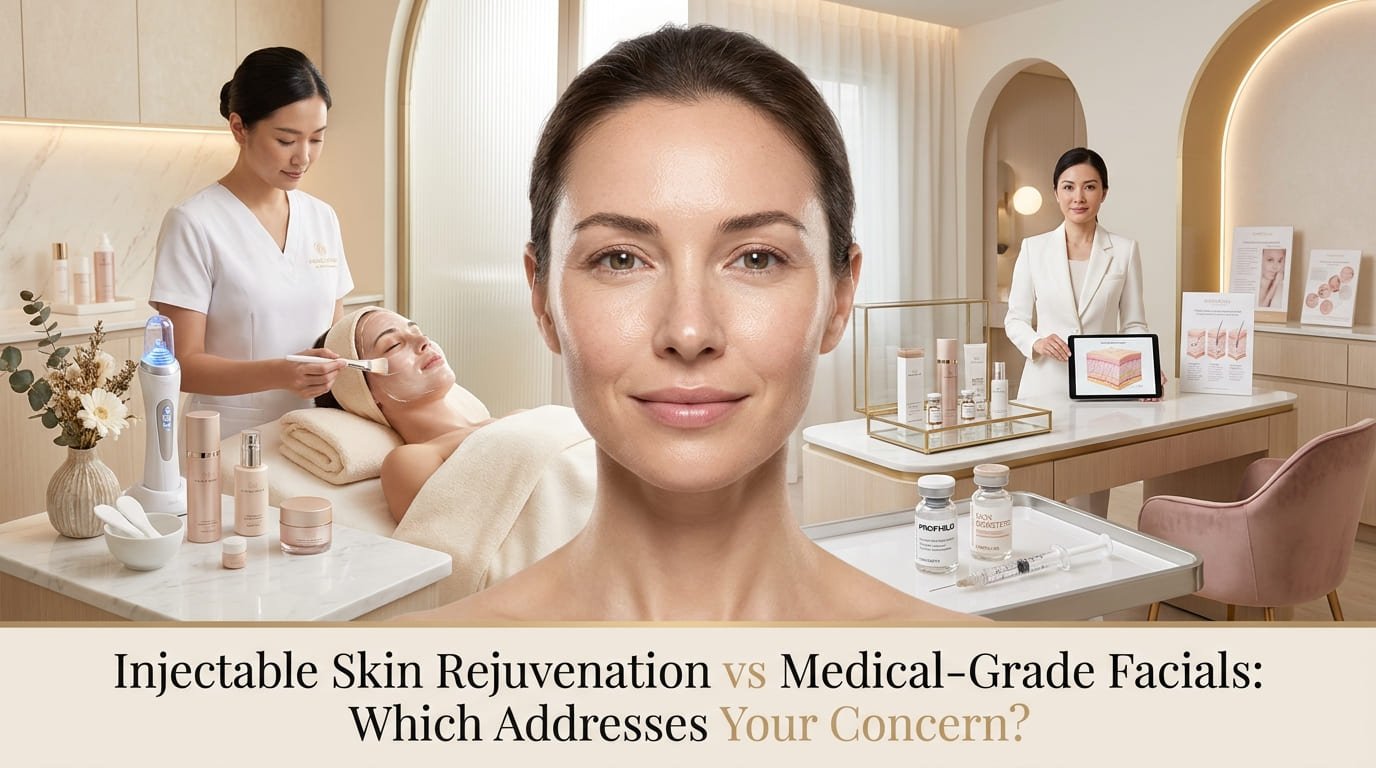
Choosing the right skin rejuvenation treatment is not always straightforward. A treatment that works well for someone in their twenties may not address the concerns of someone in their fifties. The same applies to skin type. Dry, oily, sensitive, and combination skin can respond differently to professional treatments, even when two people have similar signs of ageing.
This is why a good skin rejuvenation plan should consider more than your age or the latest treatment trend. It should take into account your current skin condition, medical history, lifestyle, previous treatments and the changes you would like to address.
Some people want to improve persistent dehydration. Others are more concerned about fine lines, uneven texture, pigmentation or reduced firmness. These concerns may overlap, but they do not necessarily require the same approach.
At Angel White Aesthetics, skin treatments include options such as Profhilo, skin boosters, polynucleotides, mesotherapy, biorevitalisation and BioRePeel. Each has a different purpose, which makes individual assessment an important part of treatment planning.
Here is how to think about building a skin rejuvenation plan that reflects your skin type and age.
Why Skin Type Matters When Planning Rejuvenation
Your skin type influences how your complexion behaves and which treatments may be appropriate. It can affect oil production, moisture retention, sensitivity and the way your skin responds to certain ingredients or procedures.
However, skin type and skin condition are not the same thing.
For example, someone can have naturally oily skin and still experience dehydration. A person with dry skin may also develop acne. Sensitive skin can occur alongside almost any skin type.
Understanding these differences helps prevent unnecessary treatments and allows a practitioner to focus on the actual concern.
1. Dry Skin
Dry skin generally produces less natural oil than other skin types. It may feel tight, rough or uncomfortable, particularly after cleansing or exposure to cold weather.
Fine lines can also appear more noticeable when the skin lacks moisture.
A suitable rejuvenation plan may focus on improving hydration and supporting the skin barrier. Professional moisturising treatments and carefully selected skincare products can form part of this approach.
For some individuals, injectable options such as Profhilo, skin boosters or biorevitalisation may also be worth discussing. These treatments are designed for different aspects of skin hydration and quality, and their suitability depends on individual assessment.
It is important to distinguish between dryness and dehydration. Dryness relates to the skin's natural oil production, whereas dehydration refers to insufficient water content. Treating one does not automatically resolve the other.
2. Oily and Acne-Prone Skin
Oily skin produces more sebum, which can contribute to enlarged-looking pores, congestion and blemishes.
A common mistake is assuming that oily skin does not need hydration. In reality, it can become dehydrated, especially when someone uses strong cleansers, frequent exfoliants or acne products that leave the skin feeling stripped.
For this skin type, treatment planning should consider both oil production and overall skin condition.
A professional exfoliating treatment such as BioRePeel may be considered for selected concerns involving uneven texture and blemish-prone skin, following an assessment. However, active acne, inflamed lesions and sensitive areas may require a different approach.
It is also important to investigate persistent or severe acne rather than treating every breakout as a surface-level concern.
3. Combination Skin
Combination skin often has more oil around the forehead, nose and chin, while the cheeks may feel normal or dry.
This can make skincare decisions difficult because different parts of the face have different needs.
A balanced approach is usually more helpful than applying strong products across the entire face. Some areas may benefit from gentle exfoliation, while others need more hydration and barrier support.
A practitioner can assess these differences and recommend treatments that suit the overall condition of the skin.
4. Sensitive Skin
Sensitive skin can react to fragrances, exfoliating acids, temperature changes and certain skincare ingredients. Symptoms may include redness, itching, burning or a feeling of tightness.
People with sensitive skin should be particularly careful about choosing treatments based on trends.
A detailed consultation should identify known triggers, previous reactions, current skincare products and any underlying skin conditions. If there is active inflammation or a suspected skin disorder, medical assessment may be needed before aesthetic treatment.
Not every injectable or exfoliating treatment is appropriate for sensitive skin. The priority should be suitability and skin comfort rather than pursuing several procedures.
5. Mature Skin
Mature skin often experiences several changes at once. These can include reduced elasticity, dryness, fine lines, uneven pigmentation and changes in facial volume.
The skin may also become thinner or more delicate with age.
A rejuvenation plan should identify which changes are most noticeable and which are most important to the individual. Treatments aimed at hydration and skin quality may be appropriate for some concerns, while pigmentation or significant volume loss may require different options.
There is no single treatment that addresses every aspect of skin ageing.
How to Approach Skin Rejuvenation at Different Ages
Age can provide useful context, but it should never be the only factor used to select a treatment. Two people of the same age may have very different skin conditions because of genetics, sun exposure, lifestyle, hormonal changes and skincare habits.
The following age groups provide a general framework rather than fixed treatment recommendations.
Skin Rejuvenation in Your Twenties
In your twenties, the main focus is often maintaining healthy skin rather than correcting advanced signs of ageing.
Concerns may include acne, post-acne marks, uneven texture, enlarged-looking pores and occasional dehydration. Some people also begin noticing early fine lines, particularly around areas exposed to repeated facial movement.
A sensible approach starts with the basics.
Daily sun protection, gentle cleansing and appropriate moisturising can help maintain skin health. If acne or pigmentation is a concern, a suitable skincare routine or professional skin assessment may be more useful than immediately considering injectable procedures.
Treatments such as BioRePeel may be discussed for appropriate surface concerns. However, active acne and persistent pigmentation should be assessed before choosing a peel.
Injectable rejuvenation is not automatically necessary because someone wants to prevent ageing. It should only be considered when there is a clear indication and the treatment is appropriate for the individual.
Skin Rejuvenation in Your Thirties
The thirties can bring noticeable changes in skin texture and hydration. Fine lines may become more visible, especially around the eyes and forehead. Some people also notice that their complexion looks less refreshed than it did previously.
Sun exposure from earlier years may begin to show through uneven pigmentation or changes in skin texture.
At this stage, a skin rejuvenation plan may combine consistent home skincare with selected professional treatments.
For people concerned about dehydration or reduced skin quality, Profhilo, skin boosters or biorevitalisation may be options to discuss. Those experiencing dullness or uneven surface texture may benefit from exploring suitable professional exfoliation.
The aim should be to address existing concerns while maintaining a routine that the skin tolerates well.
There is no need to introduce several treatments at once. A focused approach makes it easier to understand how the skin responds.
Skin Rejuvenation in Your Forties
During the forties, changes in collagen, elasticity and skin structure may become more noticeable. Hormonal fluctuations can also influence hydration, sensitivity and pigmentation.
Some people notice deeper lines, reduced firmness around the cheeks and jawline, or changes in the neck area. Others are more concerned about dullness and uneven tone.
A more individualised approach becomes particularly important.
Profhilo and selected skin boosters may be considered for people whose main concerns involve hydration and skin quality. Polynucleotides may also be discussed for appropriate rejuvenation concerns.
However, treatments designed to improve skin quality are not the same as procedures used to restore lost facial volume. If the concern involves significant changes in facial structure, a separate assessment may be necessary.
A good plan should address the areas that genuinely need attention rather than attempting to treat every visible sign of ageing.
Skin Rejuvenation in Your Fifties and Beyond
Skin changes can become more pronounced during the fifties and later years. Reduced elasticity, thinner skin, dryness and age-related pigmentation may all contribute to a different overall appearance.
Menopause can also affect skin hydration and collagen levels, although the extent of these changes varies considerably.
Treatment planning should take account of skin thickness, sensitivity, medical history and recovery considerations.
For some individuals, injectable skin rejuvenation may be appropriate to address selected skin quality concerns. Others may benefit more from carefully chosen exfoliating treatments, a consistent moisturising routine or an assessment of pigmentation.
The goal is not to make mature skin look younger at any cost. It is to improve the concerns that matter to the individual while maintaining natural-looking results.
Which Angel White Treatments May Suit Different Skin Concerns?
Understanding the purpose of each treatment is more useful than choosing one simply because it is popular.
Here is a general overview of the options available at Angel White Aesthetics.
Profhilo
Profhilo is an injectable hyaluronic acid treatment used to improve skin hydration and quality. It may be considered for people experiencing dehydration, early skin laxity or changes in skin appearance.
It is not designed to provide the same facial contouring effect as traditional dermal fillers.
Skin Boosters
Skin boosters are used to improve skin hydration and create a fresher-looking appearance. Their formulations can differ, so the product and treatment approach should be selected according to the patient's needs.
They may be worth discussing when persistent dehydration or changes in skin texture are the main concerns.
Polynucleotides
Polynucleotide treatments are used in aesthetic practice for selected skin rejuvenation concerns. They are often discussed for delicate areas, including the under-eye region, where skin quality and texture may change with age.
Suitability depends on the treatment area, product, and individual circumstances. Expected results should be explained realistically.
Mesotherapy
Mesotherapy involves delivering selected substances into the skin through multiple small injections. The ingredients and protocols vary, so it is important to understand exactly which formulation is being used and what it is intended to address.
It may form part of a personalised rejuvenation plan where appropriate.
Biorevitalisation
Biorevitalisation is an injectable treatment focused on hydration and overall skin quality. It may be considered for dull, dehydrated skin and early changes in skin appearance.
It is different from conventional filler treatments and should be selected according to the individual's concerns.
BioRePeel
BioRePeel is a professional chemical peel used to improve the appearance of skin texture and tone.
It may be considered for selected concerns involving dullness, uneven texture and superficial pigmentation. Skin condition and suitability should be assessed before treatment, particularly in people with sensitive or inflammation-prone skin.
How to Combine Treatments Without Overcomplicating Your Routine
Some people have more than one skin concern and may benefit from different treatment approaches over time.
For example, a person with dull, dehydrated skin and uneven texture may wish to explore both hydration-focused treatment and professional exfoliation.
However, combining treatments requires careful planning.
The practitioner should consider the procedures involved, their ingredients, the condition of the skin and the time needed for recovery. Not every combination is appropriate, and certain treatments should be separated rather than performed close together.
Introducing too many procedures can also make it difficult to understand which treatment is helping or causing irritation.
A more practical approach is to identify the main concern first, select an appropriate treatment and review the response before considering additional procedures.
Home skincare should also support the treatment plan. Gentle cleansing, moisturising and regular broad-spectrum sun protection remain important, regardless of age or skin type.
Common Mistakes When Planning Skin Rejuvenation
Even well-intentioned skincare routines can become unnecessarily complicated.
One common mistake is choosing treatments based entirely on age. Someone in their thirties does not automatically need injectable treatments, just as someone in their fifties does not necessarily need several procedures.
Another mistake is treating every skin concern as dehydration. Dullness, pigmentation, acne and reduced elasticity can have different underlying causes.
Some people also change their skincare routine too frequently. Using multiple exfoliating products or combining strong active ingredients without considering skin tolerance can damage the skin barrier and increase sensitivity.
Finally, expectations matter. Professional treatments can improve selected aspects of skin appearance, but they cannot remove every sign of ageing or replace healthy skincare habits.
A realistic plan should explain the expected benefits, limitations, possible side effects and maintenance requirements before treatment begins.
When Should You Have a Professional Skin Assessment?
A consultation is particularly useful when you are unsure whether your concern is related to dehydration, pigmentation, ageing, acne or another skin condition.
It can also help if your skin has become more sensitive, if previous treatments have not produced the expected outcome or if you are considering combining different procedures.
During an assessment, your practitioner can discuss your skin type, medical history, current skincare routine and treatment goals.
This helps establish whether an injectable treatment, professional peel or a simpler skincare approach is more appropriate.
At Angel White Aesthetics, consultations are used to assess individual concerns and develop treatment recommendations. The clinic offers skin treatments in both Littlehampton and Hove.
Building a Skin Rejuvenation Plan at Angel White Aesthetics
A useful skin rejuvenation plan should have a clear purpose. It should not be a long list of procedures selected without understanding what the skin actually needs.
For someone in their twenties with acne and uneven texture, the priorities may be very different from those of someone in their forties experiencing dehydration and reduced firmness.
Likewise, a person with sensitive skin may need a more conservative approach than someone whose main concern is surface dullness.
At Angel White Aesthetics, available options include Profhilo, skin boosters, polynucleotides, mesotherapy, biorevitalisation and BioRePeel. Each treatment can be considered according to the skin concern and individual suitability.
Consultations are available at the Littlehampton clinic and the Hove clinic, allowing patients across West Sussex to discuss their skin goals and explore appropriate options.
The first step is understanding your skin. From there, treatment choices become much clearer.