Running an aesthetic clinic from home is one of the most searched questions among practitioners who have recently qualified or are planning to qualify. The appeal is obvious. Lower overheads, no commute, flexibility in scheduling, and the ability to start treating patients before investing in external premises. For many practitioners, starting from home is a sensible and achievable choice.
What is less obvious is how many different areas of law, regulation, local authority jurisdiction, insurance, and practical clinical governance need to be checked and resolved before a home-based aesthetic clinic can operate legally and safely. Most guides on this subject cover one or two of these areas. This one covers all of them, because a home clinic that is legally set up in nine areas but has missed the tenth is not adequately set up.
The Regulatory and Licensing Landscape in 2026
The UK aesthetic regulatory landscape is in an active period of change that every practitioner setting up a home clinic needs to understand before proceeding.
The Health and Care Act 2022 provided the legal powers to introduce mandatory licensing for aesthetic procedures, and the government published its response to consultation in August 2025 confirming the framework. The system is a two-tier approach. Higher-risk procedures including the most dangerous non-surgical treatments are being brought under CQC regulation and will be restricted to regulated healthcare professionals in CQC-registered premises. Medium and lower-risk procedures including standard facial injectables such as botulinum toxin and dermal fillers are moving under a local authority licensing scheme, requiring both practitioner-level and premises-level licences administered by local councils.
This framework is being implemented in stages through secondary legislation. At the time of writing, the full local authority licensing scheme for injectables in England has not yet been enacted as operative regulations. The current position in England is that standard facial botulinum toxin and dermal filler treatments do not currently trigger mandatory CQC registration on their own, and most aesthetic practitioners do not currently need CQC registration unless they are performing higher-risk regulated activities or treatments involving prescription medicines within a framework that brings them into CQC scope.
Wales operates differently. Wales has already implemented mandatory licensing for special procedures under the Public Health (Wales) Act 2017 and the Special Procedure Licences (Wales) Regulations 2024, with rollout from 2025. Practitioners setting up in Wales need to engage directly with their local authority on the current licensing requirements for their specific treatment mix.
This is a rapidly evolving landscape and the requirements that apply to your home clinic will change as secondary legislation is enacted. Checking the current position with your local authority and your specialist insurer before setting up, and monitoring regulatory updates as the licensing scheme continues to roll out, is the most reliable approach rather than relying on any fixed summary.
What Your Local Authority Requires Now
Before any licensing scheme is formally enacted in your area, most local authorities in England already have powers to require registration or licensing for certain activities performed at residential premises.
Skin piercing registration is required by many local authorities for treatments that pierce the skin, including certain injectable procedures. The specific definition varies between councils and some councils require registration of both the practitioner and the premises for any treatment involving skin penetration. Contacting your local authority's environmental health department before you begin treating patients at home is the first practical step in establishing what is currently required in your specific area.
This step is missed by a significant number of home-based practitioners and it is not a minor oversight. Operating from home in breach of local authority registration requirements exposes the practitioner to enforcement action that can include being required to cease trading immediately.
Planning Permission and Change of Use
Running a business from a residential property can constitute a material change of use of the property under the Town and Country Planning Act 1990. Whether planning permission is required depends on the scale and character of the business activity relative to the residential use.
For a practitioner treating a small number of patients per week in a room that otherwise functions as domestic space, the change of use may not be material enough to require planning permission. For a practitioner who has dedicated a room exclusively to clinical use, regularly receives multiple patients per day, and has visitors attending at levels that affect the character of the property as a residential address, planning permission for change of use becomes more likely to be required.
Checking with your local planning authority rather than assuming is the correct approach. Most local authorities have a pre-application enquiry process that allows you to describe your proposed use and receive a preliminary view on whether planning permission is needed before you commit to a setup.
Mortgage, Tenancy, and Home Insurance
These three considerations are frequently overlooked and can have serious financial and legal consequences.
If you have a mortgage on the property, your mortgage agreement may contain terms about commercial activity on the premises. Many standard residential mortgage agreements prohibit or restrict the use of the property for commercial purposes, and operating an aesthetic clinic from a mortgaged residential property without the lender's knowledge or consent could technically constitute a breach of the mortgage terms. Contacting your mortgage provider and confirming their position before proceeding is the right approach.
If you rent rather than own, your tenancy agreement almost certainly requires the landlord's consent for commercial use. Operating a clinic from a rented residential property without the landlord's knowledge is a breach of the tenancy agreement that could result in eviction.
Your home insurance almost certainly does not cover liability arising from business activities conducted at the property. Standard home insurance is designed for residential use and specifically excludes commercial activity. Informing your home insurer that you are operating a business from the property is necessary to ensure your building and contents insurance remains valid, and you may need to add a business activity extension or take a separate commercial premises policy. Failure to disclose business use to your home insurer can invalidate your home insurance entirely.
What the Treatment Room Actually Needs
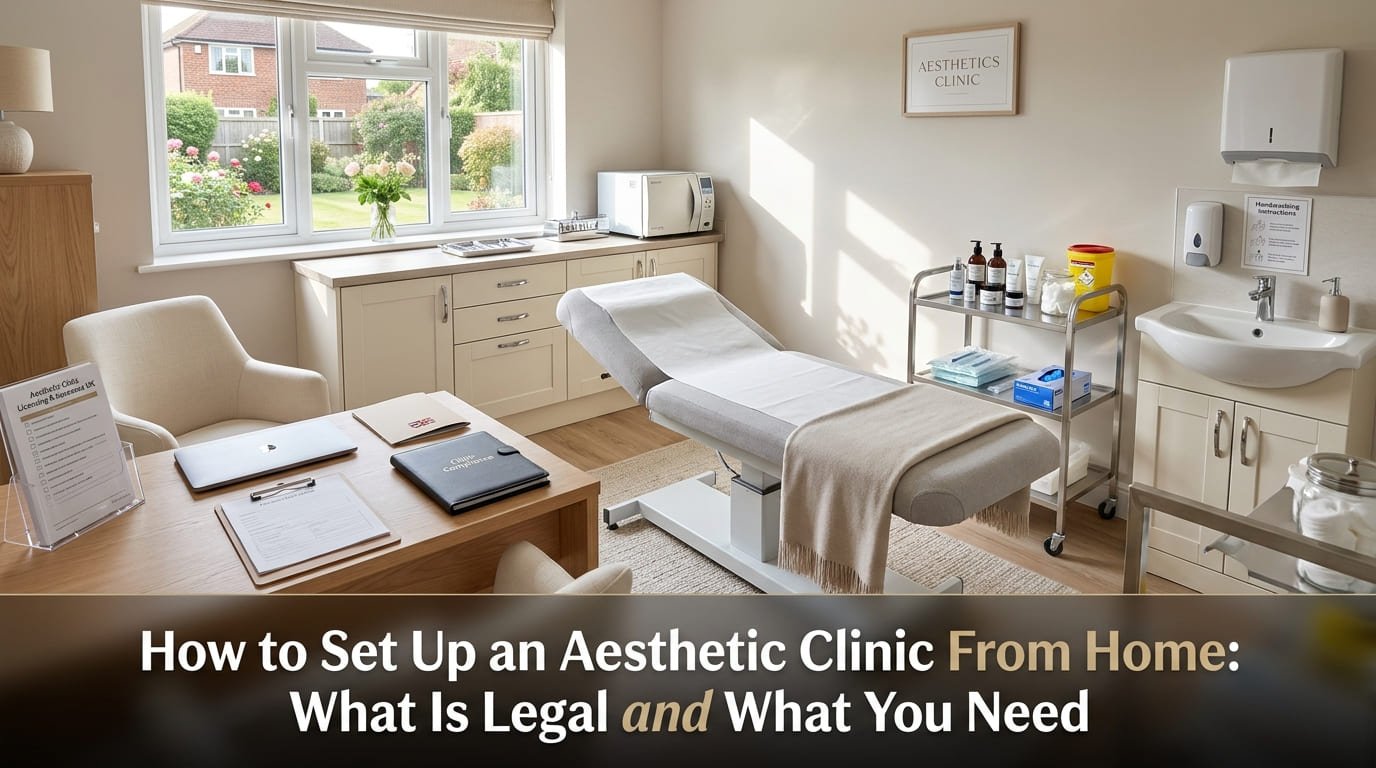
A room in your home that is used for clinical aesthetic treatment is not simply a nice room with a treatment couch. It is a clinical environment and it needs to meet clinical standards that protect both your patients and your professional standing.
The room needs to be separately accessible from the rest of your home living spaces if possible, or at minimum set up in a way that patients do not walk through your personal domestic areas to reach the treatment space. The clinical environment needs to be clearly differentiated from a residential one.
Cleaning and decontamination standards need to be met consistently. Surfaces in the treatment area need to be cleanable to clinical standards. Soft furnishings that cannot be adequately cleaned between patients are not appropriate in the treatment area. Clinical waste disposal needs to be managed correctly, which includes sharps disposal through a registered clinical waste contractor rather than through household waste.
Lighting needs to be adequate for clinical assessment. Inadequate lighting in a treatment room is not simply an inconvenience. It affects the quality of your patient assessment and your treatment delivery.
An examination couch or treatment chair that positions the patient appropriately for the treatments you perform, that you can work around safely, and that is appropriate for the clinical standard you are operating to is an essential piece of equipment.
An emergency management area needs to be set up in the room or immediately accessible. This means hyaluronidase and your emergency protocol documentation are immediately available during every treatment session, not in another room, not in a bag, and not something you need to search for.
Privacy for patients entering, receiving treatment, and leaving the premises needs to be considered. Patients attending an aesthetic clinic at a residential address are entitled to the same confidentiality they would receive at a standalone clinic.
Clinical Governance at Home
The clinical governance standards that apply to home-based aesthetic practice are identical to those that apply to any other clinical setting. Operating from home does not reduce the standard.
Patient documentation, consent processes, medical history review, treatment records, and after-care provision must meet the same standard they would in a clinic building. The fact that the clinical setting is a domestic environment does not change the professional and legal obligations.
Data protection obligations under UK GDPR apply fully to patient records held in a home setting. Patient records, photographs, and personal data stored at your home address need to be held securely. A locked cabinet for paper records and a password-protected device with encrypted storage for digital records are the minimum requirements.
Professional photography for before and after records needs to be taken in consistent lighting. Setting up a consistent photography space in your treatment room is part of the clinical governance of a home practice rather than an optional extra.
Your emergency protocol needs to be written, rehearsed, and immediately accessible in the treatment room. If a vascular event occurred during a filler treatment in your home, you need to be able to respond with the same speed and competence as you would in any other clinical setting. The emergency response is not easier to execute from a domestic environment. In some respects it is harder, which makes the preparation more rather than less important.
UK GDPR and Data Protection Registration
Any practitioner who holds personal data about patients, which includes names, contact details, medical histories, treatment records, and photographs, is operating as a data controller under UK GDPR and is required to register with the Information Commissioner's Office.
Registration with the ICO as a data controller is a legal requirement. It is completed online and involves a small annual fee. Operating as a data controller without ICO registration is a breach of data protection law.
Your patient records must be stored securely, retained for the legally required minimum period which for adult health records is a minimum of eight years from the date of last treatment, and patients must be able to request access to their records in accordance with their subject access rights.
CCTV in or around your home treatment room requires specific signage and registration with the ICO as a separate data processing activity if it captures images of patients.
Business Rates
Using part of your home for business purposes may attract business rates on the proportion of the property used commercially. Local authority business rates assessments can apply even to residential properties used partially for business if the business use is regular and substantial.
Many small home-based businesses qualify for small business rates relief and pay no business rates in practice, but you are still obligated to notify your local council of any business use and allow them to assess whether business rates apply. Operating a commercial activity from residential premises without the local council's awareness that a business is being conducted at the address is not the correct approach.
What to Do Before Treating Your First Patient
Working through these requirements systematically before treating anyone is not excessive caution. It is the minimum that a professionally and legally compliant home aesthetic clinic requires.
Contact your local authority environmental health department and confirm what registration or licensing they currently require for your intended treatment mix at a residential address. Contact your local planning authority and confirm whether your intended use requires planning permission. Contact your mortgage provider or landlord and confirm the position on business use. Contact your home insurer and disclose the business activity. Confirm that your specialist aesthetic indemnity insurance covers home-based treatment specifically. Confirm that your prescribing pathway is in place. Set up your treatment room to meet clinical standards. Set up your documentation, consent, and emergency management systems. Register with the ICO as a data controller. Confirm whether local authority business rates apply.
Every one of these steps has a practical consequence if it is missed. Working through them before you open your doors rather than discovering them afterward is what distinguishes a practice that is built on solid foundations from one that is built on assumptions.
Frequently Asked Questions
Do I need CQC registration to treat patients at home with Botox and fillers?
In England as of 2026, standard facial botulinum toxin and dermal filler treatments do not typically trigger mandatory CQC registration on their own for most practitioners. This position is subject to change as the aesthetic licensing regulations are enacted through secondary legislation. Checking the current position with your specialist insurer and local authority before setting up is strongly advisable.
What happens if my local authority requires registration and I have not obtained it?
Operating without required local authority registration or licensing exposes you to enforcement action that can include being required to cease treating patients immediately, fines, and in serious cases formal prosecution. It is not a risk worth taking.
Can I treat model patients from home during my training period?
Yes, subject to the same requirements that apply to any patient treated in a home setting. A model patient treated at your home address is a patient in all the relevant legal and professional senses. Insurance, governance, and room standards apply from the first patient regardless of whether they are a model or a paying patient.
Will my home insurance cover me if a patient is injured at my premises?
Standard home insurance will not cover liability arising from business activities. You need a specialist aesthetic indemnity policy that specifically covers home-based treatment, and you need to confirm that your home insurance has been informed of the business use and remains valid.
How do I dispose of sharps and clinical waste from my home clinic?
Clinical waste, including sharps must be disposed of through a registered clinical waste contractor. It cannot be placed in household waste or recycling. Most clinical waste companies offer collections for small-volume home-based practitioners. Setting this arrangement up before treating your first patient is part of the clinical governance of a home practice.
If you are in the process of setting up your aesthetic practice and want to discuss the training and qualification side of the picture, get in touch with the Angel White Aesthetics training team in Littlehampton or Hove.
Contact the Training Team or Explore Training Courses