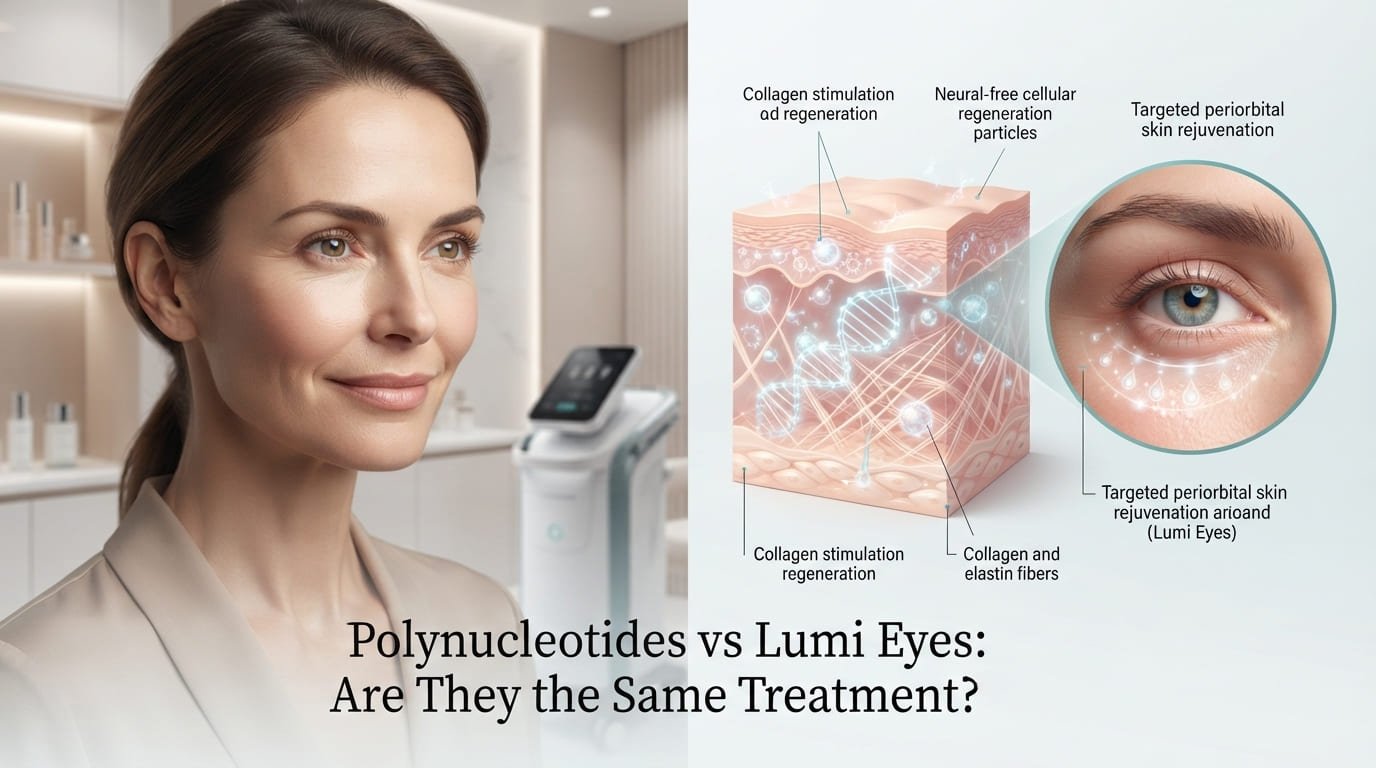
This question comes up in consultation more than almost any other in the skin quality treatment category right now. Lumi Eyes and polynucleotides are mentioned together so consistently on clinic menus and social media that patients researching under-eye treatment often arrive genuinely uncertain whether they are looking at two names for the same thing or two meaningfully different options.
The confusion is understandable. Both treatments involve polynucleotide technology. Both are injectable. Both are used for under-eye concerns. If you search for before-and-after photos of either, the results look broadly similar. But the difference between them is real, clinically relevant, and worth understanding before you decide which one to book.
What Polynucleotides Are as a Category
Polynucleotides as a treatment category refers to injectable products containing long-chain DNA fragments derived from the purified genetic material of salmon or trout. The purification process removes proteins that could cause allergic reactions, leaving behind only the nucleotide sequences that drive the regenerative biological response in human tissue.
When injected into the skin, polynucleotides stimulate fibroblasts, which are the cells responsible for producing collagen and elastin. This fibroblast activation produces genuine structural improvement in skin quality over a course of treatment. New collagen is laid down. Elastin improves. The tissue becomes thicker, firmer, and more resilient. The improvement is not from a volume deposit sitting in the skin. It is from the skin genuinely regenerating at a cellular level.
Polynucleotides as a category include a growing range of products from different manufacturers. PDRN (polydeoxyribonucleotide) and PN (polynucleotide) products are the two main molecular classifications within the category, and they differ in the size of the DNA fragments used, with PDRN using shorter fragments and standard PN formulations using longer chains. Both work through adenosine receptor activation and fibroblast stimulation, but the molecular weight difference produces some variation in how they behave in tissue and how they are best used clinically.
This is the category. Lumi Eyes sits within it. But Lumi Eyes is a specific product rather than the entire category, and the distinction matters.
What Lumi Eyes Is Specifically
Lumi Eyes is a branded injectable polynucleotide product manufactured by Matex Lab in Italy. It is formulated specifically for use in the periorbital area, which means the skin around and beneath the eye. The product contains PDRN (polydeoxyribonucleotide) at a concentration calibrated for the particular characteristics of the under-eye skin.
The periorbital area presents specific clinical challenges that distinguish it from the rest of the face. The skin beneath the eye is among the thinnest on the entire face, typically between 0.5 and 2 millimetres, which is significantly thinner than skin elsewhere. It contains fewer oil glands and less subcutaneous fat than surrounding areas. The vasculature is delicate and the lymphatic drainage in this zone is easily disrupted. The margin between a precise result and an overcorrected one is narrower here than almost anywhere else on the face.
Lumi Eyes is formulated specifically for these characteristics. The concentration, the molecular weight of the PDRN, and the product viscosity are calibrated for safe and effective use in thin, delicate periorbital skin. The injection technique used with Lumi Eyes places the product superficially within the papillary dermis of the under-eye skin at a very precise and consistent depth, which is a more specific protocol than the general facial polynucleotide injection technique used in other treatment areas.
This specificity is the central clinical distinction. Lumi Eyes is a periorbital-specific polynucleotide product designed with the under-eye environment as its primary and intended indication. General polynucleotide products are formulated for broader facial and body use and are applied with a different protocol.
Why This Distinction Matters Clinically
The question of whether it matters which product is used in the under-eye area versus the rest of the face is worth addressing directly rather than leaving as an implied technical point.
The under-eye skin is so thin that product consistency, concentration, and injection depth interact differently here than in areas with thicker skin. A polynucleotide product formulated for general facial use injected at a general facial depth into under-eye skin can produce a result that looks different from what a periorbital-specific product produces at the appropriate depth. It can also carry a slightly different risk profile in terms of visible product beneath thin skin, temporary puffiness, or variation in how evenly the result distributes across the delicate anatomy of the tear trough region.
This does not mean general polynucleotide products cannot be used near the eye area. An experienced practitioner who understands the periorbital anatomy and adjusts their technique accordingly can use a range of products effectively. What it does mean is that Lumi Eyes was specifically developed to make the periorbital treatment more standardised, more predictable, and more consistently safe across a broader range of practitioners working in this area. The product-specific protocol that comes with Lumi Eyes was designed around the unique requirements of that anatomy.
For patients, the practical implication is worth knowing. When a clinic offers polynucleotide treatment for under-eye concerns, it is worth asking whether they are using a periorbital-specific product like Lumi Eyes or a general facial formulation, and how they adapt their technique to the under-eye anatomy. A practitioner who can answer this clearly is working with an appropriate level of product and technique knowledge for the area being treated.
What Lumi Eyes Is Used For and What It Achieves
Lumi Eyes is used specifically for the concerns that present in the periorbital region and that respond to PDRN-driven tissue regeneration.
Thin, crepey skin beneath the eye is the primary indication. As skin in this area thins with age or due to genetic factors, the structures beneath it become more visible. The orbicularis oculi muscle shows through as a purplish or bluish discolouration. Fine lines appear more dramatically than they do in areas with thicker skin. The overall appearance is tired and aged in a way that is disproportionate to what is happening in the rest of the face. Lumi Eyes addresses this by regenerating the collagen and elastin in the under-eye skin, improving its thickness and structural quality over a course of treatment.
Dark circles where the mechanism is thin skin allowing underlying structures to show through respond particularly well to Lumi Eyes. As the skin thickens and improves in quality, it provides more effective coverage of the structures beneath it and the dark appearance reduces. This is distinct from dark circles caused by pigmentation in the skin surface or by vascular congestion, which require different treatment approaches.
Fine lines and early crepiness in the under-eye area benefit from the collagen stimulation the treatment drives. The lines appear less deeply etched as the surrounding skin becomes more elastic and resilient.
General periorbital fatigue, where the eye area looks consistently tired regardless of how much sleep has been had, often has skin quality deterioration as one of several contributing factors. Lumi Eyes addresses the skin quality component, which alongside other treatments targeting different contributors can produce a meaningful overall improvement in how awake and rested the periorbital area looks.
What General Polynucleotide Treatment Is Used For
General polynucleotide treatments using facial-grade formulations are used across a much wider range of areas and indications than Lumi Eyes.
The face as a whole benefits from polynucleotide treatment for skin quality improvement, collagen and elastin regeneration, and the improvement in tissue resilience and radiance that a course of treatment produces. The neck and décolletage, where skin quality deterioration is often significant but volume loss is not the primary concern, respond particularly well to polynucleotide treatment because the regenerative mechanism addresses exactly what is happening in ageing neck skin.
Acne scarring treated with polynucleotides benefits from the fibroblast stimulation that supports remodelling of scar tissue over time, gradually improving the texture and depth of atrophic scarring. The scalp and hair thinning treated with polynucleotides benefit from the same fibroblast activation applied to the follicular environment of the scalp.
The hands, the body, and other areas of skin quality concern beyond the face all fall within the clinical scope of general polynucleotide treatment. Lumi Eyes is periorbital-specific. General polynucleotides are not.
Can You Use Both in the Same Programme?
Yes, and doing so makes clear clinical sense for patients where both under-eye concerns and broader skin quality improvement are relevant goals.
A treatment programme might include Lumi Eyes specifically for the under-eye area, applied with the periorbital protocol and the calibrated concentration of the Lumi Eyes product, while broader facial polynucleotide treatment addresses the overall skin quality of the rest of the face. The two products and protocols complement each other rather than overlapping, because they are designed for different anatomical environments within the same overall treatment philosophy.
For patients whose primary concern is the under-eye area and who do not have significant skin quality concerns elsewhere, Lumi Eyes alone as a targeted periorbital course is the appropriate starting point. For patients with broader skin quality goals, building a programme that uses both in their respective roles produces a more comprehensive result.
How a Course of Lumi Eyes Treatment Works
A standard course of Lumi Eyes is typically three sessions spaced two to four weeks apart. The injection technique places the product superficially into the papillary dermis of the under-eye skin at multiple fine points across the treatment area. Topical numbing cream is applied before the procedure.
The under-eye area is more prone to bruising after injection than most other facial areas because of the delicate vasculature in the periorbital region. Minor bruising that settles within five to seven days is a common and normal post-treatment feature. Patients should plan their course with this in mind and avoid booking sessions immediately before events where visible bruising would be a concern.
Early improvements in hydration and skin quality often become noticeable after the second session. The structural regenerative results, including improved skin thickness and the reduction in dark circles caused by thin skin, develop progressively and are typically most clearly visible several weeks after completing the course as the collagen stimulation matures.
Maintenance sessions are recommended every six to twelve months to sustain the improvement. The biological changes produced by treatment persist for considerably longer than a simple hydration deposit would, because they represent genuine tissue change rather than a temporary volume effect.
How to Know Which You Are Being Offered
The most practical piece of information to take from this article is a simple question to ask at consultation. Ask specifically whether the under-eye treatment being recommended is Lumi Eyes or a general polynucleotide product, and why that specific product was chosen for the under-eye area.
A practitioner who can answer this question clearly and explain the clinical reasoning behind their product choice is working with the level of product knowledge appropriate for treating delicate periorbital skin. A practitioner who uses the terms polynucleotides and Lumi Eyes interchangeably as if they are identical is either not aware of the distinction or has not thought carefully about why it matters for the area being treated.
Neither answer necessarily means the treatment will produce a poor result. An experienced practitioner adapting a general polynucleotide protocol to the periorbital area with appropriate care can still produce a good outcome. But asking the question gives you useful information about how carefully your treatment is being planned.
Frequently Asked Questions
Is Lumi Eyes more expensive than general polynucleotide treatment?
Pricing varies between clinics and is influenced by the specific products used, the number of sessions included, and the treatment area. Lumi Eyes, as a periorbital-specific product, is typically priced comparably to general polynucleotide facial treatment rather than at a significant premium. The value is in the periorbital-specific formulation and protocol rather than a material cost difference.
Can Lumi Eyes treat under-eye hollows or tear trough volume loss?
Lumi Eyes addresses skin quality in the periorbital area rather than volume loss. Under-eye hollows caused by volume loss in the tear trough require a different treatment, typically dermal filler or a structural approach. Lumi Eyes and tear trough filler can be used in the same programme for different aspects of the under-eye presentation, but they serve different purposes.
How many sessions of Lumi Eyes before I see a result?
Most patients notice early improvement in skin hydration and a reduction in the tired appearance of the under-eye after the second session. The fuller result, including improved skin thickness and dark circle reduction where the mechanism is appropriate, develops over the weeks following the third session as collagen production accumulates.
Are there any patients who should not have Lumi Eyes?
The contraindications for Lumi Eyes are the same as those for polynucleotide treatments in general. Pregnancy and breastfeeding are contraindications. A known allergy to fish or seafood is a contraindication given the salmon-derived source material. Active skin infections in the treatment area, certain autoimmune conditions, and blood-thinning medications are all factors to declare at consultation.
Can I have Lumi Eyes and anti-wrinkle injections around the eye area at the same appointment?
This is a common combination and is generally appropriate. The sequencing and timing are managed at consultation to ensure both treatments are performed safely and that each settles properly. Your practitioner will advise on whether the same appointment is suitable for your specific situation.
My clinic offers polynucleotides for the under-eye but does not mention Lumi Eyes. Should I ask about it specifically?
Yes. Asking which specific product is being used and why it is appropriate for the under-eye area is a reasonable and informative question. The answer will tell you how carefully the treatment has been planned for the periorbital environment specifically.
If you have under-eye concerns and want to understand whether Lumi Eyes, general polynucleotide treatment, or a combination approach is most appropriate for your specific presentation, book a consultation at our Littlehampton or Hove clinic.
Book a Consultation in Littlehampton or Book a Consultation in Hove