Model patients come up in conversation during almost every aesthetic training course and in almost every forum discussion among new graduates. The concept seems straightforward. You need someone to practise on. You find someone willing to receive treatment for free or at a reduced price. You build your skills before moving to full commercial pricing.
In practice the model patient relationship is more nuanced than this and carries genuine clinical and legal obligations that new practitioners sometimes do not fully appreciate until something goes wrong. Understanding what a model patient actually is, what your obligations toward them are, and how to approach finding appropriate candidates is one of the most practically valuable things a new aesthetic practitioner can know.
What a Model Patient Actually Is
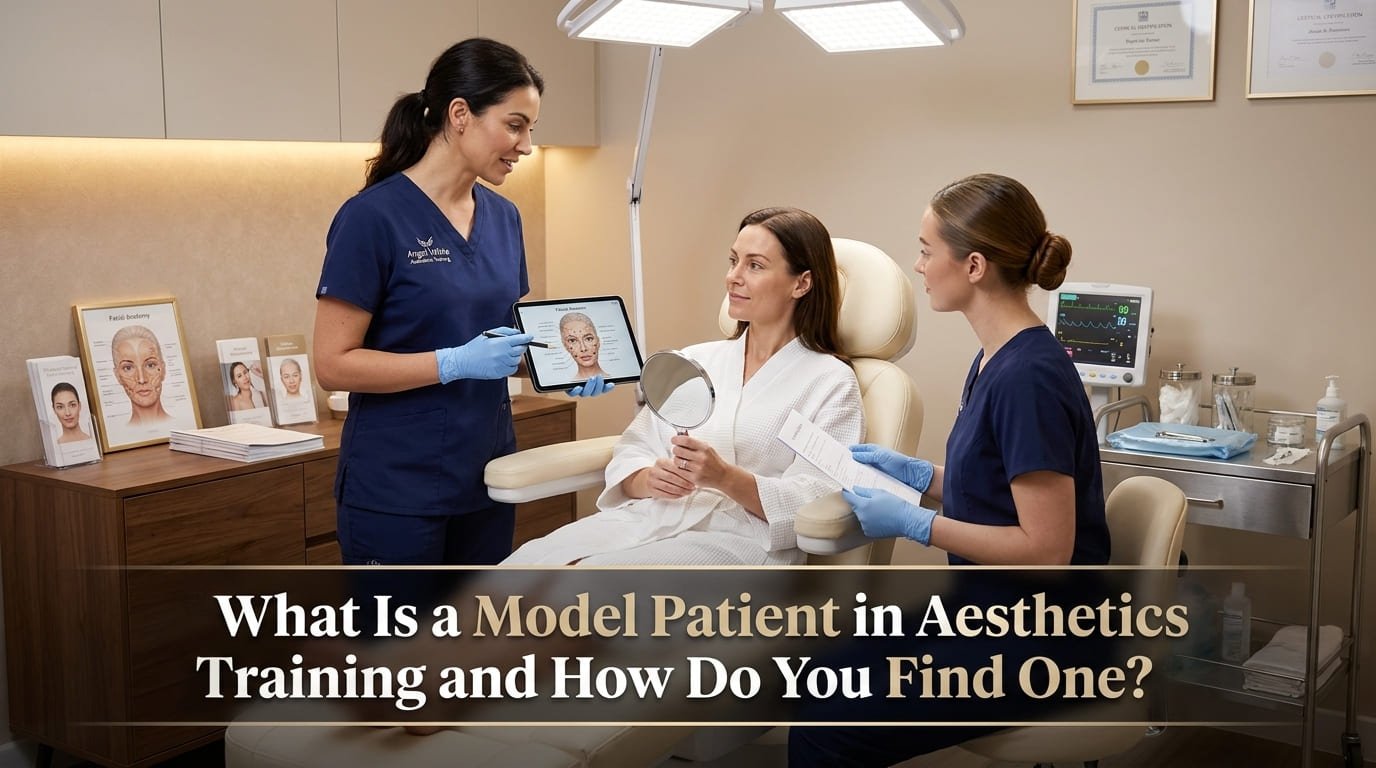
A model patient is a person who receives aesthetic treatment from a practitioner who is in the process of building their clinical experience, typically at a reduced or zero fee in exchange for that reduced commercial expectation. The arrangement is common in the period immediately following initial training when a practitioner has the knowledge and qualification to treat but has not yet built the clinical volume that develops consistent confidence and refined technique.
The word model in this context does not mean the person is a professional model or that they are being used for demonstration purposes only. It means they are receiving treatment in an educational or developmental context for the practitioner, rather than as a fully commercial appointment.
What it does not mean is that the person is anything other than a patient. This is the most important thing to understand about the model patient relationship and the thing that most new practitioners initially get wrong. A model patient is a patient. They have all the rights of a patient. They are subject to all the clinical and legal protections that apply to any other patient. The fact that they are paying nothing or paying a reduced fee does not change their status as a patient in any legally or professionally relevant sense.
If a model patient has a complication, adverse reaction, or outcome they are dissatisfied with, they can make a complaint to your professional regulatory body. They can raise a concern with your insurance provider. In serious cases they can pursue legal action. The reduced or zero fee is not a waiver of their rights as a patient and it should never be presented as one.
The Obligations That Come With Treating a Model Patient
Every obligation that applies to treating a paying patient applies equally and completely to treating a model patient.
Informed consent must be obtained before any treatment. The model patient must be given a full explanation of the treatment, the risks, the expected outcomes, the alternatives, and what to do if they have a concern afterward. They must sign a consent form that reflects the specific treatment being performed. The fact that they are receiving the treatment at reduced cost does not reduce the depth or formality of the consent process. In some respects the consent conversation should be more thorough for a model patient, because the practitioner may be less experienced and the patient should understand that the practitioner is in an early stage of developing their skills.
A full medical history must be taken before treatment. Model patients are not exempt from contraindication screening. If a model patient discloses a contraindication that makes the planned treatment inappropriate, you cannot proceed with the treatment simply because the person has agreed to participate as a model. The clinical decision about whether to treat is identical to the decision you would make for a fully paying patient.
Treatment records must be maintained with the same completeness as for any other patient. Date, treatment performed, product used, batch number, volumes, injection points, and any complications or unexpected responses are all documented regardless of the commercial status of the appointment.
Photography in consistent lighting before and after treatment is part of the standard clinical record and applies to model patient appointments exactly as it applies to fully commercial ones. Before and after photographs are important for assessing your outcomes, for demonstrating progression in your skill and supporting your CPD record, and for protecting yourself if a model patient later claims a result was worse than it was before treatment.
Aftercare information must be provided in writing or in a format the patient can refer to afterward. A model patient who does not know what to watch for, what to avoid, or who to contact if they have a concern is not adequately supported. Your duty of care does not reduce because the fee does.
Insurance for Model Patient Appointments
The insurance question is the one that most clearly demonstrates why model patients are patients rather than a special category of person outside your clinical obligations.
You need specialist aesthetic indemnity insurance in place before treating a model patient. This is not a commercial insurance arrangement that only applies once you are charging full price. It is the professional liability cover that applies any time you perform a clinical procedure on a person, regardless of whether that person is paying and regardless of how early in your practice development you are.
The insurance article in this blog covers the specific requirements for specialist aesthetic indemnity in more detail. The short version is that your NHS indemnity does not cover private aesthetic practice including model patient sessions, and your specialist aesthetic insurance needs to be active before the first model patient appointment.
Some specialist aesthetic insurers offer reduced premium policies for practitioners in the early stages of practice with limited treatment volumes, which can make the insurance cost proportionate to a period of primarily model patient activity. Confirming the specific terms with your insurer before your first model patient session is the correct approach.
The Prescribing Requirement for Injectable Model Patients
Model patients receiving injectable treatments with prescription-only medicines, which includes botulinum toxin and dermal fillers, are subject to exactly the same prescribing requirements as fully paying patients.
A prescription for the product being used must be in place before the treatment is administered. If you are not an independent prescriber yourself, you need a prescribing arrangement with an appropriate supervising prescriber who has assessed the model patient and authorised the prescription. This requirement does not change because the patient is receiving treatment at a reduced fee.
Operating a model patient programme for injectables without the appropriate prescribing pathway is not a grey area. It is administering prescription-only medicines without a valid prescription, which is a criminal offence.
Who Makes an Appropriate Model Patient
The most appropriate model patients are adults who meet your normal clinical screening criteria, who have a genuine aesthetic concern that you can address with your current skill set, and who understand the context of the appointment clearly.
Friends and family are often the first suggestion for model patients, and they are a genuinely reasonable starting point in many cases. People who know you and trust you, who understand you are building your experience, and who are likely to be honest about their experience and outcome are well suited to the developmental stage of practice. The risk is that people close to you may find it socially difficult to express a concern about their treatment or to report a complication promptly, which is why maintaining the same clinical standards with friends and family as with unknown patients is important.
Healthcare colleagues who are aware of your training and interested in trying treatments are another common and appropriate source of model patients. They typically understand the clinical context, are likely to be observant and honest about their experience, and are appropriately motivated to report any concerns that arise.
Social media and local community groups can be used to recruit model patients outside your immediate network. If you do this, the communication needs to be clear that the treatment is being offered at a reduced rate because you are in an early stage of building your clinical experience. Misrepresenting your experience level in order to attract model patients is not appropriate and could constitute false advertising.
Aesthetic model platforms exist specifically to connect practitioners seeking model patients with people interested in receiving treatments at reduced rates. These platforms vary in quality and in how well they screen candidates. Using one is a reasonable option but does not remove the obligation to conduct your own full clinical screening of every candidate before proceeding with treatment.
What to Avoid When Working With Model Patients
Several common patterns in early aesthetic practice create risk for the practitioner, for the model patient, or for both.
Attempting treatments that are beyond your current training or qualification level because you have a willing model patient is one of the most significant risks in this area. A model patient who is willing to be treated does not constitute a clinical justification for performing a treatment you are not yet trained and insured to perform. The limitations of your qualification and insurance define the scope of what you can appropriately offer, not the willingness of a patient to be treated.
Offering model patient treatments in an environment that does not meet clinical standards, specifically because you are not yet charging commercially and have not yet set up a proper clinical space, compounds the risk of early practice significantly. The treatment room standards described in the home clinic article apply from the first model patient session.
Rushing through model patient appointments in order to maximise the number of treatments is counterproductive. The developmental value of model patient sessions comes from the quality of the practice, the feedback you seek, the reflection you do afterward, and the documentation you maintain. A rushed model patient session delivers less learning than a thorough one regardless of how many you complete.
Treating model patients as a source of early income by charging them in a way that is only marginally below full commercial pricing while framing the arrangement as a developmental one is a credibility problem rather than a legal one, but it is worth noting. Model patient relationships work because there is a genuine and transparent exchange of benefit. Obscuring the commercial nature of an arrangement by calling it a model session when it is functionally a discounted commercial session creates the wrong expectation on both sides.
Using Model Patient Outcomes for CPD and Marketing
Outcomes from model patient sessions are a legitimate source of evidence for your CPD portfolio and, with appropriate consent, for your clinical portfolio and marketing materials.
For CPD purposes, detailed reflections on model patient sessions are among the most valuable CPD activities available to a new practitioner. Documenting what you attempted, what you observed during treatment, what you assessed at the post-treatment review, what you would do differently, and what the outcome demonstrated about your current skill level is genuine reflective learning that supports your professional development in the way that simply completing hours of attendance does not.
For marketing purposes, before and after photographs of model patient outcomes can only be used with the model patient's explicit written consent for that specific use. A consent to treatment is not the same as a consent to use photographic records for marketing. A separate photography consent that specifies how the images will be used, in what format, and on which platforms is required.
The ASA and CAP codes governing aesthetic advertising apply fully to outcomes from model patient sessions used in marketing material. Before and after photographs must not create unrealistic expectations of outcomes and must accurately represent the result of the treatment. Results from model patients treated by a less experienced practitioner learning their technique should not be presented in a way that implies they represent standard outcomes for experienced practitioners.
Frequently Asked Questions
Does a model patient need to pay anything for the session to be legal?
No. There is no legal requirement for a model patient to pay a fee. Zero-fee model patient sessions are entirely appropriate and common in early practice development. The fee level, whether zero or reduced, does not affect the legal or clinical obligations of the practitioner toward the patient.
Can I treat a family member as a model patient?
Yes, with the same consent, documentation, and clinical governance as any other patient. Being closely related to someone does not reduce your professional obligations toward them as a patient and should not change the clinical standard of the appointment.
What if a model patient wants additional treatments not included in the agreed session?
Agree to a clear scope before the appointment begins and stick to it. Scope creep during a model patient session where additional areas are treated without prior agreement, proper consent, and full clinical assessment is a risk management issue. Any additional treatment that was not planned and consented before the session needs to be treated as a separate appointment with its own full process.
How do I know if a model patient is appropriate for the treatment I want to practise?
The same clinical criteria you would apply to any patient. A full medical history, a screen for contraindications, an honest assessment of whether the patient's anatomy and presenting concern are appropriate for the treatment you plan to deliver, and a realistic conversation about what the treatment can and cannot achieve.
How many model patients should I treat before moving to full commercial pricing?
There is no single number that applies to every practitioner or every treatment. The right time to move to full commercial pricing in a specific treatment area is when you feel genuinely confident in your assessment, technique, and complication management for that area, and when the quality of your outcomes is consistently meeting the standard you would expect from a fully commercial appointment. For some practitioners this comes after ten model patients. For others it takes thirty. Honest self-assessment rather than a target number is the right measure.
If you are looking to build your model patient experience after completing training at Angel White Aesthetics, the training team is happy to discuss how to approach this stage of your development.
Contact the Training Team or Explore Training Courses