When people first start researching aesthetic training courses, the question that comes up almost immediately is whether to train in a group or one-to-one. It sounds like a straightforward preference question, like choosing a window or aisle seat. In practice, it has a much bigger influence on your training experience and your clinical confidence coming out the other side than most people initially realise.
Both formats have genuine strengths. Both also have limitations that are worth understanding before you commit to either. The right choice depends on more than just how you prefer to learn in a classroom. It depends on where you are in your career, what you are training in, how much hands-on time you need, and what kind of support structure helps you build real clinical confidence rather than just completing a course.
Here is an honest breakdown of both formats so you can make a decision that actually serves your development as a practitioner.
What Group Training Actually Looks Like
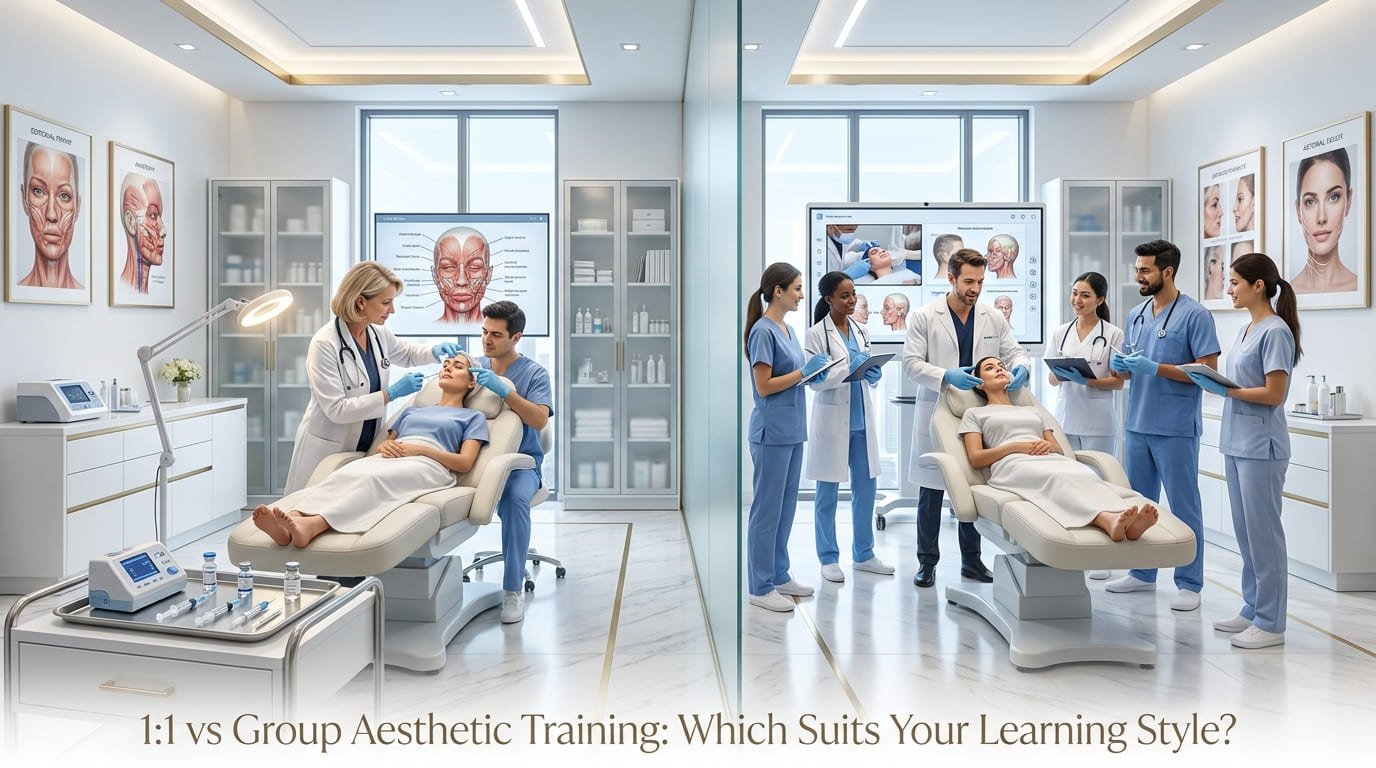
Group aesthetic training courses bring together multiple delegates on the same day to cover the same curriculum. Numbers vary between providers from as few as three or four delegates to as many as ten or twelve. The format typically involves shared theory sessions delivered to the full group followed by practical sessions where delegates rotate through treatment opportunities.
The practical element is where group size matters most and where the difference between a well-run group course and a poorly-run one is most stark. In a small, well-managed group with an experienced trainer, each delegate can still get meaningful hands-on time and individual feedback. In a larger group where the ratio of delegates to trainer is too wide, practical time becomes limited, and the quality of individual supervision drops significantly.
Group training has real advantages that are worth taking seriously. The peer environment creates a dynamic that solo training cannot replicate. Watching another delegate attempt a technique and receiving feedback from the trainer is a form of learning in itself. You observe errors you might not have made yourself. You hear questions you had not thought to ask. You see how the same technique looks different across different patients with different tissue characteristics.
The shared environment also normalises the experience of being a new practitioner in a way that one-to-one training sometimes does not. Knowing that the person next to you is also nervous, also making small errors, also asking basic questions removes a layer of self-consciousness that can inhibit learning in some trainees.
Cost is another practical reality of group training. Shared trainer time across a group of delegates means group courses are typically more affordable than one-to-one alternatives. For practitioners who are funding their own training and building toward a career in aesthetics, this matters.
What 1:1 Training Actually Looks Like
One-to-one aesthetic training is exactly what it sounds like. The entire training day is built around a single delegate and a single trainer. Every theory explanation, every practical demonstration, every injection attempt, and every piece of feedback is directed exclusively at you.
The most significant difference is the volume and quality of hands-on time. In a one-to-one environment, you are not waiting for other delegates to complete their turns. Every patient or model who attends the session is treated by you, supervised by your trainer in real time, with immediate feedback on each injection point, each technique adjustment, and each patient communication exchange.
For treatments that require a high volume of repetition to develop genuine neuromuscular confidence, such as lip filler or anti-wrinkle injections, the additional hands-on time in a one-to-one format can make a meaningful difference to how quickly a new practitioner reaches a standard of genuine clinical readiness.
The pace of a one-to-one session also adapts to the individual. If you need more time on a particular technique, the session accommodates that. If you move through a skill faster than average, the trainer can introduce additional complexity or volume within the same day rather than moving at a predetermined group pace. This responsiveness is one of the most consistently cited advantages by practitioners who have experienced both formats.
One-to-one training suits practitioners who have specific areas of uncertainty they want to work through in depth without the social pressure of a group environment. It also suits those who are returning to aesthetics after a break, retraining in a specific area after identifying a gap, or who have an unusual clinical background that means standard group pacing does not match where they are starting from.
The honest limitation of one-to-one training is the absence of the peer dynamic that group training naturally provides. The different perspectives, questions, and learning moments that come from training alongside other practitioners are genuinely valuable, and one-to-one training does not replicate them. For some people this is irrelevant. For others, particularly those who thrive in collaborative environments, it is worth factoring in.
How to Think About Which Format Suits You
Framing this as purely a learning style question is too narrow. There are several practical dimensions worth thinking through alongside the question of how you prefer to absorb information.
Your starting point matters. If you are completely new to injectable aesthetics and have limited prior exposure to clinical environments where fine motor skills and needle technique are involved, one-to-one training gives you more time per skill, more immediate correction, and less social pressure as you develop technique that is still rough. If you already have some clinical hand skill from a related background and are primarily building on an existing foundation, a well-run group course may provide perfectly adequate hands-on time while adding the peer dimension.
The treatment you are training in matters. Some treatments are more technique-dependent and require higher repetition volumes to develop genuine confidence. Others have a simpler technique component where the clinical knowledge and patient assessment skills are more important than the physical repetition. Knowing which category your training falls into influences how much hands-on time actually affects the outcome.
The trainer and the group size matter more than the format label. A one-to-one session with an inexperienced trainer yields less than a well-run small-group course with an expert trainer. A group course with six delegates supervised by a single trainer who cannot give each person meaningful attention delivers less than either. Asking about trainer experience, trainer-to-delegate ratios, and the number of patients or models provided is more important than asking whether the course is labelled group or one-to-one.
What to Ask Before Booking Either Format
The questions that separate a genuinely good training experience from a disappointing one are rarely the ones that appear in course brochures.
Ask how many delegates attend the course if it is a group format and what the maximum number is. Ask how many patients or models are provided and how hands-on time is divided across the group.
Ask about the trainer's background and clinical experience. A trainer with years of real-world patient treatment brings a different quality of practical insight than one who moved quickly from training to teaching without extensive clinical practice between them.
Ask what happens after the course. Post-training support, the ability to ask questions when you are treating your first real patients, and access to mentorship during the early months of practice are things that affect your development long after the training day is finished. The value of a provider who offers genuine ongoing support is significantly higher than one who considers the relationship complete when you receive your certificate.
Ask whether the course includes complications management as a distinct and meaningfully covered element. This is non-negotiable in any quality aesthetic training, and its absence from a course is a serious red flag regardless of the format.
The Angel White Aesthetics Approach
At Angel White Aesthetics, both training formats are available because both serve different practitioners at different stages of their development. Dr Irina Prikulis brings over fourteen years of clinical aesthetic experience to every training course, which means the insight delegates receive comes from thousands of real patient treatments rather than a teaching background alone.
Group courses are kept deliberately small to ensure the hands-on time and individual attention that makes training meaningful rather than just certificated. One-to-one courses are structured to give maximum practical repetition and the kind of honest, responsive feedback that builds real confidence rather than just completing a checklist.
The conversation about which format suits you is one we are happy to have before you book. There is no single right answer for everyone, and we would rather help you make the right choice than push you toward either option for commercial reasons.
Frequently Asked Questions
Can I switch from group to one-to-one if I feel I need more support after completing a group course?
Yes. Completing a group foundation course and then following it with a one-to-one session focused on a specific technique or area is a common and effective approach. The two formats complement each other well when used in sequence.
Does one-to-one training cost significantly more than group training?
Yes, in most cases. The full trainer time being dedicated to a single delegate is reflected in the course price. Whether the additional cost represents value depends on your specific situation and what you need from the training experience.
Is one format more recognised or respected than the other by insurance providers?
No. The format of training is not what insurance providers assess. They look at the qualification, the course accreditation, and the scope of your clinical background. Both formats produce the same certificate from Angel White Aesthetics and carry the same accreditation.
I am anxious about training in front of other people. Should I automatically choose one-to-one?
Anxiety about training in a group is very common among new practitioners. It is worth considering whether that anxiety would limit your learning meaningfully before assuming one-to-one is automatically better. Some people find the group environment actually reduces anxiety because it normalises the experience of being a learner among peers.
What if I have specific techniques I want to focus on rather than a standard course curriculum?
One-to-one training is much better suited to bespoke learning objectives. A tailored one-to-one session can be structured around your specific needs in a way that a group course following a fixed curriculum cannot.
If you are trying to decide between training formats and want to talk it through before committing to anything, get in touch with the Angel White Aesthetics training team. We will ask the right questions and help you choose based on what actually suits your situation.
Explore Training Courses or Get in Touch With the Training Team