Written by Dr Irina Prikulis, founder of Angel White Aesthetics, with over 14 years of clinical aesthetic practice across Littlehampton and Hove.
The aesthetic training market has grown significantly in Sussex and across the South East over the past decade. The number of training providers offering injectable and skin treatment courses within a reasonable travelling distance of Brighton, Worthing, Chichester, and the surrounding areas has increased substantially, which is genuinely good for access. More options means more practitioners can train locally rather than travelling to London.
What has not grown at the same rate as the number of providers is the consistent quality of what those courses actually deliver. The most meaningful difference between training programmes that produce competent, confident practitioners and those that produce practitioners with a certificate and persistent uncertainty about their clinical skills comes down to one thing more than any other.
It is the quality and quantity of in-person supervised practice.
Why Aesthetic Training Cannot Be Learned Online
The rise of online education has been genuinely valuable for a wide range of professional and clinical training. Anatomy lectures, pharmacology modules, consultation frameworks, and medical knowledge can all be delivered effectively through video and written materials. A motivated practitioner can build substantial theoretical knowledge from a well-designed online resource.
Injectable aesthetic technique cannot be learned this way. Not meaningfully. Not at the level that produces safe, consistent clinical results.
The reason is specific and worth understanding rather than accepting as a vague assertion. Injectable technique involves a combination of skills that are built through physical repetition rather than intellectual understanding. The depth at which a needle sits in tissue is not something you can calibrate by watching a video. The pressure needed to express a consistent volume of product across multiple injection points is not something you develop by passing a theory assessment. The tactile feedback that tells an experienced injector whether they are in the correct tissue plane, approaching a vessel, or placing product where it is intended to go is absent from any remote learning format.
These are not subtle skills. They are the core of what makes the difference between a result that is safe and natural and one that is not. A practitioner who has extensive theoretical knowledge and limited hands-on experience is carrying a knowledge gap at exactly the level that matters most in clinical practice.
This is why the in-person supervised practice element of a training course is not a nice addition to the theoretical content. It is the component that actually builds the clinical capability the course is supposed to produce.
What In-Person Supervised Practice Actually Involves
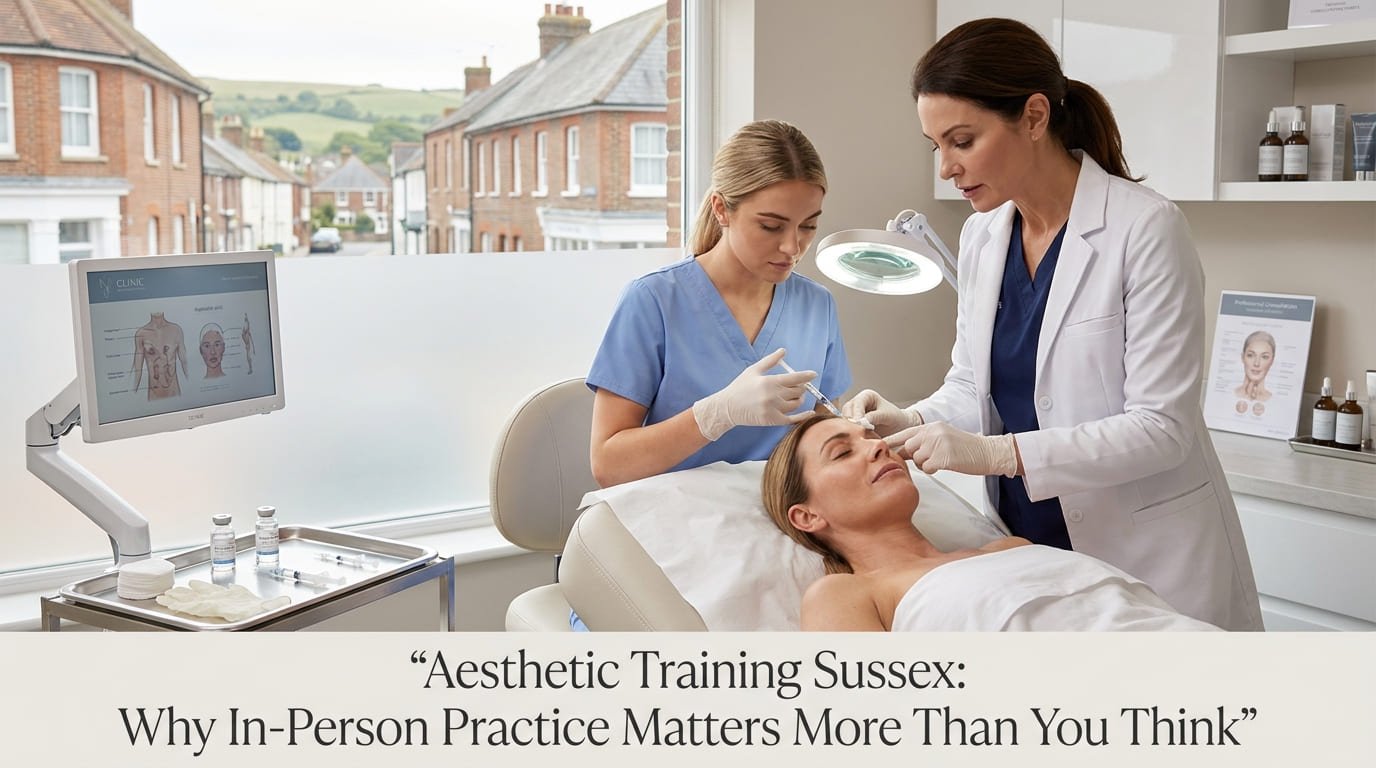
Supervised practice in aesthetic training means a qualified, experienced practitioner watching your injection technique in real time and providing feedback that is specific, immediate, and actionable.
It means observing the angle at which you are approaching the tissue and correcting it before it becomes a fixed incorrect habit. It means watching the depth of needle placement across multiple injection points and identifying when you are too superficial in one area and too deep in another. It means seeing the patient's skin response in real time and teaching you to read what that response tells you about where the product is going.
It means asking you to explain why you are placing the next injection where you are planning to place it and ensuring that the clinical reasoning behind the technique decision is as developed as the physical technique itself. A practitioner who can inject correctly but cannot explain why they are making each clinical decision cannot adapt when a patient presents outside the template they were trained on.
Good supervision also means being corrected when your assessment of the patient's anatomy leads to a treatment plan that is not appropriate for what the face actually shows. This is a more advanced supervisory skill than technique correction and requires a trainer whose clinical experience extends significantly beyond the training context.
What in-person supervision cannot be replaced by is an instructor watching a video of your technique after the fact, a peer review process where other trainees assess each other's work, or a written case study submission. These methods have their place in the broader educational structure of a training programme, but none of them provide what immediate, real-time supervision from an expert provides.
Why Location Matters for Training Quality
Training locally in Sussex matters for reasons beyond convenience. When the training provider you choose is also a practising clinical operation in the same county, several things become true that are not true when you train with a large national provider whose training arm operates independently from any active clinical practice.
The trainer's clinical knowledge is current and locally grounded. At Angel White Aesthetics, the training delivered by Dr Irina Prikulis reflects the clinical reality of treating patients in West Sussex and the Brighton and Hove area daily. The questions that practitioners in this region encounter, the patient presentations they see, and the clinical situations they navigate are familiar to the trainer not because they have studied them but because they are managing them in practice now.
Post-course support is more accessible when your trainer is geographically close. The questions that arise in the first months of independent practice are more easily addressed when your trainer is a phone call away rather than an online submission to a customer service team. A clinical question about a patient presentation you are uncertain about is answered by someone who has seen that presentation before, not by a standard response generated from FAQ documentation.
The training environment reflects real clinical conditions. Courses delivered in a functioning aesthetic clinic rather than a rented conference room give practitioners an accurate picture of the clinical setting they will be working in independently. The equipment layout, the patient communication environment, the documentation process, and the post-treatment protocol are all elements that training in a real clinic normalises before you encounter them in your own practice.
Local training also builds a professional network within the region that supports early practice in ways that national training programmes do not facilitate. Connections with other practitioners in Sussex who trained at the same academy, who share knowledge about the local patient market, and who can discuss clinical questions with each other from a shared reference point are a genuine early-career resource.
The Sussex Aesthetic Training Market: What to Know Before You Choose
Sussex has enough training providers that choosing between them requires more than comparing price and availability. The questions worth asking before booking with any provider in the county are the ones that reveal the quality of the supervised practice component rather than the attractiveness of the marketing.
Ask how many delegates attend each course session. A foundation course with two or three delegates sharing a trainer provides a fundamentally different experience from one with eight to ten. The practical time available to each individual delegate and the quality of the supervision they receive is directly related to the ratio of trainees to trainer. Ask this question specifically and confirm it before you book rather than discovering the answer when you arrive.
Ask how many live patient treatments each delegate performs during the course. A single demonstration on one patient model is not adequate clinical practice for a foundation course. Multiple treatment opportunities across patients with different anatomical presentations, different skin types, and different procedural responses are the minimum for genuinely useful supervised practice.
Ask about the trainer's clinical background. How long have they been practising aesthetics? How recently and how actively are they treating patients? What is the range of their clinical experience, and does it extend into the areas being taught on the course? The quality of supervision available to you during training is bounded by the depth of the trainer's own clinical experience, and a trainer who moved quickly from training to teaching without sustained clinical practice cannot provide the same quality of insight as one who has spent years in active clinical work.
Ask about complications management. A course that does not specifically cover vascular occlusion recognition and management, hyaluronidase administration, and the emergency protocol for a serious adverse event is not preparing you for the full clinical reality of injectable practice. This is not advanced knowledge that belongs only in specialist training. It is foundational safety knowledge that every injectable practitioner needs from the beginning.
Ask about post-course support. What happens when you are in your first weeks of independent practice, and you encounter a patient situation you are not sure how to handle? Is your trainer accessible? Is there a mechanism for asking clinical questions and receiving a genuine clinical answer rather than a reference to course materials?
What Angel White Aesthetics Offers Practitioners in Sussex
Angel White Aesthetics operates its training academy from the Littlehampton clinic base, with selected courses available in Hove, covering both the Littlehampton and Brighton and Hove markets within West Sussex and East Sussex respectively.
The training programme spans foundation and advanced injectable courses, chemical peel training, fat dissolving training, biorevitalisation training, complications management, hyaluronidase training, and first aid in aesthetics. Each course is delivered with the same standard of supervised practice that the clinical reputation of the academy has been built on.
Training at Angel White is delivered by Dr Irina Prikulis personally. The clinical experience that informs that training spans fourteen years of active aesthetic practice across the full range of treatments offered, including the more advanced and specialist procedures that many other Sussex training providers do not offer at all. The teaching reflects what real clinical practice in this region actually involves rather than a theoretical curriculum assembled from generic training materials.
Course numbers are deliberately kept small. This is a commercial decision that limits the volume of trainees who can be taken through each course and therefore the revenue the academy can generate at any given time. It is also the decision that most directly determines the quality of supervision each delegate receives. Both-or-neither is not an option. Small group sizes and meaningful individual supervised practice go together. Large groups and meaningful individual supervised practice do not.
Post-course support from Angel White is not a marketing claim. It is a clinical commitment that reflects the understanding that the training day is the beginning of a practitioner's development rather than its conclusion. Questions that arise in the months following a course are met with genuine clinical responses from a trainer who knows both the course content and the clinical realities that produce those questions.
The In-Person Practice Question Applied to Online and Hybrid Courses
A growing number of aesthetic training providers offer hybrid or partially online training formats where the theoretical content is delivered remotely, and the practical element is condensed into a shorter in-person day. These formats are worth evaluating critically before committing to them.
The theoretical content delivered online is the element of training that this format handles most successfully. Anatomy, pharmacology, consultation frameworks, and clinical protocols can all be covered effectively through well-produced online material and most practitioners can engage with this content productively in their own time.
The practical element compressed into a shorter in-person day is where the hybrid format most commonly falls short. If the full training day format already risks providing insufficient supervised practice time when all of it is in-person, a shorter practical component within a hybrid model carries an even higher risk of leaving practitioners underprepared for independent clinical work.
The appropriate question to ask of any hybrid or partially online format is the same as for any other course. How many live patient treatments does each delegate perform under direct supervision? What is the trainer-to-delegate ratio during the practical component? What post-course support is available when clinical questions arise after the compressed practical day is complete?
A hybrid format that answers these questions satisfactorily may provide genuinely adequate preparation. A hybrid format whose answers reveal that the in-person component is too short or too crowded to provide meaningful individual supervision is not an adequate preparation for independent clinical practice regardless of how comprehensive the online theoretical content is.
Making the Right Training Decision for Your Stage of Practice
The right training course in Sussex for any individual practitioner depends on several intersecting factors. Your professional background and what clinical foundation you are bringing to training. The specific treatments you want to learn and the order that makes clinical sense for your intended practice. Your budget and the realistic financial return timeline of aesthetic practice. Your learning style and whether a one-to-one format or a well-run small group format is more likely to help you develop clinical confidence quickly.
What remains constant across all of these variables is the importance of in-person supervised practice. Whatever format, whatever provider, whatever course level, the single most important question to ask is what supervised live patient treatment looks like for each individual delegate and whether the honest answer to that question is sufficient to build the clinical capability the course claims to produce.
Training is an investment. The return on that investment is not the certificate at the end of the course day. It is the clinical confidence, the technique quality, and the patient safety standards that the training actually built. Those things come from supervision. From real patients. From a trainer who sees what you are doing and tells you specifically how to do it better. From practice that is repeated enough times to become reliable rather than performed once and recorded as complete.
In-person supervised practice in aesthetic training is not a feature of the course. It is the course. Everything else is preparation for it or support after it.
Frequently Asked Questions
Can I train at Angel White Aesthetics if I am based in Brighton or further along the coast?
Yes. The Littlehampton clinic is accessible from Brighton, Worthing, Bognor Regis, Chichester, and surrounding areas. Courses are also available at the Hove clinic. Travel time from Brighton to Littlehampton is typically thirty to forty minutes by car or train, which most practitioners from the Brighton and Hove area find manageable for a training day.
Are Angel White training courses accredited?
Yes. Accreditation details are available on the individual course pages and can be confirmed before booking. Confirming that your insurance provider recognises the accreditation of any course you are considering is the practical verification step worth taking before you commit.
Can I observe a treatment session before committing to training?
This is worth discussing directly with the training team. Observing a treatment in a clinical setting involves patient consent and clinic scheduling considerations. The training team can advise on what is possible and appropriate in response to a specific request.
Is foundation training a prerequisite for all other courses?
Foundation injectable training is the appropriate prerequisite for advanced filler training and forms a natural foundation for other injectable specialist courses. Non-injectable courses, including chemical peel training and biorevitalisation training, have their own entry requirements that are described in the individual course information.
What is the approximate total investment in a complete aesthetic training pathway?
This varies significantly depending on which courses are included, whether one-to-one or group formats are chosen, and the sequencing of the training over time. The training team can provide specific pricing for each course and discuss realistic programme planning for different professional starting points and budget frameworks.
If you are a healthcare professional in Sussex considering aesthetic training and want to discuss which courses are most appropriate for your background and goals, contact the Angel White Aesthetics training team before you book anywhere. An honest conversation about what the right programme looks like for your specific situation is always the best starting point.
Explore the Training Programme or Contact the Training Team at Angel White Aesthetics, 19 Beach Road, Littlehampton, West Sussex, BN17 5JA. Telephone: 01903 446063