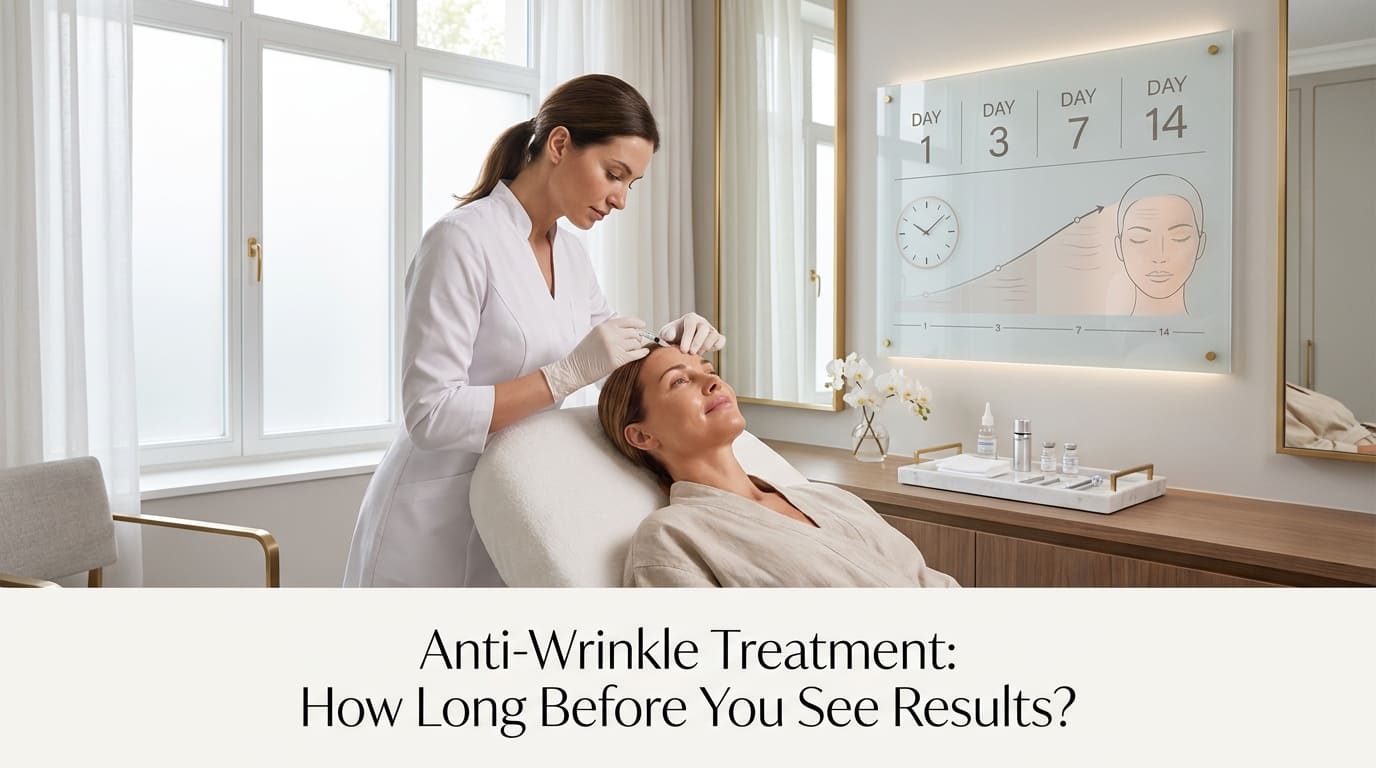
This is one of the most common questions asked before and after anti-wrinkle injections. You have had the treatment done. You look in the mirror the next morning. Nothing has changed. You start wondering whether it worked.
It has almost certainly worked. It just has not kicked in yet.
Anti-wrinkle injections do not work the same day. They do not even work the next day in most cases. The timeline surprises a lot of people, particularly those having treatment for the first time, and understanding it properly changes the whole experience.
Here is exactly what to expect and when.
How Anti-Wrinkle Injections Actually Work
Before getting into the timeline, it helps to understand the basic mechanism because the timeline makes much more sense once you do.
Anti-wrinkle injections work by temporarily blocking the signals between nerves and the muscles underneath the skin. When those muscles cannot contract as strongly as they normally would, the overlying skin stops creasing in the same way. Lines that come from repeated movement, such as frown lines, forehead lines, and crow's feet, gradually soften and become less visible.
This process is not instant. The nerve-blocking effect builds gradually over a number of days as the treatment takes hold in the muscle tissue. That is why results are not visible immediately and why patience in the first two weeks matters more than most people expect.
Day 1 and 2: Nothing Visible Yet
Most people see no change at all in the first 24 to 48 hours. This is completely normal.
The injection sites themselves may feel slightly tender. There may be small red marks or minor bruising at the treatment points. These typically fade within a day or two and have nothing to do with whether the treatment is working.
Some people notice a very faint sense of heaviness in the treated area in the first couple of days. This is an early sign the treatment is beginning to take effect. It is not discomfort that needs attention, just something worth knowing about so it does not feel unexpected.
Do not try to assess your result on day one or day two. There is genuinely nothing to assess yet.
Day 3 and 4: The First Signs of Movement Change
Around day three or four, most people start to notice something shifting.
The muscle does not feel quite as responsive as it normally does. If you try to make a strong frowning expression or raise your eyebrows dramatically, there is a slight resistance that was not there before. The skin above those muscles may look marginally smoother when you make those expressions.
This is the treatment beginning to work. It is subtle at this stage. The full effect has not come through yet, but the process has started.
Some people feel a mild sense of tightness or a light pressure in the treated area during this phase. This is completely normal and settles on its own.
Day 5 and 7: Noticeably Different
By the end of the first week, most people can clearly see a difference.
Movement in the treated area is visibly reduced. Frown lines look softer. Forehead lines are less deep when you make expressions. Crow's feet around the eyes are less pronounced. The skin overlying those muscles has had less opportunity to crease repeatedly, and it shows.
This is when most people first feel genuinely happy with their result, particularly if they went in with realistic expectations about what anti-wrinkle treatment can and cannot do.
It is worth noting that at this stage the result is still not fully settled. There is more improvement to come.
Day 10 to 14: The Full Result Emerges
The complete effect of anti-wrinkle injections is usually visible between 10 and 14 days after treatment.
By this point, the nerve-blocking effect has fully established itself in the muscle tissue. The reduction in movement is at its most complete. Lines that appear when you make expressions are at their softest. Depending on the depth and type of lines being treated, static lines (lines visible even without making an expression) may also appear lighter as the skin has had time to stop being repeatedly folded.
This two-week mark is the right time to assess whether you are happy with your result properly. It is also the appropriate time to contact your practitioner if you feel one area has not responded as well as others. Small adjustments, where needed, are much better assessed at this stage than at day three when the treatment is still settling.
Week 3 and 4: Result at Full Strength
By weeks three and four, your result is fully established and at its strongest.
This is what your anti-wrinkle treatment looks like at its best. Most people feel very natural at this stage. The muscle has enough relaxation to prevent the lines forming but enough residual movement to look completely normal, not frozen.
This full-strength phase is what you are maintaining during the life of the treatment. Enjoying this period without comparing it to day one is the best approach.
Months 2 and 3: Results Still Holding
Anti-wrinkle treatment typically lasts between three and six months, though this varies significantly between individuals.
During month two and into month three, the result generally holds well for most people. The nerve signal blocking remains effective. Lines stay soft. The difference from your baseline is still very clear.
Some people find results begin to soften slightly towards the end of month three. Others find their treatment holds strongly right through to month four or even beyond. There is no single universal timeline, and the variation between individuals is completely normal.
Month 4 Onwards: Movement Gradually Returns
As the treatment begins to wear off, nerve signals slowly start getting through to the muscle again.
The return of movement is gradual rather than sudden. You will not wake up one day and feel like it has completely gone. It creeps back over a period of weeks. Lines that had softened become slightly more visible again. Expressions become gradually more animated.
Most practitioners suggest booking a repeat treatment somewhere between three and six months after your first, depending on how quickly your metabolism processes the product and how long your results tend to hold. Over time and with regular maintenance treatments, many people find their lines become less deep between sessions because the muscle has had extended periods of reduced activity.
Why Some People See Results Later Than Others
Not everyone reaches the two-week point at the same pace. Several factors genuinely influence how quickly results appear and how strongly they show.
Muscle strength and thickness matter. People with very strong or well-developed facial muscles may need a little longer to see the full effect because more muscle tissue is involved in the response.
Metabolism plays a role. People with faster metabolisms tend to process the product a little quicker. They may see results appear and then fade slightly sooner than average.
The dose used influences the timeline. A more conservative dose may take a little longer to fully show its effect.
The area being treated makes a difference. Some areas of the face respond slightly faster than others based on the muscle groups involved.
First-time patients sometimes have a slightly different response to their first treatment compared to subsequent ones. This is also completely normal.
What to Avoid in the First 24 to 48 Hours
The first couple of days after treatment are when the product is settling into the muscle tissue. A few things are worth avoiding during this window.
Avoid lying down flat or bending over for at least four hours after treatment. Staying upright helps the product settle precisely where it was placed.
Avoid touching, rubbing, or massaging the treated areas. Pressure on the injection sites in the first few hours can affect placement.
Avoid intense exercise for 24 hours. Increased blood flow and raised body temperature during this period can affect how the product distributes.
Avoid alcohol for at least 24 hours. Alcohol affects circulation and can increase the likelihood of bruising.
Avoid saunas, steam rooms, and hot baths on the day of treatment.
Avoid any other facial treatments or facial massage until the two-week settling period is complete.
When Results Do Not Meet Expectations
Occasionally, people feel their results are not quite what they hoped for. This is worth addressing calmly and with the right timing.
If at two weeks you feel one area has responded less strongly than another, this is worth mentioning at a review appointment. Small adjustments are possible and are a normal part of the treatment process for some patients.
If after four weeks you feel there has been very little response at all, this is also worth discussing. A complete non-response is rare but does occasionally happen and is something your practitioner will want to know about.
Never assess results before the two-week mark. The treatment simply has not finished working at that point and drawing conclusions too early leads to unnecessary concern.
How Long Do Results Last for Most People
The honest answer is that three to six months covers the realistic range for most people.
First-time patients are often at the shorter end of this range, with results lasting around three to four months. With regular maintenance over time, many people find results last progressively longer as the muscles respond to sustained periods of reduced activity.
Lifestyle factors also influence longevity. High sun exposure, smoking, and significant physical stress all affect how the body processes the product over time.
Frequently Asked Questions
Can I speed up the process so results show faster?
No, and it is not worth trying. The timeline is determined by how the body responds to the treatment at a cellular level. There is no aftercare technique that meaningfully accelerates it.
What if my result looks uneven at day seven?
Wait until day fourteen before drawing any conclusions. Uneven results before the two-week mark are almost always a result of the treatment still settling rather than a permanent outcome.
Will I look frozen or expressionless?
A well-dosed treatment from a skilled practitioner should leave you looking natural and refreshed, not expressionless. The goal is softened movement, not eliminated movement.
Is it normal to feel nothing in the treated area at all?
A mild sense of reduced responsiveness in the muscle is common and expected. Numbness of the skin surface itself is not a typical result of anti-wrinkle treatment and worth mentioning to your practitioner if it occurs.
Can I have anti-wrinkle treatment and lip filler at the same appointment?
In many cases, yes, depending on the areas being treated and your practitioner's assessment. This is best confirmed at consultation.
How do I know when to book my next appointment?
When you notice movement returning noticeably and lines beginning to reappear, that is generally the right time. Most people find a rhythm after their first two or three treatments and start to recognise their own pattern.
Thinking about booking anti-wrinkle treatment or want to talk through your concerns before committing? We offer consultations across our Littlehampton and Hove clinics and are happy to answer any questions before your first appointment.
Book a Consultation in Littlehampton or Book a Consultation in Hove