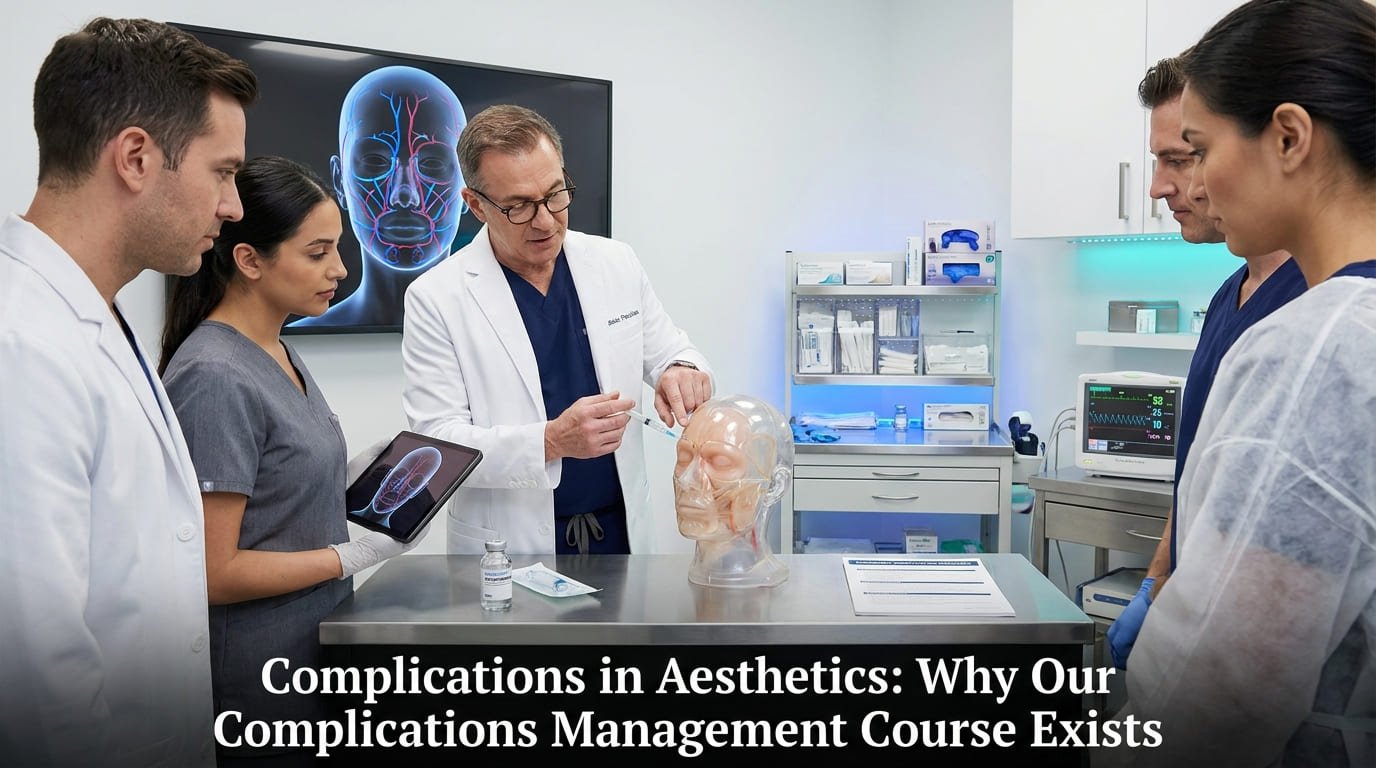
Every practitioner who trains in aesthetic injectables learns the techniques. They learn how to place filler, how to dose anti-wrinkle treatment, how to assess a patient and plan a result. That knowledge is the foundation of the work.
What is covered far less consistently across the industry is how to handle situations when something goes wrong.
Complications in aesthetic practice are not common. The vast majority of treatments are completed without incident, and patients leave happy. But the treatments being performed involve needles, prescription medicines, and facial anatomy that includes named arteries sitting in very close proximity to the injection points used in everyday aesthetic work. The possibility of a complication is never zero. And the gap between a complication that resolves without lasting harm and one that causes permanent damage is often a matter of whether the practitioner in the room knew what they were looking at and what to do about it in the first few minutes.
That gap is exactly why this course exists.
The Industry Problem This Course Is Responding To
Foundation aesthetic training courses teach technique. The best ones also cover complications as part of the curriculum. But coverage of complications in a foundation course is, by necessity, relatively brief. There is a lot of ground to cover in a foundation programme, and the primary focus is on teaching practitioners how to perform treatments safely in normal circumstances.
The problem is that knowing how to avoid a complication and knowing how to manage one are two different skill sets. A practitioner can follow every correct technique protocol and still encounter a vascular occlusion. They can take a thorough medical history and still have a patient experience an unexpected adverse reaction. The variables in clinical practice are too numerous for technique alone to guarantee an uncomplicated outcome every time.
What protects patients in those moments is not the technique the practitioner used. It is the practitioner's ability to recognise what they are seeing, respond immediately and correctly, and manage the situation with the clinical confidence that comes from having trained specifically for this scenario rather than encountering it for the first time in a live clinical setting.
That is the skill set a dedicated complications management course exists to build.
What Vascular Occlusion Actually Means and Why It Demands Specific Training
Vascular occlusion is the complication that drives the most urgent case for dedicated complications training. It occurs when dermal filler is accidentally injected into a facial blood vessel or applies enough pressure to compress one, cutting off the blood supply to the tissue it feeds. The tissue downstream begins to be deprived of oxygen immediately.
The clinical window for intervention is narrow. Early recognition and immediate treatment with hyaluronidase gives the best chance of restoring blood flow before irreversible tissue damage occurs. Delayed recognition or delayed treatment dramatically worsens outcomes.
The early signs of vascular occlusion are specific. Skin that blanches suddenly to white at or near the injection site. A mottled or dusky discolouration that follows a vascular pattern rather than spreading evenly as bruising does. Pain that is disproportionate to what the injection itself would normally cause. In cases involving vessels that supply the eye, visual disturbances that require emergency referral.
Knowing these signs intellectually from reading about them is different from having trained to recognise them under conditions that simulate the pressure of a real clinical scenario. Practitioners who have specifically trained in complication recognition respond faster and more accurately than those who have only read about it. In a vascular event, that difference in response time matters clinically.
The complications management course covers vascular occlusion in specific, clinical detail. The anatomy of the facial vasculature that makes certain injection zones higher risk than others. The products and techniques associated with higher occlusion risk and why. The recognition of early and late-stage signs. The immediate management protocol using hyaluronidase. The escalation pathway when emergency referral is required.
Beyond Vascular Occlusion: The Full Landscape of Aesthetic Complications
Vascular occlusion is the most acute complication in aesthetic practice, but it is not the only one that requires specific training to manage well. The course covers the full range of complications encountered in clinical aesthetic work.
Infection following injectable treatment ranges from minor localised reactions to more serious presentations including abscess formation and, in rare cases, chronic biofilm infections, difficult to diagnose and requiring specific management pathways. Recognising an infection early, understanding the difference between normal post-treatment swelling and early infection, and knowing when to prescribe, refer, or escalate are all part of competent practice.
Filler migration and nodule formation are among the most common longer-term complications practitioners encounter. Understanding why migration occurs, which areas and products carry higher risk, and how to manage established migration, including appropriate use of hyaluronidase, is a practical and regularly relevant skill.
Tyndall effect, which is the bluish discolouration that appears when filler is placed too superficially, is a complication that practitioners encounter in their own patients and in patients presenting from other practitioners. Managing it correctly requires understanding the cause and applying the appropriate treatment response rather than an instinctive but incorrect approach.
Delayed hypersensitivity reactions to filler can occur weeks or months after treatment and are often misunderstood by both patients and practitioners who are not specifically trained to recognise them. They require a different management approach from immediate post-treatment swelling and are missed or mismanaged when the practitioner does not know what they are looking for.
Herpes simplex reactivation triggered by lip filler or any lip area treatment is a complication every practitioner working in the facial area will encounter at some point. The identification and treatment pathway is straightforward when you know it and easily missed when you do not.
The course addresses each of these systematically, with the emphasis on what the practitioner actually does in the room, not just what the complication is called.
Who This Course Is For
The complications management course is designed for practising aesthetic practitioners at any stage of their career, not just those who are newly qualified.
New practitioners completing foundation training have the most immediate need for dedicated complications training because their clinical experience is limited and the early months of practice are when unfamiliar situations feel most challenging. Completing complications management training shortly after foundation qualification, before independent patient caseloads build significantly, is the approach that best protects both patients and practitioners during the most vulnerable phase of a new aesthetic career.
Experienced practitioners who have not undertaken dedicated complications training at any point in their career also belong on this course. Length of practice without a complication is not evidence that complications training is unnecessary. It is evidence that you have been fortunate so far and that the absence of a major incident to date has not yet tested the limits of your management capability. That is a reasonable description of most practitioners in the industry because serious complications are genuinely rare. But rare is not the same as impossible.
Practitioners who have had a complication and want to build more structured knowledge around what happened and how to improve their future response also use this course to process a clinical experience in an educational environment with an experienced guide.
Why Experience Level Does Not Replace Dedicated Training
There is a particular pattern of thinking in aesthetics, as in other clinical fields, where years of uneventful practice generate a quiet confidence that complication training is something for beginners. If it has not happened in ten years, it is not going to happen.
This thinking is understandable, and it is wrong.
The practitioners who manage complications most effectively are not those who have encountered the most of them. They are the ones who have trained specifically for scenarios they hope never to face, in a structured environment, with accurate information and the kind of deliberate rehearsal that builds a reliable automatic response under pressure.
Clinical emergencies are not the moment to be working through a management protocol for the first time. They are the moment to draw on training that is already embedded well enough to execute without having to think your way through each step individually.
Dedicating a day to complications management training is not an acknowledgement that your practice is unsafe. It is an acknowledgement that you take your responsibility to the patients in your chair seriously enough to prepare for the full range of what clinical practice can present.
What the Course Delivers in Practice
The complications management course at Angel White Aesthetics covers the clinical content described above alongside practical training in emergency protocols, hyaluronidase administration, and the documentation and escalation pathways that good clinical governance requires.
Dr Irina Prikulis delivers the course drawing on fourteen years of clinical aesthetic experience that includes encountering, managing, and learning from the complications that real clinical practice produces. The teaching is grounded in genuine clinical experience rather than a theoretical framework assembled from reading alone.
Participants leave with a structured management framework for the complications they are most likely to encounter, confidence in their recognition skills, clarity about escalation thresholds, and the kind of procedural rehearsal that makes a fast and correct response possible when a situation demands it.
Frequently Asked Questions
Do I need to have completed foundation training before attending the complications management course?
The course is designed for practitioners already working in or entering aesthetic practice. Foundational knowledge of the treatments being discussed is assumed. If you are pre-foundation and want to understand the right sequencing of training, get in touch and we will advise.
How long does the course take?
Full course details including duration are available on the complications management course page. The content is substantial enough that adequate time for both theory and practical elements is built into the structure.
Will this course satisfy my insurance provider's continuing professional development requirements?
Most specialist aesthetic insurers look favourably on dedicated complications management training as part of a CPD portfolio. Confirming the specific requirements with your insurance provider before booking is the best approach.
Is the course relevant if I only perform anti-wrinkle injections and not filler?
Yes. While vascular occlusion risk is primarily associated with filler, the course covers a range of complications relevant across injectable aesthetic practice. Any practitioner performing facial injectables benefits from dedicated complications training.
Can I book as a small group with colleagues from my practice?
Yes. Group bookings for in-clinic or practice-based complications training are available. Get in touch with the training team to discuss the options.
If you are a practising aesthetic practitioner who has not yet completed dedicated complications management training, or if you want to refresh and structure your knowledge in this area, the Angel White Aesthetics complications management course is the right next step.
View the Complications Management Course or Get in Touch With the Training Team