You have decided you want to train in dermal filler. Maybe you are already working in aesthetics and want to expand your skills. Maybe you are making a career change, and this is your entry point. Either way, the first question most people ask is a very practical one.
What actually happens on the course?
It is a fair question. Foundation filler training courses vary widely between providers. Some are thorough, clinically grounded, and genuinely prepare you to treat real patients confidently. Others pack too much into a single day, skip the anatomy that matters, and send you home with a certificate before you have had enough hands-on time to feel ready.
Knowing what a good foundation filler course actually covers helps you make a better decision about where to train, and helps you know what to expect once you have enrolled.
Here is what is covered on the Angel White Aesthetics foundation filler training course, and why each element is there.
Who the Course Is For
Foundation filler training at this level is designed for medical and healthcare professionals who are new to injectable aesthetics.
This includes nurses, doctors, dentists, and other regulated healthcare practitioners. Prior experience in aesthetics is not required. What is required is a professional background that gives you the clinical foundation the course builds on, because aesthetic training assumes a baseline of anatomy knowledge, patient care experience, and understanding of safe practice.
If you are unsure whether your background qualifies, the entry requirements page covers this in detail.
The Theory Foundation That Comes First
Before anyone picks up a needle, the course covers the clinical knowledge that makes safe practice possible.
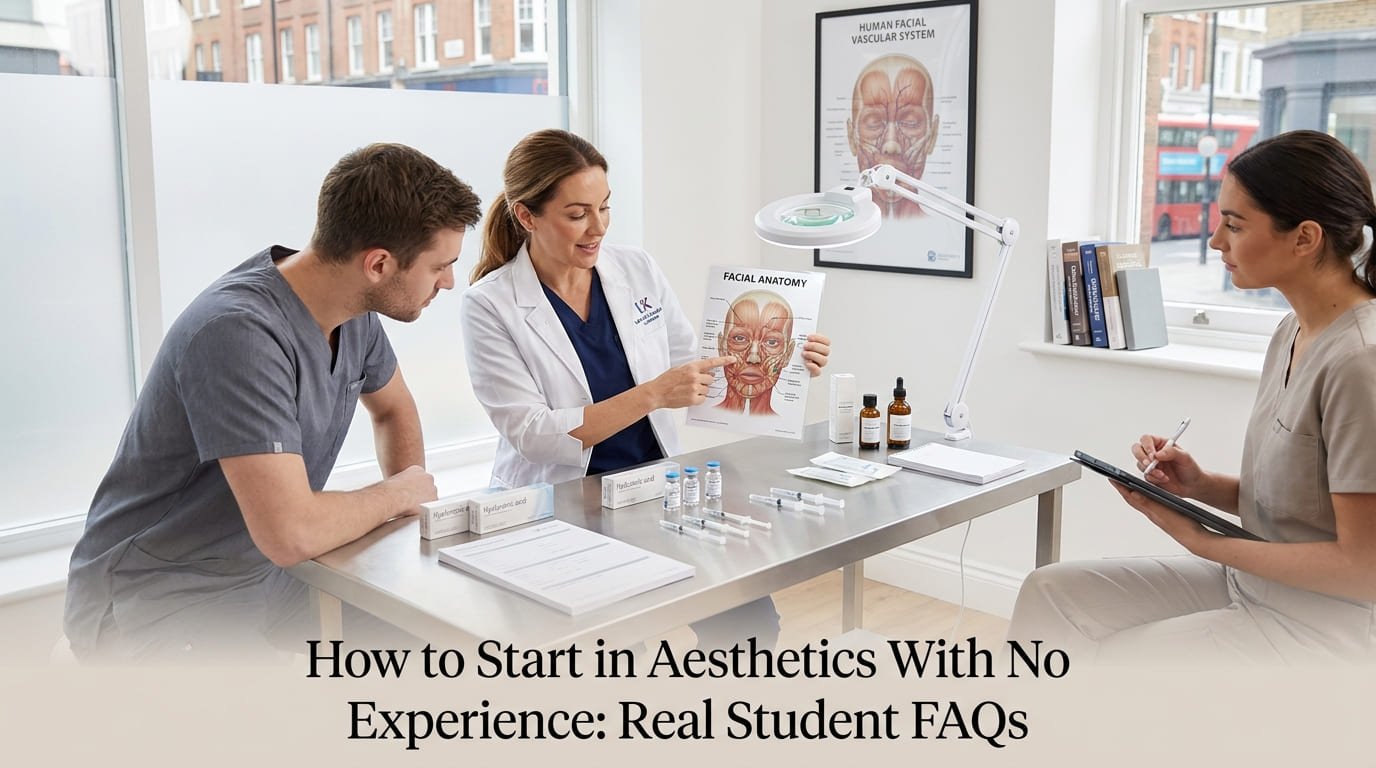
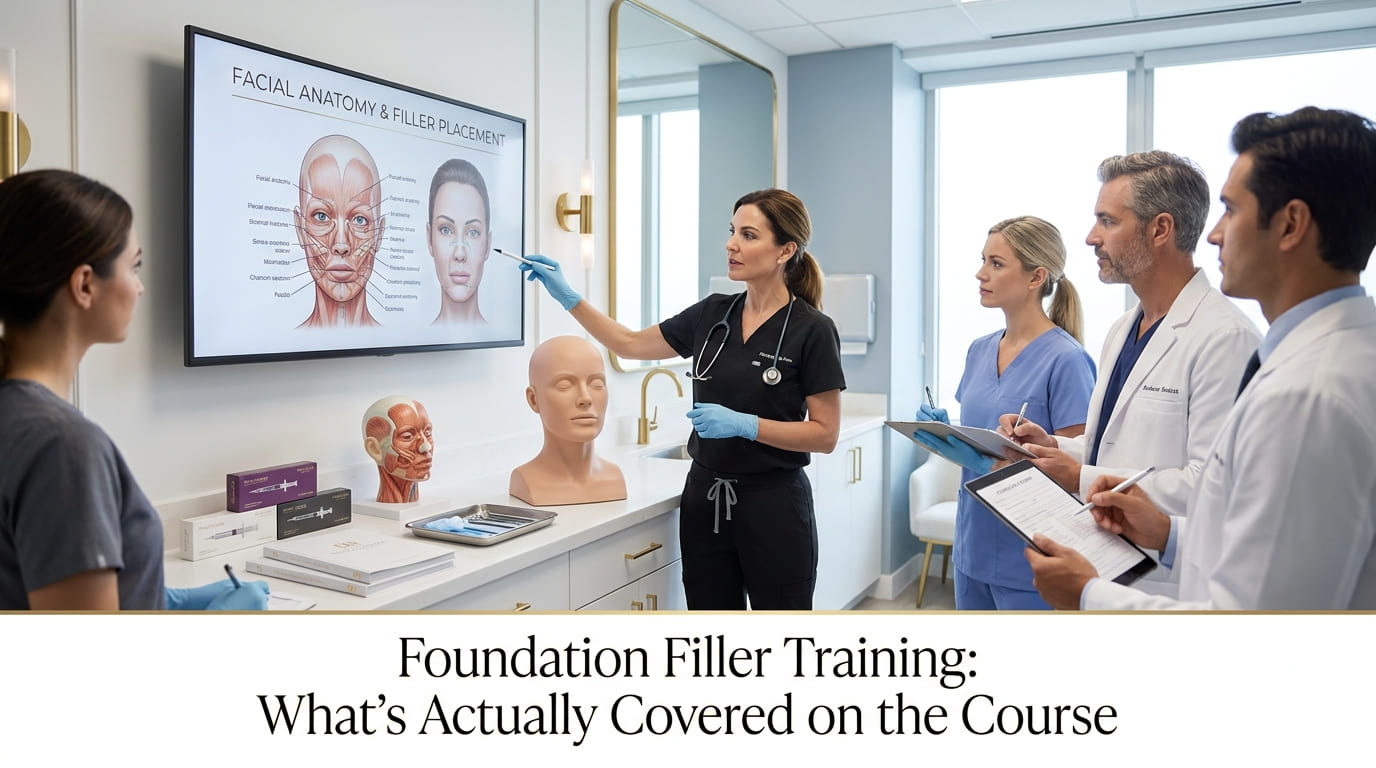
Facial anatomy sits at the centre of this. Understanding the muscle layers, fat compartments, ligaments, and crucially the vascular structures of the face is not optional background knowledge in filler training. It is the difference between a safe treatment and a serious complication. Knowing where the named facial arteries run, where they are most vulnerable to accidental injection, and how to avoid them is a non-negotiable part of learning to inject filler.
The theory section covers this in real depth. You will learn the anatomy relevant to the treatment areas covered on the course. You will learn how different filler products work, how they are classified by their thickness and cross-linking, and why product selection matters for different areas and different patients.
You will also cover consultation theory. This means understanding how to assess a patient properly before treatment, how to identify contraindications that make a particular patient unsuitable, and how to manage patient expectations honestly and realistically. The consultation is where most poor outcomes in aesthetics are actually prevented, and good training reflects that.
Informed Consent and Legal Responsibilities
This section matters more than some training courses acknowledge, and it is covered properly here.
Informed consent in aesthetics is not just a signature on a form. It means your patient genuinely understands what the treatment involves, what the realistic outcomes are, what the risks are, and what happens if something goes wrong. Getting this right protects your patient and protects you professionally.
The course covers the legal and ethical responsibilities that come with performing aesthetic treatments as a healthcare professional. This includes documentation standards, record keeping, photography protocols, and what you are required to have in place before you treat anyone in a professional setting.
Complications: Recognition, Management, and Prevention
This is the section that separates well-designed training from courses that gloss over the difficult parts.
Complications in filler treatment do happen. Most are minor and manageable. Some are serious and require fast, confident action. The most significant complication associated with filler is vascular occlusion, which occurs when filler is accidentally placed in or compresses a blood vessel. Knowing how to recognise the early signs, how to respond immediately, and how to manage the situation is something every practitioner must be trained in before they treat any patient.
The foundation course covers complication recognition and management in a meaningful way. You will learn what the early warning signs of a vascular event look like, what to do in the critical first minutes, and what role hyaluronidase plays in emergency management. You will also learn about less acute but still important complications such as bruising, swelling, infection, asymmetry, and filler migration.
Understanding complications is not about scaring new practitioners. It is about building the kind of clinical confidence that means you never freeze when something unexpected happens.
Hands-On Practical Training
The practical element is what most people are most curious about, and rightly so.
Theory alone does not make a competent injector. You become competent by practising technique under supervision from someone who can watch, guide, and correct what you are doing in real time. This is why the quality of hands-on training matters so much and why course size, supervision ratio, and the experience of the trainer all affect what you actually get from the day.
On the Angel White Aesthetics foundation filler course, practical training is supervised by Dr Irina Prikulis, who brings over fourteen years of clinical aesthetic experience to the teaching. You are not learning from someone who completed their own training recently. You are learning from a practitioner who has treated thousands of patients and encountered the full range of clinical presentations and challenges that come with real-world aesthetics.
The practical element covers the treatment areas included in the course. You will practise needle technique, injection depth, product placement, and how to assess the result as you work. You will also practise the patient communication that surrounds the treatment itself, because how you manage a patient through the appointment is part of the skill, not separate from it.
What Treatment Areas Are Covered
Foundation filler training at this level focuses on the areas appropriate for a new injector building their foundational skills. These typically include the lips and the nasolabial folds, which are among the most commonly requested treatments and the most important to master early.
More advanced areas such as cheeks, temples, jawline, and tear troughs are generally covered at an intermediate or advanced level once the foundational technique is secure. Starting with areas well suited to developing your precision and patient management skills is the right clinical approach.
What You Leave With
By the end of the course, you will have covered the theory, the consultation framework, the complication management knowledge, and the practical injection experience needed to begin treating patients in a supervised and appropriately insured setting.
You will receive a certificate of completion. You will also have access to ongoing support from Angel White Aesthetics as you move into your early practice. The learning does not stop when you walk out of the training room. Questions come up when you are face-to-face with a real patient for the first time, and knowing you have a clinical mentor you can reach is genuinely valuable in those early months.
What Good Foundation Training Sets You Up For
Completing a foundation filler course is a starting point, not a destination.
The practitioners who build genuinely successful aesthetic careers are the ones who invest in ongoing education, who build their skills progressively, and who approach every new area of treatment with the same respect for anatomy and patient safety they brought to their foundation training.
From foundation filler training, the natural progression is toward intermediate and advanced courses covering additional facial areas, and then into specialist training such as complications management, polynucleotides, or bio-remodelling treatments.
The foundation is where that journey starts. Getting it right at this stage matters more than getting through it quickly.
Frequently Asked Questions
Do I need previous aesthetics experience to enrol?
No prior aesthetics experience is required for the foundation filler course. You do need to be a regulated healthcare professional. The entry requirements page has the full details on who qualifies.
How many people are on the course at once?
Course numbers are kept deliberately small to ensure meaningful hands-on time and proper supervision throughout the practical element. This is something worth asking any training provider directly before you book.
Will I be able to treat patients independently after completing the course?
You will have the foundational knowledge and practical experience to begin treating patients in an appropriate professional setting with the right insurance in place. Most new practitioners benefit from a supervised transition period as they build their confidence with real patients.
Is the course accredited?
Yes. Accreditation details are available on the course page and can be confirmed directly before you enrol.
What support is available after the course?
Angel White Aesthetics provides ongoing support to graduates as they move into early practice. This is something to ask about specifically when you are comparing training providers, because post-course support varies considerably.
Interested in foundation filler training or want to talk through whether the course is the right fit for where you are in your career? Get in touch with the Angel White Aesthetics training team, and we will answer any questions before you commit to anything.
Book Your Place on the Foundation Filler Course