How long will this actually last? is one of the first questions most people ask before booking Profhilo, and fairly enough, since it's the difference between planning a one-off treat and budgeting for an ongoing skincare routine.
The honest answer isn't a single number. Profhilo works gradually, builds over a course of sessions, and fades differently depending on your skin, age, and lifestyle. Here's a realistic, week-by-week look at what to actually expect, rather than a marketing-friendly average.
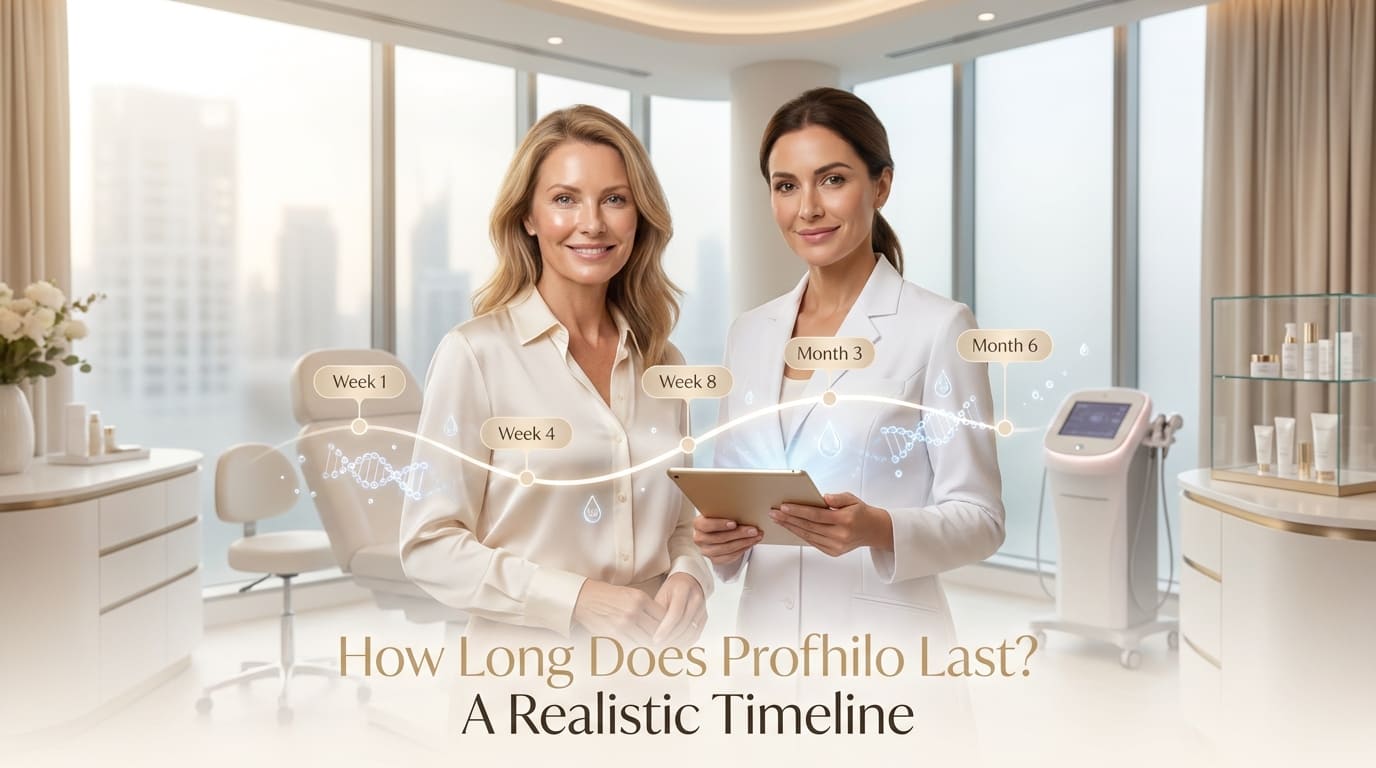
A full Profhilo course (two sessions, four weeks apart) typically gives visible results for around 6 months, with the best results usually seen 8 weeks after the first injection, once collagen and elastin production has kicked in. Many clients then return for a top-up or maintenance session every 6 months to sustain results.
That's the average. Some people see results hold for longer, others find they want a touch-up sooner, and that's normal, not a sign anything went wrong.
Why Profhilo isn't a one and done treatment
Unlike dermal fillers, which holds its shape once injected, Profhilo works by spreading through the skin and slowly stimulating your own collagen and elastin. That biological process takes time to build, which is exactly why a single session isn't designed to be the full treatment.
This is why Profhilo is sold as a course of two sessions, not a single appointment. The first session starts the stimulation process; the second, four weeks later, reinforces it. Skipping the second session or spacing it out too far reduces how much benefit you get from the treatment overall.
The realistic week-by-week timeline
Week 0, First session: Profhilo is injected at several points across the treatment area. Mild redness, small bumps at injection sites, or slight swelling are normal and usually settle within 24–48 hours.
Week 1–3, Early changes. Some clients notice early improvements in hydration during this window, but this is not the main event; your skin is still in the early stages of responding.
Week 4, Second session. The second treatment is given to reinforce the collagen-stimulating process. This is a planned part of the course, not a "top-up because the first one didn't work.
Week 5–8, Results build. This is where most people start to notice real change: improved hydration, a firmer feel to the skin, and a more even, "glowy" texture. Collagen and elastin production from both sessions is now actively rebuilding skin quality.
Week 8, Peak results. This is generally when results are at their most visible. Skin tends to look its firmest, most hydrated, and most refreshed at this stage.
Month 3–5, Gradual maintenance phase. Results don't disappear overnight. They tend to gently plateau and then slowly soften over the following months as the stimulated collagen naturally turns over.
Month 6, Time to consider a top-up. By around six months, most clients notice results have faded enough that skin is returning closer to its pre-treatment texture. This is the typical point to book a maintenance session if you want to sustain the effect.
What affects how long your results last
No two people get the same timeline, and several factors influence where you'll land on the "6-month average":
- Age and skin condition at the start: more advanced skin laxity may show a shorter-lived effect than early-stage dehydration
- Sun exposure: UV damage accelerates collagen breakdown, so results may fade faster without daily SPF
- Smoking, known to reduce collagen production and speed up skin ageing generally
- Skincare routine: a consistent routine (especially one including SPF and retinoids) tends to help maintain results longer
- Metabolism and lifestyle, general health, hydration, and diet all play a role in how quickly your body processes the treatment
- Treatment area: areas with thinner skin or more movement (like the neck) may show changes and return slightly sooner than the face
This is also why how long does Profhilo last doesn't have a single universal answer; it's closely tied to your individual starting point and habits, not just the product itself.
Do you need to keep having it forever?
Not necessarily, but most clients who are happy with their results choose to maintain them. Think of it less like a one-time fix and more like an investment in skin quality that needs periodic reinforcement, similar in concept to how regular facials or skincare routines need to be kept up to keep delivering a benefit.
A common approach is:
- Initial course: two sessions, four weeks apart
- Maintenance: one session roughly every 6 months thereafter
Some clients space maintenance sessions further apart once they've had a couple of rounds and built a good baseline, but this varies person to person and is best discussed with your practitioner based on how your skin is actually responding.
Profhilo vs filler: a quick longevity note
If you're comparing timelines against dermal fillers, it's worth knowing they're not directly comparable, because the treatments do different jobs. Filler tends to last longer per session because it physically holds shape until it's metabolised, whereas Profhilo's effect comes from a biological stimulation process that naturally has a shorter active window. For the full breakdown of how the two treatments differ, see our guide on Profhilo vs Dermal Filler.
Frequently Asked Questions
Will my skin go straight back to how it was before, after 6 months?
Not entirely. While the most visible effects fade, some clients report a residual improvement compared to their original starting point, particularly after multiple courses over time.
Can I leave it longer than 6 months before a top-up?
Yes, there's no medical requirement to book at exactly 6 months. Many clients go by how their skin looks and feels rather than the calendar.
Is the second session in the course really necessary?
Yes. The course is designed as two sessions for a reason; skipping the second significantly reduces the overall benefit, since it's part of how the stimulation process is reinforced.
Does Profhilo last longer in younger skin?
Not necessarily longer, but younger skin with less advanced laxity often shows a more dramatic initial improvement, simply because there's a stronger baseline collagen response to build on.
What happens if I just stop having Profhilo altogether?
Your skin will gradually return to behaving as it did before treatment, generally over the months following your last session; there's no rebound effect or sudden change.
Curious whether Profhilo is the right fit for your skin, or how it compares to other options? Book a consultation at Angel White in Littlehampton or Hove, and we'll talk through a realistic plan based on your skin, not a generic timeline.