Getting lip filler is the easy part. What happens after is where most people feel unprepared. You leave the clinic and suddenly the swelling sets in, and you wonder if something has gone wrong.
It almost certainly has not. But knowing what normal is each day after treatment genuinely changes the experience. It stops panic. It helps you look after your lips properly. And it gives you the best possible shot at a result you are really happy with.
This guide walks through exactly what to expect, day by day, after lip filler.
Before the Day-by-Day Breakdown: A Few Things Worth Knowing First
Lip filler is usually made from hyaluronic acid. This is a substance your body already produces naturally. Your lips are treated with a fine needle, and the filler is placed carefully to add shape, definition, or a subtle fullness depending on what you and your practitioner agreed.
Once it is in, the healing process takes a couple of weeks. Not days. Weeks.
The first few days look and feel nothing like your final result. That is completely normal and worth understanding before you see your lips for the first time post-treatment.
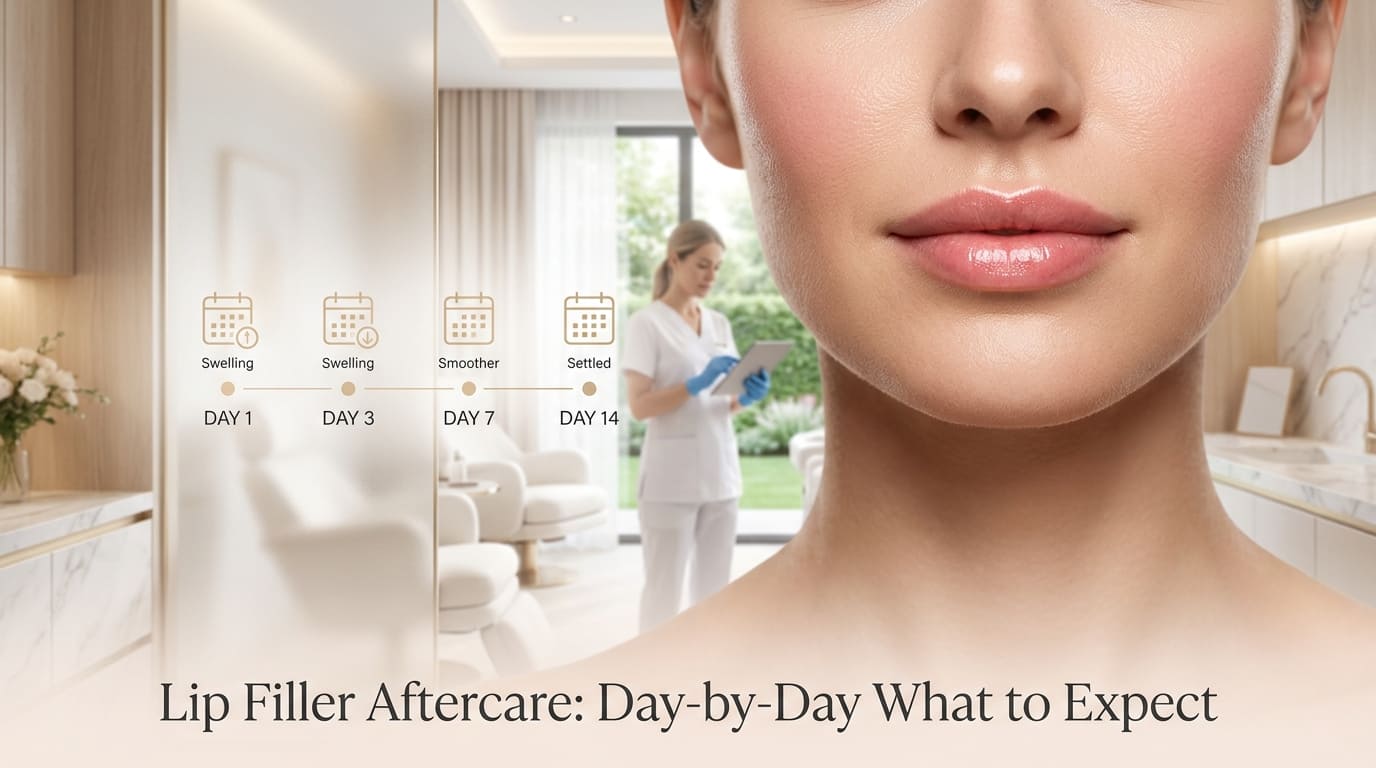
Day 1: Expect Swelling, Tenderness, and Some Surprise at What You See
This is the day most people find difficult.
Your lips will be swollen. They may feel tender or tight. The shape will almost certainly look uneven to you. Some people describe their lips as looking much bigger than they wanted, or lopsided, or somehow "wrong."
In most cases, nothing is wrong. Swelling does not distribute evenly across both lips, and it does not follow the shape the filler was actually placed in. What you are seeing on day one bears very little resemblance to your settled result.
What to do on day one:
Apply a cool compress gently to your lips if they feel uncomfortable. Do not use ice directly on the skin. Keep your head elevated if the swelling feels significant. Drink plenty of water. Avoid touching or pressing your lips. Do not apply lipstick or any products to the area.
Bruising is also possible on day one, particularly if you had a more precise or detailed treatment. This is not a sign something went wrong.
Day 2: Still Swollen, Possibly More So
Many people find day two looks and feels worse than day one.
Swelling often peaks around 24 to 48 hours after treatment. If your lips look larger or more uneven than yesterday, this is still within the completely normal range.
Bruising may be more visible now than it was immediately after. Bruising after lip filler can appear purple, yellow, or green as it starts to fade. This is normal healing.
Keep avoiding heat. No hot drinks, saunas, steam rooms, or intense exercise. Heat increases blood flow to the area and can worsen swelling.
Continue drinking plenty of water throughout the day. Staying hydrated genuinely helps the healing process.
Day 3 to 4: Swelling Starts to Calm Down
By day three or four, most people notice the initial swelling beginning to ease.
Your lips will still look slightly bigger than your final result will be. But they will begin to settle into a shape that is closer to what was actually placed. Tenderness often starts to ease around this point too.
You might notice small lumps or bumps along your lips when you press gently. These are usually just the filler settling. They are not cause for concern unless they are very hard, very painful, or accompanied by other symptoms.
If you have a special event coming up, three to four days post-treatment is not enough time. Your lips simply will not have settled properly yet.
Day 5 to 7: Looking More Like Your Actual Result
By the end of the first week, most of the initial swelling should be gone.
Your lips will begin to look much more like the result you actually requested. The shape becomes clearer. Any visible asymmetry from swelling generally resolves itself at this stage rather than being a permanent feature.
Some light bruising may still be visible, depending on how you bruise and how much bruising you had initially. Concealer is fine to use at this point if needed, as long as the skin surface itself is not broken or irritated.
Lips may still feel slightly firm or "set" when you press them. This softens with time.
Day 7 to 14: Filler Begins to Integrate
During the second week, the hyaluronic acid filler integrates more fully into the tissue of your lips.
This is when the feel really starts to change. Lips that felt firm or slightly stiff will begin to feel much more natural, both to you and to others.
By around day 10 to 14, many people feel genuinely settled into their result and are happy with how their lips look and feel.
This two-week mark is generally when it is appropriate to assess your result properly, raise any concerns with your practitioner, or discuss whether any adjustment is needed. Anything raised before this point is too early to assess properly.
Day 14 to 28: The Full Settled Result
By week two to four, your lips should be at or very close to their fully settled result.
The filler has integrated. Swelling is long gone. The shape reflects the treatment you actually had rather than the aftermath of healing.
This is the point where most practitioners would want to see you for a review if one was discussed at your consultation. Any very minor adjustments, if needed at all, would be considered at this stage.
Things to Avoid in the First Two Weeks
During the healing period, there are a handful of things worth being consistent about avoiding.
Avoid heat in all forms. This includes saunas, steam rooms, hot yoga, very hot showers, and sunbathing.
Avoid intense exercise for the first 24 to 48 hours. Physical activity increases circulation and can worsen swelling and bruising.
Avoid alcohol for at least 24 hours after treatment. Alcohol thins the blood and can contribute to bruising and inflammation.
Avoid touching or massaging your lips unless your practitioner has specifically told you to. Filler needs to settle undisturbed.
Avoid dental procedures for at least two weeks after treatment. The pressure involved can displace filler before it has settled.
Avoid sleeping face down. Try to sleep on your back or with your head elevated for the first few nights.
Avoid lip scrubs, exfoliants, or harsh skincare products on or near the lips during the first two weeks.
When to Contact Your Practitioner
Most symptoms after lip filler are completely normal. But certain signs need prompt attention.
Contact your practitioner if you notice skin that turns white or very pale around or near the lips. This can indicate a vascular issue and needs to be assessed immediately.
Contact your practitioner if you have severe pain that is getting worse rather than better after the first day or two.
Contact your practitioner if you develop a cold sore. Lip filler can trigger cold sore outbreaks in people who are prone to them. Treatment is available but needs to be started quickly.
Contact your practitioner if swelling is extreme, spreading significantly, or accompanied by a high temperature.
If at any point you are unsure whether what you are experiencing is normal, reach out rather than waiting. A good practitioner will always prefer you ask.
How to Get the Best Result From Your Treatment
The aftercare you do in the first two weeks genuinely affects your result.
Stay hydrated. Hyaluronic acid works best in a well-hydrated environment, and drinking plenty of water in the days after treatment supports the integration process.
Protect your lips from the sun once healed. UV exposure breaks down hyaluronic acid faster and shortens how long your filler lasts.
Look after your lips between treatments. A good SPF lip balm, staying hydrated, and avoiding excessive dryness all contribute to how well filler holds.
How Long Does Lip Filler Last?
Most lip filler lasts between 6 and 12 months, though this varies significantly between individuals.
People who move their lips a lot (talking, eating, animated expressions) tend to metabolise filler a little faster. Lifestyle factors like sun exposure and overall hydration also play a role.
When results fade, the process is gradual rather than sudden. Your lips return to their natural shape over time as the hyaluronic acid is absorbed by the body.
Frequently Asked Questions
Is it normal to hate my lips on day one?
Yes, and this is one of the most common things practitioners hear. Day one looks nothing like your final result. Swelling, asymmetry, and tenderness are all completely expected at this stage. Most people feel very differently about their lips by day seven.
Can I wear makeup after lip filler?
Avoid applying anything to the lips on the day of treatment. From day two onward, most people find light products are fine as long as the skin surface is intact. Lipstick and lip liner are generally fine within a couple of days.
What if my lips look uneven after two weeks?
Minor natural asymmetry is normal because everyone's lips are naturally asymmetrical to some degree. If you have a genuine concern about symmetry or placement after the two-week settling period, raise this with your practitioner at your review appointment.
Can I get lip filler before a big event?
Allow at least three to four weeks between your treatment and any important occasion. Two weeks is the minimum for settling, but a little extra buffer means you can enjoy your result properly without any residual swelling or bruising.
Does lip filler aftercare affect how long it lasts?
Yes, in a meaningful way. Sun protection, good hydration, and avoiding extremes of heat all support how long filler holds. Consistent, basic lip care between appointments makes a real difference over time.
What happens if I do not like my result?
Hyaluronic acid filler can be dissolved using an enzyme called hyaluronidase. This is one of the reasons experienced practitioners tend to prefer HA-based products, because the result is not permanent and can be adjusted if needed.
Ready to book your lip filler appointment or want to talk through what to expect at your consultation first? We see clients across both our Littlehampton and Hove clinics and are happy to answer questions before you commit to anything.
Book a Consultation in Littlehampton or Book a Consultation in Hove