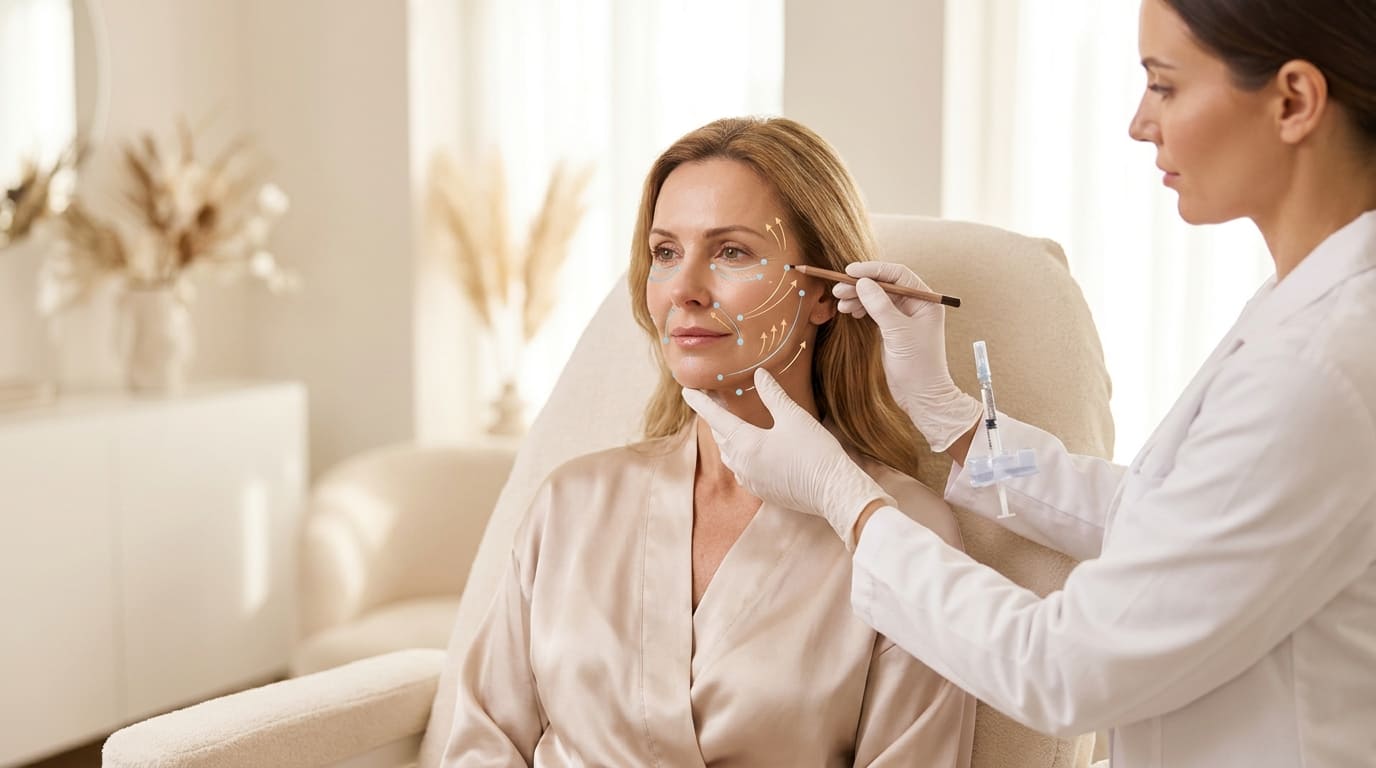
A liquid facelift UK treatment is designed for people who want a fresher, more lifted appearance without surgery. Also known as an 8-point facelift, this approach uses dermal fillers across carefully selected areas of the face to restore lost volume, improve facial structure, and support natural-looking contour.
At Angel White Aesthetics in Littlehampton, a liquid facelift is not treated as a one-size-fits-all procedure. It is an assessment-led, full face filler treatment planned around your facial anatomy, ageing pattern, and desired outcome. The aim is not to change your face, but to restore balance, soften heaviness, and create a refreshed result that still looks like you.
What Is a Liquid Facelift?
A liquid facelift is a non-surgical facelift filler treatment that uses injectable dermal fillers, usually hyaluronic acid fillers, to support areas of the face affected by volume loss, soft tissue descent, and reduced definition.
As the face ages, it can lose collagen, elastin, fat pad support, and bone structure. This can make the cheeks appear flatter, the under-eye area more tired, the nasolabial folds deeper, and the jawline less defined. A liquid facelift works by placing filler in strategic points to create supportive scaffolding under the skin.
This is why it is often described as full-face rejuvenation, structural aesthetics, or whole-face harmonisation. Instead of treating one line or one wrinkle, the treatment looks at how the cheeks, mid-face, lower face, mouth area, chin, and jawline work together.
Is a Liquid Facelift the Same as an 8 Point Facelift?
The terms are closely related. A liquid facelift is the broader treatment category, while the 8-point facelift is a structured method within it. The 8-point lift uses multi-point augmentation, meaning filler is placed across several anatomical zones rather than one isolated area.
The concept is linked to vector lifting and vector-based aesthetics. In simple terms, this means filler is placed in a way that supports the direction of natural facial lift. The result is not the same as surgical lifting, but it can improve contour, projection, and facial balance.
Some advanced approaches are influenced by the MD Codes framework, developed by Dr Maurício de Maio. This method focuses on mapping facial areas and planning HA filler placement around anatomical landmarks. In a practical clinic setting, this supports safer, more structured treatment planning.
What Does an 8 Point Facelift Include?
A common question is: what does an 8-point facelift include? The exact points may vary depending on your face, but an 8-point full-face protocol often focuses on these areas:
| Point | Anatomical Area | What It Supports |
| 1 | Lateral cheekbone | Lifted cheek contour and upper-face support |
| 2 | Mid-cheek | Mid-face lift and volume restoration |
| 3 | Tear trough support area | Tired-looking under-eye hollows |
| 4 | Nasolabial fold support | Softening nose-to-mouth lines |
| 5 | Lower cheek | Support for facial sagging |
| 6 | Marionette area | Downturned mouth corners |
| 7 | Pre-jowl area | Smoother transition into the jawline |
| 8 | Jawline and chin support | Improved jawline definition and lower-face balance |
This anatomical map is useful because it explains that a non-surgical facelift is not simply “filler in the cheeks.” It is a multi-syringe protocol where each area supports the next. For example, restoring the mid-face can sometimes reduce the appearance of lower-face heaviness because the cheek structure provides upward support.
What Does a Liquid Facelift Actually Do?
A liquid facelift can help with several common concerns:
- Restore lost cheek and mid-face volume
- Improve facial contouring and definition
- Soften nasolabial folds and marionette lines
- Support mild jowling and lower-face heaviness
- Improve jawline definition
- Create a more refreshed, rested appearance
- Support whole-face harmonisation without surgery
The treatment does not remove loose skin, cut tissue, or reposition facial muscles like a surgical facelift. Instead, it creates non-surgical lifting by restoring structure and support where the face has lost volume.
This distinction matters. A liquid facelift can be very effective for early to moderate ageing, hollowing, and loss of contour. However, people with significant skin laxity may need a different plan or a surgical opinion.
Who Is a Good Candidate?
A liquid facelift UK treatment may suit clients who want improvement without the downtime of surgery. It is often considered by people who have noticed flatter cheeks, tired under-eyes, deeper folds, mild jowls, or reduced jawline definition.
You may be suitable if you want a natural-looking result, have realistic expectations, and prefer a treatment plan based on facial assessment. It may also suit people who have already had single-area filler and now want a more balanced full-face filler approach.
You may not be suitable if you are pregnant, breastfeeding, have an active skin infection, have certain medical conditions, or need correction that filler cannot safely achieve. A proper consultation is essential before treatment.
How Long Does Liquid Facelift Last?
How long does a liquid facelift last? Results vary from person to person, but many hyaluronic acid filler treatments last around 9 to 18 months depending on the filler type, treatment area, metabolism, lifestyle, and how much structural support is needed.
Areas with more movement may break filler down faster, while deeper supportive areas may last longer. Maintenance appointments can help preserve the result gradually, rather than allowing all volume support to fade before retreatment.
Liquid Facelift Cost UK
The cost of liquid facelift UK treatment depends on the amount of filler required, the number of areas treated, the complexity of the case, and the practitioner’s planning approach.
Angel White’s current Liquid Face Lift treatment is £500 with assessment-led planning. Because full face filler treatment is highly individual, the safest approach is to book a consultation and receive a recommendation based on your anatomy rather than choosing by syringe amount alone.
Is There Downtime?
A liquid facelift usually has minimal downtime compared with surgery. Common temporary effects can include swelling, bruising, redness, tenderness, or small injection marks. These usually settle over the following days.
Aftercare may include avoiding alcohol, heavy exercise, heat treatments, facial massage, and pressure on the treated areas for the advised period. You should also avoid touching the area unnecessarily and follow your practitioner’s aftercare guidance.
Risks and Safety
Dermal fillers are widely used, but they are still injectable medical aesthetic treatments and should be planned carefully. Possible side effects include swelling, bruising, asymmetry, tenderness, lumps, and overcorrection. Rare but serious complications can include vascular occlusion, where blood flow is affected.
This is why facial anatomy knowledge, safe product selection, and consultation-led planning matter. A good liquid facelift is not about using the most filler. It is about using the right amount, in the right place, for the right reason.
Liquid Facelift vs Surgical Facelift
A liquid facelift is best understood as a non-surgical facial rejuvenation treatment. It can restore volume, contour the face, and create the appearance of lift, but it does not replace surgery.
A surgical facelift can reposition deeper facial tissues and remove excess skin. A liquid facelift uses HA filler to provide structural support and improve facial harmony. The right option depends on your age, skin laxity, facial structure, goals, and expectations.
For many people, an 8-point lift is a good first step because it is less invasive, has less downtime, and can be adjusted over time.
Final Thoughts
A liquid facelift is not just “full face filler.” When planned properly, it is a structured full-face protocol based on multi-point augmentation, vector lifting, and supportive scaffolding. It can refresh the mid-face, soften lower-face heaviness, improve jawline definition, and create natural-looking whole-face harmonisation.
If you are considering a non-surgical facelift in Littlehampton, Angel White Aesthetics offers assessment-led treatment designed around your features, your goals, and your suitability.
FAQs
What is a liquid facelift?
A liquid facelift is a non-surgical facelift filler treatment using dermal fillers to restore volume, support facial structure, and improve contour. It can create a refreshed, lifted appearance without surgery, but it does not remove loose skin like a surgical facelift.
What does an 8-point facelift include?
An 8-point facelift usually includes filler placement around the cheekbone, mid-face, tear trough support area, nasolabial folds, lower cheek, marionette area, pre-jowl area, jawline, or chin. The exact points depend on your anatomy and treatment goals.
How long does liquid facelift last?
A liquid facelift commonly lasts around 9 to 18 months, depending on the filler used, treatment areas, metabolism, lifestyle, and how your face responds. Maintenance treatments can help preserve the result gradually and keep the face looking balanced.
How much is a liquid facelift UK?
Liquid facelift cost UK varies by clinic, practitioner experience, filler amount, and treatment complexity. At Angel White Aesthetics, the Liquid Face Lift page currently lists treatment at £500, with assessment-led planning to decide suitability and the right approach.
Is an 8 point facelift painful?
Most people find an 8-point facelift manageable. Numbing cream or filler containing local anaesthetic may be used to improve comfort. You may feel pressure, small pinches, or tenderness, but significant pain is not expected during a well-planned treatment.
Is a liquid facelift better than a surgical facelift?
A liquid facelift is better for people wanting subtle, non-surgical rejuvenation with less downtime. A surgical facelift may be better for significant loose skin or deeper tissue sagging. The best choice depends on your anatomy, goals, and consultation findings.