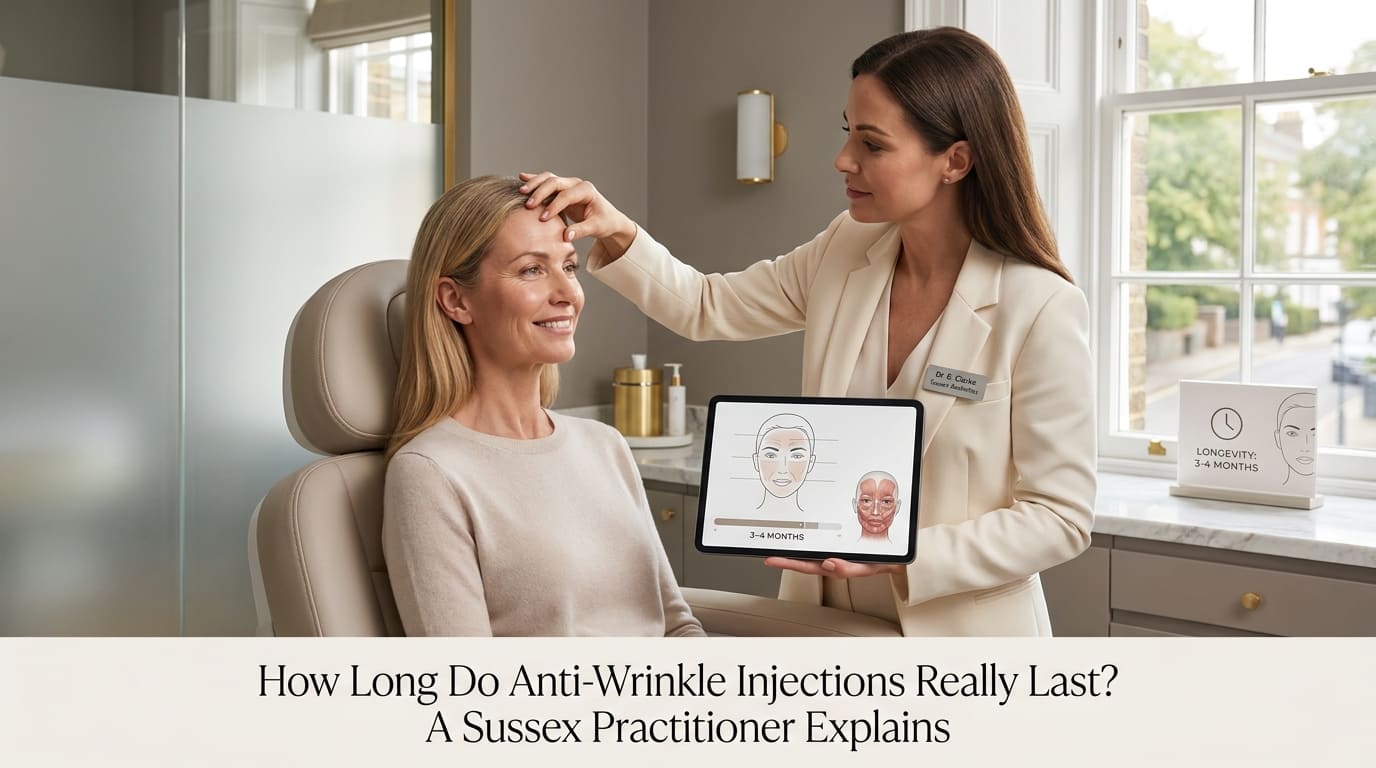
One of the most common questions people ask before booking treatment is simple: how long do anti-wrinkle injections last? The honest answer is that most results last around three to four months, but the exact anti-wrinkle injections duration can vary from person to person.
At Angel White Aesthetics in Sussex, the focus is not only on softening lines. It is on understanding your facial movement, skin condition, lifestyle, treatment history and expectations before creating a plan that looks natural. Angel White’s own clinic positioning is based around medically led care, clinical assessment and personalised treatment planning for natural, balanced results.
Anti-wrinkle injections are commonly used to soften dynamic expression lines such as forehead lines, frown lines and crow’s feet. These lines form because facial muscles repeatedly contract when you smile, frown, squint or raise your brows. Wrinkle relaxing injections reduce selected muscle movement temporarily, helping the overlying skin look smoother and more refreshed.
How long anti-wrinkle injections last on average
For many people, anti-wrinkle injections last three to four months. Some notice movement returning slightly earlier, while others may enjoy a smoother appearance for longer. A typical muscle relaxant timeline is:
- Days 3–5: early softening may begin
- Days 10–14: full effect is usually visible
- Weeks 8–12: muscle movement may slowly start returning
- Months 3–4: many people are ready to discuss maintenance
- Beyond 4 months: results may remain visible in some clients, but usually with more movement than at the peak
The treatment does not usually switch off suddenly. Instead, the effect fades gradually as muscle reactivation occurs. This is why you may first notice slight movement in the forehead or around the eyes before lines become more visible again.
Why duration varies from person to person
The reason anti-wrinkle injections do not last the same for everyone comes down to individual metabolic variability, muscle strength, treatment area, dose, product choice, and how your body responds.
A person with strong forehead or frown muscles may metabolise or work through the effect faster because the treated muscles are more active. Someone who exercises intensely, has a fast metabolism or is very expressive may also feel that their anti-wrinkle treatment wears off in three months or even slightly before.
The science behind neuromodulator duration is also important. These treatments work at the nerve-muscle junction by reducing the signal that tells a muscle to contract. Over time, receptor recovery, nerve signalling and muscle reactivation allow normal movement to return. This is why terms such as neuromodulator half-life, receptor turnover and product-specific kinetics matter, even though clients usually experience this simply as “my movement is coming back.”
Does the brand affect how long results last?
Botox duration UK, Bocouture longevity, Azzalure results or Xeomin duration because they want to know whether one product lasts longer than another. In the UK, several botulinum toxin type A products are used in medical and aesthetic settings. BNF/NICE lists medicinal forms including Bocouture, Botox, Letybo and Xeomin, while Azzalure patient information confirms it contains botulinum toxin A and temporarily relaxes muscles.
Brand can play a role, but it is rarely the only factor. Botox, Bocouture, Azzalure and Xeomin all work by relaxing targeted muscles, but they differ in formulation, units, preparation and practitioner preference. For example, Azzalure information notes that its Speywood units are specific to that product and are not interchangeable with other botulinum toxin preparations.
This is why choosing a practitioner based only on “longer-lasting Botox” is not the best approach. The right product, dose and injection pattern should be chosen after a face-to-face consultation and assessment.
Why does my treatment wear off fast?
If your anti-wrinkle injections wear off fast, it does not always mean something has gone wrong. Common reasons include strong muscle mass, conservative dosing, first-time treatment, high metabolism, frequent intense exercise, stress, smoking, sun exposure, or very active facial expressions.
A first appointment is often planned carefully and conservatively. This is usually safer than over-treating because the aim is a refreshed result while keeping natural expression. If movement returns earlier than expected, your practitioner can review your response and plan future treatment intervals more accurately.
Some people also compare their results to friends, but this can be misleading. Two clients may receive treatment in the same area and still have different injectable longevity because their anatomy, muscle pattern, and receptor recovery are different.
Do anti-wrinkle injections last longer over time?
For some people, yes. Anti-wrinkle injections can appear to last longer over time when treatments are planned consistently, and the targeted muscles become less dominant. If a muscle is repeatedly relaxed at appropriate treatment intervals, expression lines may soften and the skin may look smoother between appointments.
However, this does not mean you should book too often. Over-treatment can increase the risk of an unnatural appearance, heaviness or unwanted weakness. The ideal interval between anti-wrinkle treatments is usually guided by how your own movement returns, not by copying someone else’s schedule.
A good practitioner will look at your face at rest and in movement, review previous results, and advise whether you need the same dose, a changed dose, a different placement pattern, or simply more time before your next appointment.
How often should you have anti-wrinkle injections?
Most people who want to maintain results consider treatment around every three to four months, but this is not a fixed rule. Some clients prefer occasional softening before events, while others want a steady maintenance plan.
If you are new to anti-wrinkle injections, a sensible approach is to start with a consultation, allow the full result to settle, review at around two weeks if needed, then plan future treatments based on your response. This helps avoid unnecessary top-ups and supports natural-looking results.
The term botox top-up is often searched online, but top-ups should not be automatic. They should only be considered after the product has fully settled and your practitioner has assessed symmetry, movement and whether additional treatment is appropriate.
Which areas wear off fastest?
Crow’s feet can sometimes appear to wear off sooner because the eye area moves frequently when smiling, laughing and squinting. Forehead lines may also need careful planning because too much relaxation can cause heaviness, while too little may fade quicker than expected.
Frown lines between the brows often respond well because the treatment targets stronger muscles in a defined area, but muscle strength still varies. The best plan depends on anatomy, not just the named area.
Common treatment areas include:
- Forehead lines
- Frown lines
- Crow’s feet
- Bunny lines
- Dimpled chin
- Downturned mouth corners
- Neck bands in suitable cases
Can lifestyle help results last longer?
Lifestyle cannot stop receptor turnover or muscle reactivation, but it can support better-looking skin and treatment outcomes. Good skincare, daily SPF, hydration, sleep, balanced nutrition and avoiding smoking can help your skin look healthier while the injectable effect is active.
Aftercare also matters. Your practitioner may advise you to avoid rubbing the area, heavy exercise, heat exposure or lying flat for a short period after treatment. These steps are not about making the product last forever; they are about allowing the treatment to settle properly and reducing avoidable irritation or bruising.
Why a Sussex consultation matters
If you are searching locally for anti-wrinkle injections in Sussex, Littlehampton, Hove or West Sussex, the most important step is not choosing the strongest dose. It is choosing a medically led clinic that assesses your face, explains suitability and gives realistic advice.
Angel White Aesthetics lists Littlehampton and Hove as clinic locations and presents its approach as evidence-based, safety-focused and personalised. The clinic also encourages consultation-led booking for people who are unsure what treatment they need.
Botulinum toxin is a prescription-only medicine in the UK, so a proper assessment is essential. The MHRA advises people considering cosmetic procedures to understand the risks and choose a reputable, insured and qualified practitioner.
How long do anti-wrinkle injections really last?
Anti-wrinkle injections usually last around three to four months, but your personal result depends on muscle mass, metabolism, treatment area, dose, product choice, lifestyle and how your body recovers nerve-muscle activity.
If your goal is natural-looking softening rather than a frozen look, the best approach is a personalised plan. At Angel White Aesthetics, clients can book a consultation in Littlehampton or Hove to discuss fine lines, wrinkle-relaxing treatment, maintenance intervals and whether anti-wrinkle injections are suitable for their goals.
FAQs
1. How long do anti-wrinkle injections last?
Anti-wrinkle injections usually last around three to four months, although some people notice movement returning sooner or later. Duration depends on metabolism, muscle strength, treatment area, dose, product choice, and how consistently the treatment is maintained.
2. Why does my Botox wear off fast?
It may wear off faster because of strong facial muscles, high metabolism, intense exercise, conservative dosing, first-time treatment, or very active facial expressions. It does not always mean poor treatment; your practitioner can review your response and adjust future planning.
3. Do anti-wrinkle injections last longer over time?
They can last longer for some people when treatments are repeated at suitable intervals. Over time, targeted muscles may become less active, so lines may soften between appointments. However, results still vary, and over-treatment should be avoided.
4. How often should you have anti-wrinkle injections?
Many people plan anti-wrinkle injections every three to four months, but the ideal interval depends on how quickly your movement returns. A practitioner should assess your face, previous response and desired result before recommending maintenance.
5. When do anti-wrinkle injections start working?
Most people begin to notice early softening within three to five days. The full result usually develops around 10 to 14 days, which is why practitioners often recommend waiting before judging the outcome or considering a review.
6. Can you have a Botox top-up after two weeks?
A review around two weeks may be appropriate because the result has usually settled by then. A top-up should only be given if clinically needed after assessment, not automatically, because unnecessary extra product can affect natural movement.