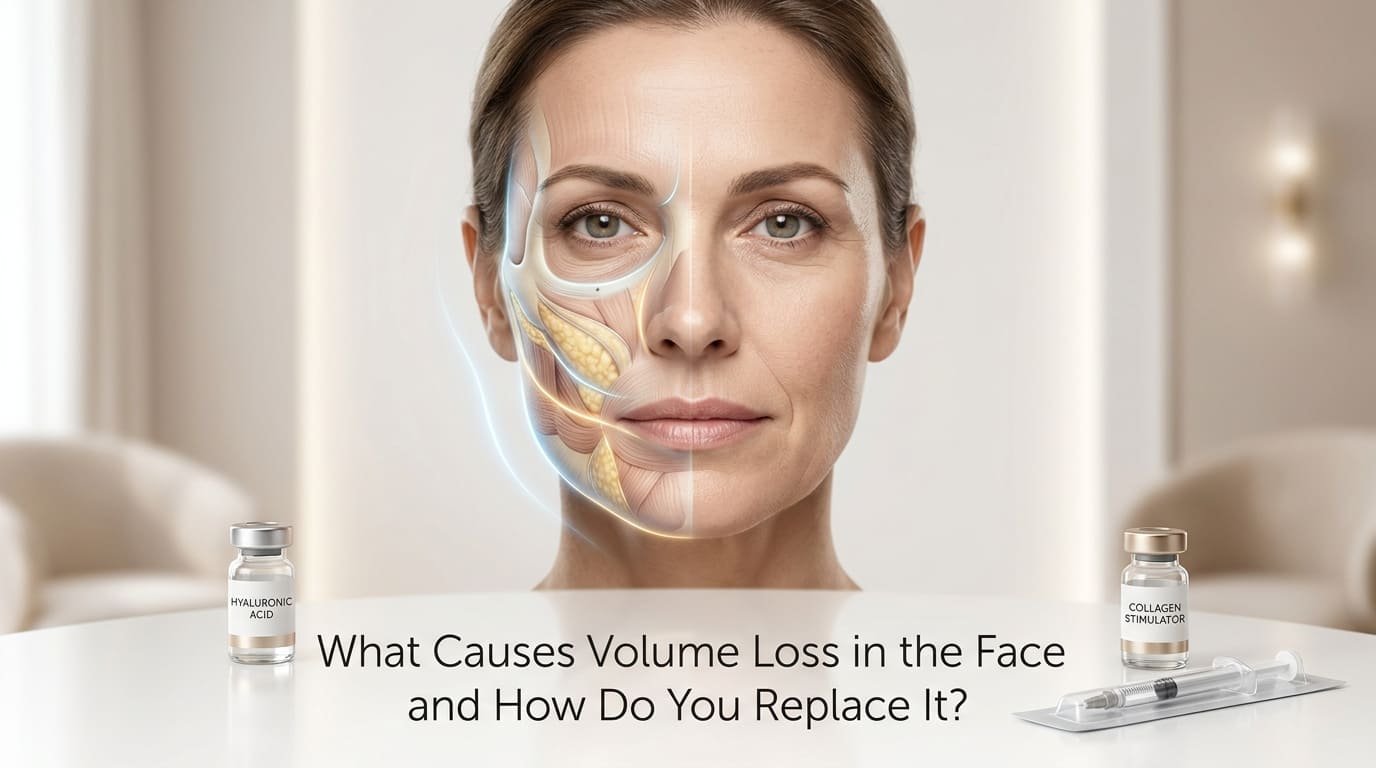
The word ageing is used as shorthand for what happens to the face over time, but it describes a collection of distinct biological processes happening simultaneously rather than a single unified change. One of the most significant of these processes, and arguably the one that has the most dramatic visible effect on how the face looks, is volume loss.
Volume loss is not simply the skin getting thinner or losing its firmness, though those changes happen too. It refers specifically to the reduction in the structural mass of the facial tissues across multiple layers, from the bone underneath to the fat compartments in the midface to the subcutaneous tissue supporting the overlying skin. Understanding that volume loss happens across all of these layers, and that each layer contributes differently to the visible change in appearance, is what makes the difference between a treatment plan that addresses the actual problem and one that addresses only the most visible symptom of it.
The Layers of the Face That Lose Volume With Age
The face is not a flat surface with a single layer of tissue beneath it. It is a three-dimensional structure built from multiple concentric layers, each of which changes in its own way as decades pass. Volume can be lost from any or all of these layers, and the visible result of that loss depends on which layers are most affected.
The deepest layer of facial structure is the skeleton. Bone is not static. It undergoes continuous remodelling throughout life through the activity of osteoblasts, which build bone, and osteoclasts, which resorb it. In younger years, these processes are in balance or favour bone deposition. With age, and particularly in postmenopausal women, the balance shifts toward net bone resorption.
The facial bones that resorb most significantly include the orbital rim, which expands downward and laterally, making the eye socket larger; the maxilla, which loses volume in the midface and contributes to the hollowing beneath the eye and cheek; the mandible, which loses height particularly in the posterior body, contributing to jowl formation and loss of jaw definition; and the pyriform aperture around the nose, which widens and contributes to descent of the nasal tip and deepening of nasolabial changes.
This skeletal resorption means the scaffolding that all the overlying soft tissue depends on is gradually diminishing. Skin and fat that were once supported by a robust bony framework progressively lose that support, and gravity does the rest.
Above the bone sit the deep fat compartments of the face. These pockets of fat are not evenly distributed. They sit in specific anatomical locations, including the deep medial cheek fat, the deep lateral cheek fat, and the sub-orbicularis oculi fat, known as SOOF. With age, these deep fat compartments deflate. The fullness they once provided in the midface diminishes, and the structural projection of the cheeks reduces.
The superficial fat compartments sit above the muscle layer and below the skin. These include the malar fat pad, the nasolabial fat, and the jowl fat compartment. Unlike the deep compartments, superficial fat tends not only to deflate but also to descend with gravity as the retaining ligaments that hold it in position weaken over time. Descended superficial fat contributes to jowl formation, deepening of the nasolabial fold, and the overall heaviness of the lower face that many patients associate with ageing.
The skin itself loses structural support from within as collagen and elastin production declines and as the dermis thins. This is a distinct process from fat volume loss, but it is closely related to how volume loss appears at the surface because thinner skin is more readily deformed by the loss of support beneath it.
Why Volume Loss Looks the Way It Does
The visible consequences of volume loss reflect which layers have been most affected and in which areas of the face the loss is most pronounced.
Hollowing beneath the eyes and in the midface is typically the first obvious sign of deep fat compartment deflation and orbital rim resorption. The area that once showed a smooth curve from the lower eyelid to the cheek develops a groove or hollow as the structural support beneath it diminishes.
Flattening of the cheeks reflects deep medial and lateral cheek fat deflation alongside maxillary bone resorption. Cheeks that were once projecting and three-dimensional become flatter and less defined.
Deepening of the nasolabial folds reflects the descent of the malar fat pad toward the fold, the loss of midface projection that previously supported the fold from above, and the relative prominence of the fold as the tissue above it deflates.
Jowl formation reflects the descent of the jowl fat compartment as its supporting ligaments weaken, combined with the loss of mandibular bone height that previously supported the lower face contour.
Temple hollowing is one of the most ageing changes and one of the least discussed. The temporal fat pad that fills the temple region deflates with age, creating a hollow that makes the lateral brow appear more prominent and contributes to a skeletonised appearance to the upper face.
The overall effect of these changes across all layers is a face that appears deflated, descended, and structurally hollow in ways that cannot be fully addressed by surface-level treatments that do not replace the structural support that has been lost.
How Dermal Filler Replaces Lost Volume
Hyaluronic acid filler is the most widely used tool for facial volume replacement, and it works directly and immediately by physically replacing the structural mass that has been lost in specific areas.
Filler placed in the deep medial cheek fat compartment restores midface projection and provides the structural support that reduces nasolabial folding, lifts the descended tissue above the fold, and gives the face back its three-dimensional shape. Cheek filler is one of the most structurally impactful facial filler treatments because the midface functions as the architectural keystone of the whole face. Restoring volume here improves the appearance of multiple surrounding areas simultaneously rather than addressing a single isolated concern.
Tear trough and periorbital filler addresses the hollow beneath the eye that results from orbital fat deflation and orbital rim resorption. Small amounts of soft, precisely placed HA filler reduce the shadow and depth of the tear trough and restore the smooth transition between the lower eyelid and the cheek. This is a technically demanding area requiring specific product selection and placement expertise, covered in more detail in the tear trough filler article on this blog.
Temple filler addresses temporal hollowing by restoring volume to the fat pad that has deflated, reducing the skeletonised appearance and providing structural support to the lateral brow and the overall upper face frame.
Mandibular filler along the jawline and at the chin replaces volume lost through mandibular bone resorption, restoring definition and structural edge to the lower face contour.
The principle across all of these treatments is the same. Filler physically occupies the space left by deflated fat compartments and resorbed bone, providing the structural support that the overlying skin and soft tissue need to sit in a more youthful position.
How Radiesse Replaces Volume Differently
Radiesse approaches volume replacement through a different mechanism from HA filler, covered in detail in the dedicated Radiesse article on this blog. The calcium hydroxylapatite microspheres in Radiesse provide immediate volume through the gel carrier and then drive the tissue to produce its own collagen scaffold as the product degrades.
For structural areas like the cheeks and jawline where longevity and tissue quality improvement alongside volume replacement are the goals, Radiesse produces a different quality of result from HA filler. The collagen produced in response to the microsphere scaffold means the tissue in the treated area is structurally better supported at six months than it was on the day of injection, which is the opposite trajectory from HA filler, which produces its best result immediately and then gradually diminishes.
The irreversibility of Radiesse means it is not a first choice for patients who have never had structural filler before and who do not yet know how they respond to volume replacement in specific areas. HA filler in the same areas on a first treatment, with the safety net of reversibility through hyaluronidase, is typically the more appropriate starting point.
The Order in Which Volume Replacement Works Best
One of the most clinically significant principles in facial volume replacement is that the order of treatment matters as much as the choice of treatment.
Volume restoration typically proceeds from the deepest structural layer outward. Restoring midface projection with cheek filler before attempting to address nasolabial folds often reduces the apparent depth of the folds without filler needing to be placed directly into them, because the restored midface projection reduces the relative prominence of the fold. Addressing the structural scaffold before the superficial appearance often means less total filler is needed to achieve a natural result.
This top-down and inside-out approach to volume replacement is what distinguishes a properly planned treatment programme from a series of appointments that treat individual concerns in isolation. A practitioner who assesses the whole face and plans the sequence of volume replacement based on the structural hierarchy of the concern produces better results with more natural-looking outcomes than one who simply fills the areas the patient identifies as bothering them.
The Honest Limits of Non-Surgical Volume Replacement
Injectable volume replacement is genuinely effective for mild to moderate facial volume loss. It is not a surgical equivalent, and for patients with significant volume deficits, it cannot fully replicate what surgical intervention achieves.
Surgical fat transfer, which involves harvesting fat from elsewhere in the body and grafting it to the face, provides larger volumes of autologous fat in a way that injectable filler in realistic amounts cannot. For patients with very significant volume loss who want the most substantial and longest-lasting result, surgical fat transfer is a legitimate option worth discussing with a surgeon.
A lower facelift addresses the structural consequences of volume loss and tissue descent, including jowling and neck laxity, in ways that injectable treatments cannot fully replicate when the degree of change is significant. A practitioner who tells you honestly at consultation whether your presentation is within the range that injectable treatment can adequately address or whether surgical consultation would produce better alignment with your goals is providing more value than one who proceeds with injectable treatment regardless of the clinical indication.
Frequently Asked Questions
At what age does facial volume loss typically become visible?
Volume loss begins in the twenties in the deep fat compartments but is usually not clinically significant until the mid-thirties to early forties for most patients. The rate of visible change accelerates through the forties and fifties as bone resorption and ligament weakening compound the fat deflation that has been accumulating.
Does losing body weight make facial volume loss worse?
Yes, significantly. Significant weight loss in adulthood accelerates facial volume loss because the fat compartments that provide structural support in the face deflate alongside fat loss elsewhere in the body. This is one of the reasons some patients who lose a substantial amount of weight find their face looks older than before despite feeling healthier.
How much filler is typically needed to address significant facial volume loss?
This varies enormously by patient and the areas being addressed. A conservative approach to multiple areas of the face in a single session typically involves several millilitres of product across different treatment zones. Planning the volume carefully to achieve natural proportionality rather than simply filling to a predetermined amount is the mark of careful clinical practice.
Can volume loss in the face be prevented?
The underlying bone resorption and fat deflation that cause volume loss cannot be prevented. The rate of decline can be influenced by consistent daily SPF to reduce photoageing-related collagen and elastin loss, maintaining a stable healthy weight to avoid accelerating fat compartment deflation, and avoiding smoking, which accelerates all components of facial ageing.
Will my face look natural after filler for volume loss?
In experienced hands using appropriate products in appropriate volumes, yes. The most natural-looking results come from restoring lost volume to its original anatomical position rather than adding volume beyond what was present before. A result that looks natural is achieved through conservative, anatomically informed volume replacement rather than the maximum possible amount of filler.
Is there a point where I have had too much filler over time?
Repeated filler additions in the same areas over years can accumulate beyond what produces a natural result. A practitioner who periodically reassesses what is present, considers whether dissolving and resetting is appropriate before adding more, and resists the temptation to add volume simply because a patient requests it is practising more carefully than one who adds indefinitely.
If you want to understand what specific volume changes are affecting your face and what a realistic and proportionate treatment plan would look like for your individual anatomy, book a consultation at our Littlehampton or Hove clinic.
Book a Consultation in Littlehampton or Book a Consultation in Hove