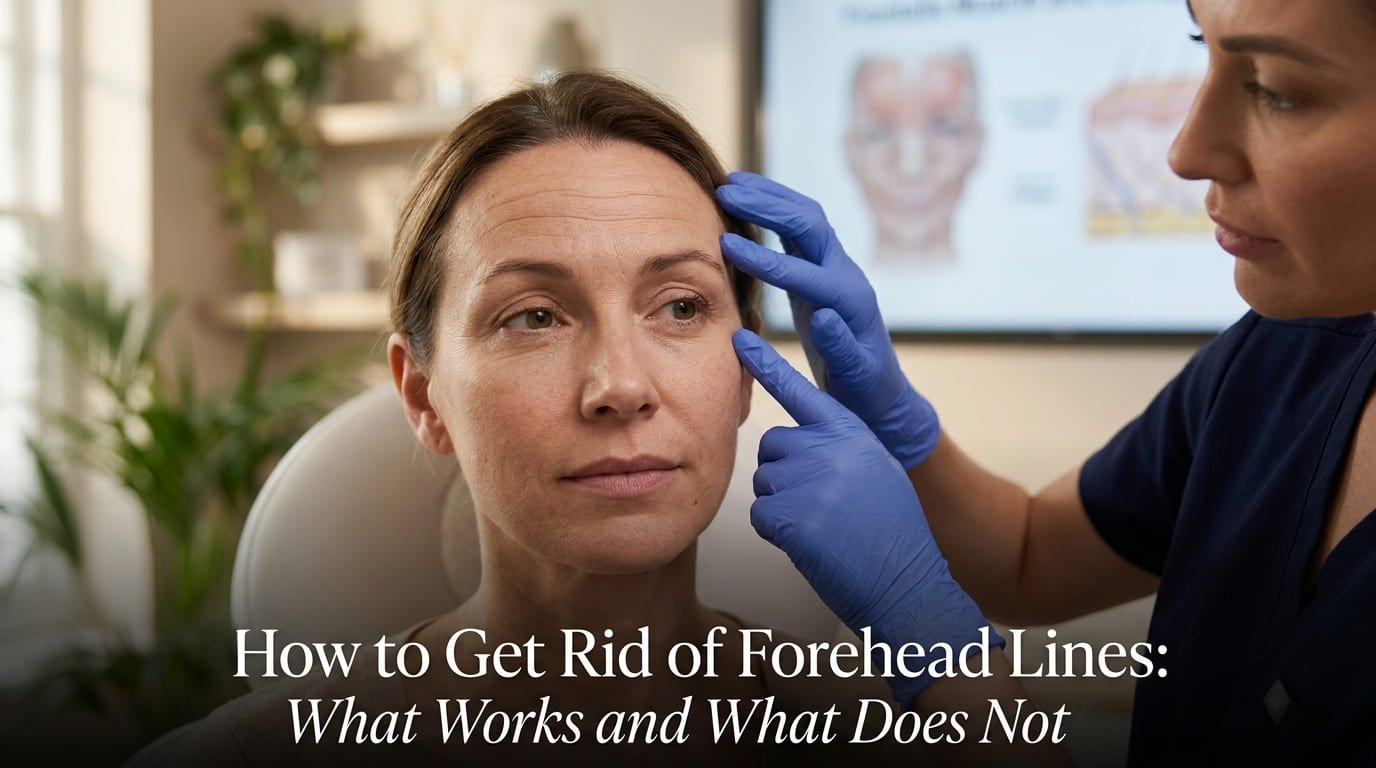
Forehead lines are one of the most common reasons people book their first aesthetic appointment. They develop gradually, become more visible through the thirties and forties, and at some point cross a threshold where they are present not just when making expressions but permanently etched into the skin at rest.
What most people do not know before that first appointment is that forehead lines are not a single type of problem. They have two distinct causes that require different treatments, and treating the wrong cause with the wrong approach explains why many patients do not get the result they expected from treatments they thought should have worked.
Understanding the biology of forehead lines before booking any treatment is the starting point for a result that actually meets expectations.
Why Forehead Lines Form in the First Place
The forehead is one of the most expressive areas of the face. Every time you raise your eyebrows, the frontalis muscle, which is the large flat muscle covering the entire forehead, contracts and pulls the brow upward. Every time it contracts, the skin above it folds into horizontal lines. Do this thousands of times over decades, and the skin gradually loses its ability to smooth back out between expressions. The lines that were once present only during the movement become increasingly present at rest.
This is the dynamic component of forehead lines. They are caused by the repeated mechanical folding of the skin over a contracting muscle, and they are the type of forehead line that responds most reliably to anti-wrinkle treatment.
But there is a second component that develops alongside and eventually independently of the dynamic one. As the skin ages, it loses collagen and elastin at the dermis level. The structural proteins that give skin its ability to recoil after movement deplete over time through a combination of intrinsic ageing, photoageing from UV exposure, and the repeated mechanical stress of decades of expression. When the structural support of the dermis itself is depleted, the lines become present at rest regardless of muscle activity because the skin simply no longer has the elasticity to smooth itself out.
These are static lines. They are present when the face is completely relaxed. They are not caused by the muscle in that moment, even though the muscle created them over time. And they do not fully respond to anti-wrinkle injections because relaxing the muscle does not restore the structural capacity of skin that has lost its collagen and elastin foundation.
This distinction is the single most important thing to understand about forehead lines because it determines what treatment is appropriate and what to realistically expect from it.
What Anti-Wrinkle Injections Do to Forehead Lines
Anti-wrinkle injections work by temporarily blocking the signal between the nerve and the frontalis muscle. When this signal is reduced, the muscle contracts less forcefully and the skin above it folds less deeply with each expression. Lines that form during expression are significantly reduced. The skin has less opportunity to fold repeatedly over the treatment period, which gradually allows some degree of passive smoothing in the skin above the reduced-activity muscle.
For patients who have predominantly dynamic forehead lines, meaning lines that are clearly visible during expression but significantly less visible or absent at rest, anti-wrinkle treatment delivers a very satisfying result. The lines during expression soften substantially. Between expressions, the forehead looks significantly smoother. Over multiple treatment cycles the ongoing reduction in mechanical folding allows the skin to soften further than it would have with treatment alone.
For patients who have developed significant static lines, meaning lines that remain clearly present when the face is completely relaxed, anti-wrinkle injections improve the dynamic component but do not fully resolve the static component. The lines during expression soften. The lines at rest improve partially but do not disappear because the structural deficit in the dermis that is causing them to remain at rest is not addressed by reducing muscle activity.
This is why two patients who both have anti-wrinkle treatment for forehead lines can have quite different results. The patient with predominantly dynamic lines sees a dramatic improvement. The patient with significant static lines sees a real but more limited improvement. Both received the same treatment correctly delivered. The difference is in what was causing the lines and what anti-wrinkle treatment can and cannot address.
The Frontalis Muscle and the Brow Position Relationship
Treating forehead lines with anti-wrinkle injections requires understanding a clinical relationship that is not immediately obvious, but that has a significant effect on outcomes.
The frontalis muscle is the only muscle in the forehead that raises the brow. It does not have a significant opposing muscle acting directly above it. When anti-wrinkle treatment reduces frontalis activity, the brow loses some of its active elevation. In patients with naturally lower brows, or in patients who habitually use their frontalis to compensate for other anatomical factors that create visual heaviness above the eye, reducing frontalis activity can cause the brow to drop below where it sits naturally at rest.
This is one of the reasons that complete relaxation of the frontalis, which would be required to completely eliminate forehead lines, is rarely clinically appropriate. A well-dosed forehead treatment reduces line formation while preserving enough muscle activity to maintain natural brow position. This balance requires clinical judgement about the individual patient's anatomy, their baseline brow position, and their goals.
Patients who ask for their forehead lines to be eliminated through anti-wrinkle treatment are sometimes asking for something that would require an amount of product that drops the brow below where it should sit. The right result is a meaningful improvement in lines while maintaining a natural and appropriate brow position, not a completely line-free forehead achieved at the cost of a heavy brow.
What Skin Quality Treatments Add to the Equation
For patients with significant static forehead lines, or for those who want the best possible result from their anti-wrinkle treatment, skin quality treatments that address the dermal structural deficit work alongside anti-wrinkle injections rather than as alternatives to them.
The static component of forehead lines reflects collagen and elastin depletion in the dermis. Treatments that drive collagen and elastin production in the treated tissue gradually improve the structural capacity of the skin to smooth out after movement. As this structural improvement accumulates, lines that were previously present at rest become less deep, less numerous, and less visible.
Profhilo used on the forehead area drives bio-remodelling through the high-concentration non-cross-linked HA mechanism. The fibroblast stimulation and collagen production it initiates in the dermis improve the tissue quality that determines how well the skin smooths between expressions. Profhilo does not directly target forehead lines, but it improves the dermal environment in the area, which means lines that have a significant static component appear less etched over a course of treatment.
Polynucleotides applied to the forehead contribute the same regenerative fibroblast stimulus through the PDRN mechanism. The skin thickening and collagen production effects described in the polynucleotides article on this blog are as relevant in the forehead as in other areas. For patients where the static component of their forehead lines reflects significant tissue quality decline, polynucleotides used alongside anti-wrinkle treatment often produce a more complete result than either treatment alone.
Skin boosters deliver direct hydration and mild collagen stimulation to the forehead dermis. They contribute to improvement in fine surface texture and surface line visibility rather than the deeper structural component that Profhilo and polynucleotides address. They work well as part of a maintenance programme following an initial combined approach.
BioRePeel used in the forehead area contributes surface cellular renewal and the amino acid biosynthetic stimulus that supports collagen synthesis in the upper dermis. The surface texture improvement from BioRePeel makes the forehead skin look smoother and more even, which reduces the visibility of fine lines even before deeper structural treatments have fully taken effect. It also supports the ongoing maintenance of results between other treatment sessions.
Why Topical Products Produce Limited Results
The honest reality about topical skincare for forehead lines is that the results are limited. This is not because topical products are without benefit but because the structural mechanisms driving established forehead lines are in the dermis at a depth that most topical ingredients cannot reliably reach.
Retinoids are the topical ingredient with the strongest evidence for reducing fine lines through increased cellular turnover and stimulation of collagen synthesis. Consistent daily use of an appropriately dosed retinoid over several months does produce measurable improvements in fine surface lines and skin texture. For patients who are not ready for injectable treatment or who want to support their injectable results between sessions, a well-formulated retinoid is the most appropriate topical choice.
The limitation of retinoids for significant forehead lines is one of depth and degree. They improve the surface component of fine lines. They do not adequately address the established static lines in older skin where significant dermal collagen depletion has occurred. They are valuable in a supporting role, but they are not the primary tool for meaningful forehead line improvement in patients with moderate to significant concern.
SPF applied every morning to the forehead is the topical step with the most direct protective value for this area. UV exposure in the forehead region drives ongoing photoageing that compounds the collagen and elastin loss from repeated movement. Protecting the forehead from daily UV exposure slows the rate at which new line formation and deepening of existing lines occurs. It is not a treatment for existing lines, but it is the most impactful preventive measure for slowing future change.
What a Realistic Treatment Plan Looks Like
For a patient presenting with forehead lines of moderate severity, a well-designed treatment plan typically combines more than one approach.
Anti-wrinkle treatment reduces the dynamic component and gives the skin a period of reduced mechanical stress during which the surface can partially smooth. Skin quality treatment, whether Profhilo, polynucleotides, or skin boosters depending on the specific dermal quality concern, addresses the structural component that anti-wrinkle treatment does not reach. BioRePeel or appropriate topical retinoid use manages the surface component and maintains cellular renewal between sessions.
The combination is more effective than any single element because each treatment addresses a different dimension of the same problem. Anti-wrinkle alone improves but does not fully resolve significant static lines. Skin quality treatment alone does not prevent the ongoing mechanical folding that is deepening those lines with every expression. Together they produce a more complete and more sustained result.
The timeline for visible improvement in significant forehead lines from a combination programme is typically three to four months. Anti-wrinkle results appear within two weeks of treatment as described in the dedicated timeline article on this blog. Skin quality improvements build over the following months. The most satisfying comparison is between photographs taken before starting and at three to four months into the programme.
Frequently Asked Questions
Will anti-wrinkle treatment for my forehead lines look unnatural?
A well-dosed forehead treatment reduces line formation while preserving enough frontalis activity to maintain natural brow position and normal facial expression. Looking unnatural is a consequence of overtreatment rather than the treatment itself. Conservative dosing that achieves meaningful improvement without complete muscle paralysis produces a result that looks refreshed rather than frozen.
My forehead lines are there even when I am not making expressions. Will anti-wrinkle treatment help?
Anti-wrinkle treatment will improve the dynamic component of your lines and partially improve the static component by reducing ongoing mechanical deepening. For significant static lines, combining anti-wrinkle treatment with a skin quality treatment that addresses the dermal structural deficit produces a more complete result.
How young is too young to treat forehead lines?
Preventive anti-wrinkle treatment in the mid to late twenties, before lines become static, produces the most favourable long-term outcomes because the ongoing mechanical deepening of lines is interrupted before significant dermal structural damage has accumulated. There is no universal minimum age, but treatment before static lines have established is clinically easier than treating established static lines afterward.
Can I prevent forehead lines from developing?
Consistent daily SPF significantly slows the photoageing component of forehead line formation. A well-formulated retinoid used from the late twenties onward supports collagen maintenance. Preventive anti-wrinkle treatment before lines become established limits ongoing mechanical deepening. No combination prevents all line formation, but these measures meaningfully slow the rate of visible change.
How often will I need anti-wrinkle treatment for forehead lines?
Most patients find forehead anti-wrinkle treatment lasts three to four months before movement noticeably returns. With consistent treatment over time, many patients find results last slightly longer as the muscle gradually responds to sustained periods of reduced activity. The dedicated anti-wrinkle longevity article on this blog covers this in more detail.
Can deeper forehead lines be improved or only prevented from getting worse?
Both. Existing static lines improve meaningfully with appropriate treatment over time. They do not disappear entirely, but they become noticeably less deep, less numerous, and less visible with a sustained combination programme. Prevention of further deepening is a realistic goal and significant improvement of established lines is achievable in most patients.
If you want an honest assessment of your forehead lines and a treatment plan that addresses the specific causes contributing to them, book a consultation at our Littlehampton or Hove clinic.
Book a Consultation in Littlehampton or Book a Consultation in Hove