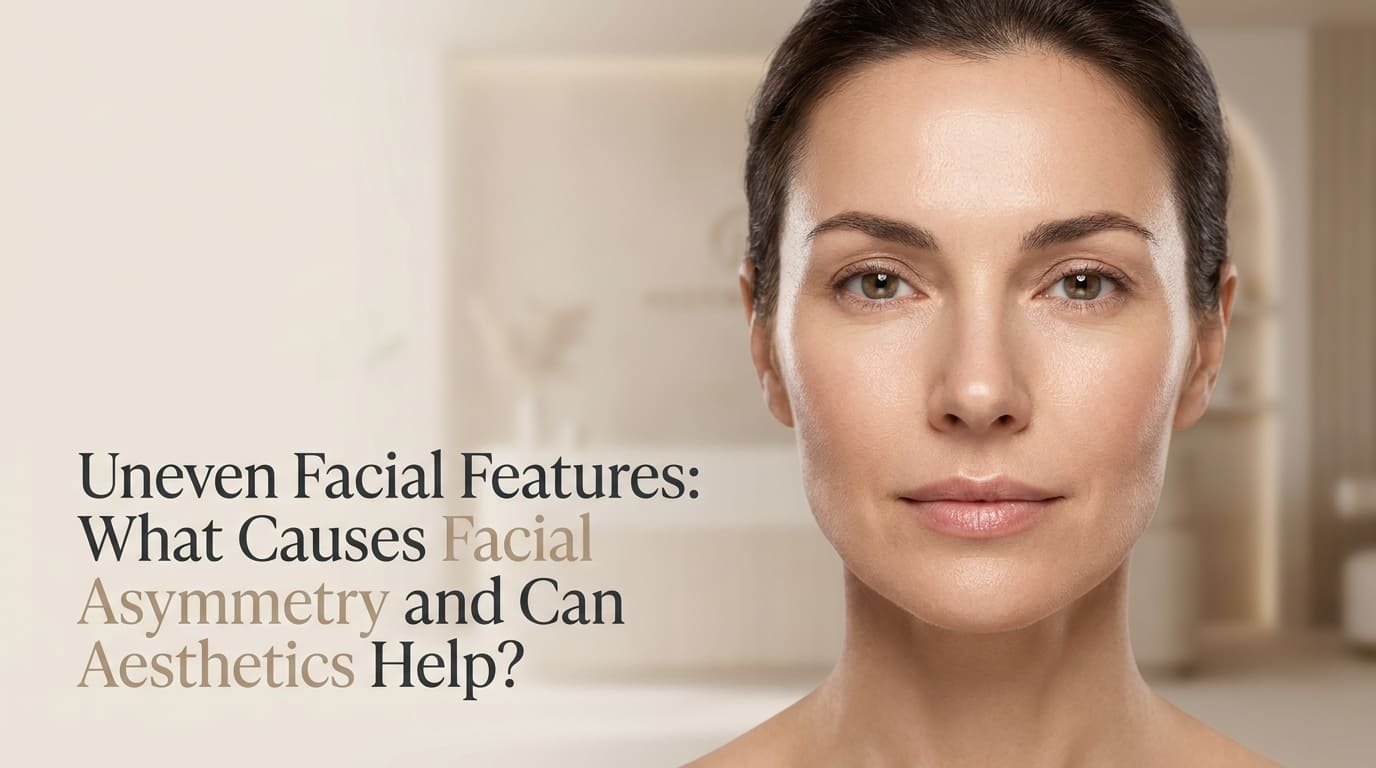
Look closely at your face in a photograph, and you may notice that one eyebrow sits slightly higher than the other, one cheek appears fuller, or one side of your smile looks different. These small differences can become more noticeable when you start paying attention to facial proportions.
Facial asymmetry is extremely common. In fact, almost nobody has a perfectly symmetrical face. The two sides naturally differ in bone structure, muscle movement, fat distribution, and soft tissue. These variations are part of what makes each face individual.
However, some people become concerned when the differences seem more pronounced. One side may appear flatter, the jawline may look uneven, or the eyebrows may sit at noticeably different heights.
Aesthetic treatments may help improve certain types of facial imbalance, particularly when they are related to muscle activity, soft tissue volume, or skin laxity. They cannot correct every cause of asymmetry, and treatment is not always necessary.
Understanding why the face looks uneven is the most important starting point. This guide explores common causes of facial asymmetry, how practitioners assess facial proportions, and which non-surgical options may be suitable.
What Is Facial Asymmetry?
Facial asymmetry refers to differences between the left and right sides of the face. These differences can involve the eyebrows, eyes, cheeks, nose, lips, jawline, or chin.
Some variations are visible when the face is relaxed. Others become noticeable only when smiling, speaking, or making expressions.
For example, one side of the mouth may rise slightly higher when smiling. One cheek may have more natural fullness, or one eyebrow may move more actively than the other.
There is an important distinction between natural asymmetry and a change that develops suddenly.
Longstanding differences are usually related to natural anatomy, development, or gradual ageing. Sudden facial drooping or weakness is different and may indicate a medical problem requiring urgent assessment.
What Causes Uneven Facial Features?
Facial asymmetry can develop for several reasons. In many cases, more than one factor contributes to the overall appearance.
1. Natural Bone Structure
The underlying facial skeleton provides the foundation for the face. Differences in the shape or position of the cheekbones, jawbone, chin, and eye sockets can influence how the soft tissues sit.
One side of the jaw may naturally be slightly wider. The chin may sit a little off centre, or one cheekbone may be more prominent.
These differences often develop during growth and may remain relatively stable throughout adulthood.
Aesthetic treatments can sometimes improve the appearance of surrounding soft tissues, but injectable treatments cannot change the underlying bone structure. More significant skeletal differences may require assessment by an appropriately qualified medical or surgical specialist.
2. Uneven Muscle Activity
Facial muscles control expressions such as smiling, frowning, raising the eyebrows, and closing the eyes.
The muscles on each side do not always work with the same strength or movement pattern. One eyebrow may lift more easily, or one side of the mouth may move more during a smile.
Repeated expressions can make these differences more noticeable over time.
In selected cases, anti-wrinkle injections may help address muscle-related asymmetry. However, treatment requires a careful understanding of the muscles involved. Reducing movement on one side without considering the other can sometimes make the imbalance more noticeable.
You can explore the anti-wrinkle treatment options at Angel White Aesthetics to learn more about this treatment approach.
3. Uneven Facial Volume
The cheeks, temples, and lower face contain different fat compartments that contribute to facial shape and fullness.
These areas do not always change evenly with age. One cheek may gradually lose more volume than the other, or differences in the distribution of soft tissue may become more visible.
Weight changes can also affect facial fullness. A person may notice that one side appears flatter or less defined, even when the difference was present before.
When volume imbalance is the main concern, a practitioner may assess whether carefully selected dermal filler treatment could improve the overall proportions.
However, adding volume is not automatically appropriate. The practitioner must consider the existing facial structure, skin condition, and underlying cause.
4. Ageing and Changes in Skin Support
Ageing affects the face gradually. Collagen and elastin production decline, skin firmness changes, and the deeper supporting structures also undergo natural changes.
These processes may not happen equally on both sides. As a result, one cheek may appear lower, one side of the jawline may look softer, or folds around the mouth may become more noticeable on one side.
Skin laxity and tissue descent can contribute to facial asymmetry, particularly in the lower face.
Where appropriate, treatments designed to improve facial contour or support may be discussed. The choice depends on whether the concern is related to volume, skin laxity or another structural factor.
5. Dental and Jaw Differences
The position of the teeth and jaw can influence facial balance. Differences in the bite, jaw alignment, or dental structure may affect the lower face and chin.
Some people also develop uneven jaw muscle size because they favour one side when chewing or clench their teeth.
In these situations, aesthetic treatment alone may not address the underlying cause. A dental or orthodontic assessment may be more appropriate, particularly when asymmetry is associated with discomfort, difficulty chewing or changes in the bite.
6. Lifestyle and Sleeping Habits
People sometimes associate facial asymmetry with sleeping on one side, chewing predominantly on one side, or everyday habits.
These behaviours may influence comfort, muscle use, or the way the face appears temporarily. However, they should not automatically be blamed for structural facial differences.
Longstanding asymmetry usually has several possible contributing factors. It is better to understand the individual's anatomy than assume that one habit is responsible.
Can Aesthetic Treatments Help Facial Asymmetry?
In selected cases, yes. The aim is usually to improve facial balance rather than make both sides identical.
The appropriate treatment depends on the cause. A practitioner should assess the face at rest and during movement before recommending any procedure.
Dermal Fillers for Uneven Facial Volume
Dermal fillers may be considered when one area has less soft tissue volume or definition than the other.
For example, carefully planned treatment may help address differences in cheek fullness, chin projection, or jawline contour.
The goal is to create better overall proportions. It is not necessarily to add the same amount of filler to both sides. In some cases, only one area may need treatment.
Product selection, placement and quantity require individual assessment. Dermal fillers also carry risks, including swelling, bruising, infection, lumps and rare but serious vascular complications.
You can learn more about dermal filler treatments in Littlehampton and the considerations involved before treatment.
Face Contouring for Improved Proportions
Facial contouring focuses on the relationship between different areas of the face. It may involve selected treatments to improve the appearance of the cheeks, chin or jawline.
This approach can be useful when uneven facial proportions are related to soft tissue volume or contour rather than a major difference in bone structure.
A full facial assessment is important. Treating one feature in isolation may not produce the balance someone expects.
Explore the face contouring treatment page to understand the areas that may be considered during an individual treatment plan.
Anti-Wrinkle Injections for Muscle-Related Differences
When asymmetry is mainly caused by uneven muscle activity, anti-wrinkle injections may sometimes be considered.
For example, differences in eyebrow movement or certain expression patterns may be assessed to determine whether carefully placed treatment could improve balance.
The treatment works by temporarily reducing activity in selected muscles. It does not correct differences in bone structure or replace lost volume.
The practitioner must also consider how the muscles work together. Treating one side without understanding the full movement pattern can create an unwanted result.
Liquid Facelift for Multiple Areas
Some people have more than one concern. They may notice reduced cheek fullness, changes around the mouth, and less definition in the lower face.
A liquid facelift is a non-surgical approach that may use dermal fillers in selected areas to address volume and facial contour.
It is not a surgical facelift and cannot correct every type of asymmetry. Its suitability depends on the individual's facial structure, treatment goals, and the extent of the changes.
Read more about the liquid facelift treatment at Angel White Aesthetics.
Thread Facelift for Selected Cases of Skin Laxity
When unevenness is partly related to skin laxity or soft tissue descent, a thread facelift may be discussed in selected cases.
Thread treatments aim to provide support to certain areas of the face. They do not change the underlying bone structure or correct every cause of uneven features.
Suitability depends on skin condition, tissue characteristics, and the degree of laxity. A consultation should establish whether this approach is appropriate or whether another option would be more suitable.
You can find further information on the thread facelift treatment page.
When Is Aesthetic Treatment Not the Right Answer?
Not every uneven feature should be treated with an injectable or cosmetic procedure.
If the difference is caused by significant jaw misalignment, dental problems, or underlying skeletal structure, a different type of assessment may be needed.
Similarly, adding filler to an area that already has sufficient volume may make the face look heavier rather than more balanced.
There are also situations where asymmetry should be assessed medically before any aesthetic treatment is considered.
Seek urgent medical help if facial asymmetry develops suddenly, particularly if one side of the face droops or feels weak. Sudden facial weakness, difficulty speaking, arm weakness or sudden vision changes can be signs of a stroke. Call 999 immediately in the UK.
New or unexplained facial changes should not simply be treated as signs of ageing.
How Is Facial Asymmetry Assessed Before Treatment?
A proper consultation involves more than looking at the face from the front.
A practitioner should consider the face at rest and during natural expressions. Photographs from different angles may help identify differences in proportions and movement.
The assessment may include:
- Upper face: Eyebrow height, forehead movement, and differences around the eyes.
- Midface: Cheek projection, volume distribution and the relationship between the cheeks and under-eye area.
- Lower face: Chin position, jawline definition, lip alignment and the appearance of the smile.
- Skin and soft tissue: Skin firmness, laxity and differences in tissue support.
- Facial movement: How the muscles behave when smiling, speaking, and raising the eyebrows.
Medical history is also important. Previous injuries, dental treatment, surgery, and earlier aesthetic procedures may all be relevant.
The practitioner should explain which differences can realistically be addressed and which are part of the person's natural anatomy.
Can Facial Asymmetry Be Corrected Completely?
Usually, complete symmetry is neither realistic nor necessary.
The two sides of the face naturally differ, and trying to make them identical can lead to excessive treatment. This may create an unnatural appearance or change features that already suit the individual's face.
A more sensible aim is to improve balance where a specific difference is causing concern.
Some people may benefit from a small adjustment. Others may find that no treatment is needed once they understand the cause of the asymmetry.
The decision should always be based on suitability, realistic expectations, and informed consent.
Frequently Asked Questions
Is facial asymmetry normal?
Yes. Most people have some degree of facial asymmetry. Differences in bone structure, muscle activity and soft tissue distribution are natural.
Why does one side of my face look fuller?
Differences in fat distribution, facial anatomy, ageing and weight changes can influence cheek fullness. A professional assessment can help identify the likely cause.
Can dermal fillers correct an uneven face?
Dermal fillers may help selected cases where differences in soft tissue volume or contour are responsible. They cannot correct every structural or muscular cause of asymmetry.
Can anti-wrinkle injections make eyebrows more even?
In some cases, carefully planned treatment may help address differences in eyebrow movement caused by muscle activity. Results depend on individual anatomy and require an experienced practitioner.
Does sleeping on one side cause facial asymmetry?
Sleeping position is sometimes blamed for uneven facial features, but it is not usually possible to attribute longstanding structural asymmetry to this habit alone. Natural anatomy, ageing and other factors may play a greater role.
Should I treat mild facial asymmetry?
Not necessarily. Mild differences are normal and do not require correction. Treatment should be considered only if there is a clear concern and a suitable option has been identified.
A Balanced Approach to Facial Aesthetics
Uneven facial features are common, and they do not automatically indicate a problem. Differences in bone structure, muscle movement, facial volume, and skin support can all influence how the face looks.
Aesthetic treatments may help in selected cases, particularly when asymmetry is related to soft tissue volume, facial contour, or muscle activity. However, the right approach depends on understanding the cause rather than treating the most noticeable feature.
At Angel White Aesthetics, an individual assessment can help establish whether a treatment may be appropriate, what it could realistically achieve, and whether another type of professional advice would be more suitable.
The aim should not be perfect symmetry. It should be a natural balance that respects your existing facial features.