Written by Dr Irina Prikulis, founder of Angel White Aesthetics, with over 14 years of clinical aesthetic practice.
Mesotherapy has been part of European medical practice for over seven decades. In UK aesthetics, it went through a period of being overshadowed by the more dramatic, immediately visible results of filler and anti-wrinkle treatment. That period is ending. Patient demand for skin quality improvement treatments that work gradually from within rather than producing obvious structural change has grown significantly and consistently over the past several years, and mesotherapy is positioned directly in the centre of that demand.
For practitioners who want to offer a genuinely complete range of skin quality treatments, mesotherapy training is no longer an optional add-on to an injectable portfolio. It is increasingly a clinical expectation from patients who research their treatments before booking and who are actively looking for practitioners who understand the full range of options rather than defaulting to a short list of popular injectables.
This article covers what the Angel White Aesthetics mesotherapy training course contains, who it is designed for, and what you will be able to do clinically once you have completed it.
Why Mesotherapy Is Growing as a Treatment Category
The growth in mesotherapy demand is not driven by social media trends in the way that some treatment categories are. It is driven by a genuine shift in how patients think about their skin and what they want from aesthetic treatment.
A growing proportion of patients arriving at consultation are not seeking dramatic structural change. They are seeking sustained improvement in skin quality, even tone, hydration, and luminosity. They have often already tried the topical skincare route and found it insufficient for what they want to achieve. They want something that works at the tissue level rather than at the surface. They want results that look like genuinely healthy skin rather than treated skin.
Mesotherapy addresses this precisely. The multi-ingredient approach delivers vitamins, minerals, amino acids, hyaluronic acid, and antioxidants directly into the dermal tissue where topical products cannot reach. The results develop gradually over a course of treatment and produce exactly the kind of genuinely improved skin quality that this patient group is looking for.
Practitioners who can offer mesotherapy alongside their injectable portfolio have a meaningful clinical advantage. They can address a wider range of patient presentations and they can design treatment programmes that combine modalities in ways that produce better results than any single treatment delivers alone.
Who the Mesotherapy Training Course Is For
The mesotherapy training course at Angel White Aesthetics is designed for practitioners who already hold a foundation injectable qualification and who are looking to expand their clinical offering into skin quality treatments.
Nurses, doctors, dentists, and other regulated healthcare professionals who have completed their foundation aesthetic training and are actively practising in an aesthetic setting are the primary audience. The course assumes a baseline of clinical knowledge including understanding of facial anatomy, injection technique, patient assessment, and complication management. It builds on that foundation rather than repeating it.
Practitioners who are newer to aesthetics and who want to develop a skin quality treatment specialism alongside their injectable work find mesotherapy training a logical early step in their continuing professional development, often completing it alongside or shortly after their foundation filler training.
Practitioners with an established injectable practice who have noticed patients requesting skin quality improvements that their current treatment portfolio does not fully address are also well suited. Mesotherapy fills the gap between topical skincare and structural injectable treatment in a way that opens a genuinely new clinical conversation with existing patients.
The course is not appropriate for practitioners who have not yet completed foundation injectable training. Mesotherapy involves fine needle injections and requires a clinical foundation that the course builds on rather than introduces.
What the Course Covers: Theory
The theory element of the mesotherapy training course establishes the clinical foundation that makes safe and effective practice possible.
The history and scientific basis of mesotherapy is covered first. Understanding where the technique comes from, how it has been developed, and what the peer-reviewed evidence for its use in aesthetic practice shows is important context for any practitioner who will be explaining the treatment to patients and making clinical decisions about when to recommend it.
The science of the mesoderm and the mechanism of dermal delivery is covered in the depth required for a practitioner to understand why injecting into the dermis produces different results from topical application of the same ingredients. The concept of bioavailability and the pharmacokinetics of how different active ingredients behave once they are placed in the tissue is directly relevant to understanding what specific formulations are designed to achieve and why one product performs differently from another in the same patient.
Ingredient science is given significant attention. The course covers the role of each category of active ingredient found in mesotherapy formulations, including hyaluronic acid at different molecular weights, B vitamins and vitamin C, minerals, amino acids and their role in collagen synthesis, antioxidants and free radical management, and the range of growth factors and peptides included in more advanced formulations. Understanding what each ingredient contributes is what allows a practitioner to choose the most appropriate product for a given patient presentation rather than using a single generic formulation for every patient.
Contraindications and patient assessment specific to mesotherapy are covered thoroughly. While the contraindication profile for mesotherapy overlaps with injectable treatments generally, there are specific product-related considerations including sensitivity to particular ingredient categories and the assessment of skin conditions that affect how the treatment should be approached. A practitioner who applies the same protocol to every patient without assessing these variables is not practising at the standard the course prepares for.
Treatment area anatomy relevant to mesotherapy is covered at the level needed for safe delivery across the face, neck, décolletage, and other body areas included in the course scope. The injection technique used in mesotherapy is relatively superficial compared to structural filler placement, but it requires precise depth control and an understanding of how the anatomy varies across different treatment areas.
What the Course Covers: Practical Training
The practical element of the mesotherapy training course is where the clinical knowledge built in the theory session is translated into treatment competence.
Injection technique for mesotherapy is the foundational practical skill. Mesotherapy uses either a single needle applied in a sequential point-by-point pattern, a mesotherapy gun device that automates the depth and spacing of injections, or a combination of both depending on the treatment area and the practitioner's approach. The course covers both techniques and the clinical situations where each is most appropriate.
The nappage technique, which involves a series of very fine, lightly spaced injections just beneath the skin surface, and the papule technique, which places slightly deeper deposits that form visible skin-level papules that resolve over the following hours, are both covered with practical application on models.
Product preparation and mixing is covered as a practical skill because some mesotherapy treatments involve preparing a cocktail from individual ingredients rather than using a pre-formulated product. Understanding how to combine ingredients safely, at appropriate concentrations, and in a sterile manner is a clinical skill with both efficacy and safety implications.
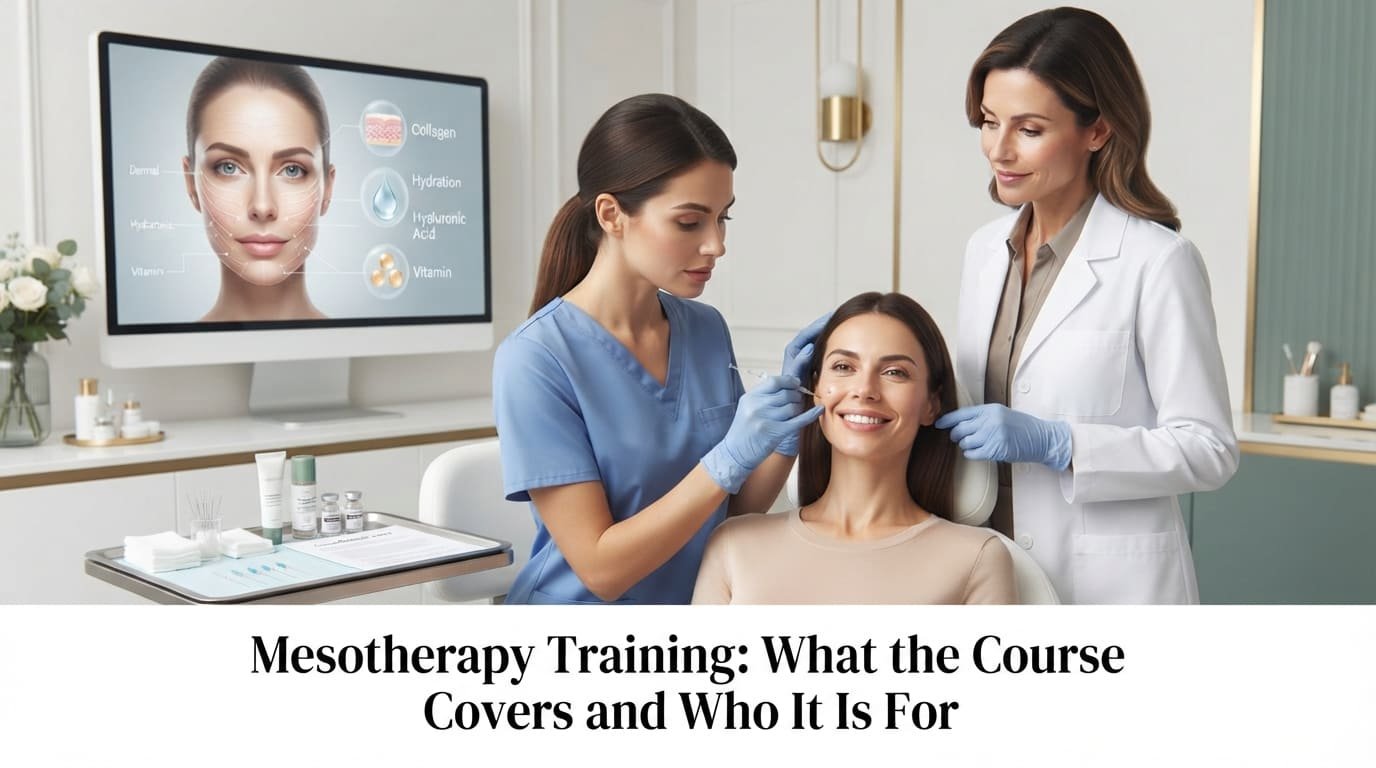
Practical sessions are supervised by Dr Irina Prikulis throughout the hands-on element. The supervision is consistent and engaged rather than available only when a delegate specifically requests input. Each injection attempt is observed, and feedback is provided in real time rather than after the fact.
Treatment areas covered in the practical session include the face as the primary site and the neck and décolletage as additional areas where the same technique is commonly applied in practice. Body mesotherapy applications are introduced at a theoretical level with practical coverage determined by the course programme and the time available.
Patient assessment and consultation role-play is incorporated into the practical element because the treatment decision and the patient communication surrounding it are as clinically important as the injection technique itself. A practitioner who cannot clearly explain what mesotherapy does, what results are realistic across a course, and why it is the right recommendation for a specific patient presentation is not fully prepared to offer the treatment regardless of their technical injection skill.
What You Can Treat After Completing the Course
Completing the mesotherapy training course prepares you to offer mesotherapy as a clinical treatment in your own practice for a defined range of indications.
Skin quality improvement across the face and neck is the primary clinical application. Dullness, dehydration, uneven tone, early fine lines, and a general loss of luminosity and vitality in the skin are all presentations that mesotherapy addresses well and that you will be equipped to treat following the course.
Post-inflammatory hyperpigmentation, where the melanin deposits left by previous acne or other skin inflammation contribute to an uneven complexion, is an indication where mesotherapy's multi-ingredient approach, particularly formulations containing vitamin C and glutathione as brightening agents, produces meaningful improvement over a course of treatment.
Early hair thinning and scalp health are covered as an indication. Scalp mesotherapy has an established evidence base and a strong patient demand that is growing as awareness of non-pharmacological approaches to hair thinning increases. The course prepares you to assess whether a patient's hair concern is appropriate for mesotherapy, to apply the technique to the scalp anatomy specifically, and to discuss realistic expectations for this indication honestly.
Skin quality improvement in body areas including the hands, inner arms, and abdomen are within the scope of what the course prepares for, with the specific body applications covered at a level appropriate to the course structure.
How Mesotherapy Fits Into a Broader Treatment Programme
One of the most clinically important things the course develops is an understanding of how mesotherapy works alongside other treatments rather than in isolation.
Mesotherapy combined with polynucleotide treatment addresses both the multi-ingredient nutritional support dimension and the specific fibroblast stimulation and tissue regeneration mechanism of polynucleotides. The combination is greater in effect than either treatment alone because the mechanisms complement rather than overlap.
Mesotherapy used before or alongside a course of Profhilo creates a more comprehensively hydrated and nutritively supported tissue environment for Profhilo's bio-remodelling mechanism to work in.
Mesotherapy used as a maintenance treatment between courses of more intensive skin quality interventions sustains the tissue environment that the primary treatments have improved. Patients who have completed a course of polynucleotides or Profhilo and want to extend and maintain the result between courses respond well to periodic mesotherapy sessions that reinforce the nutritive support without requiring the full investment of another intensive course.
Understanding this combination logic is what allows you to design treatment programmes for patients rather than simply offering individual treatments. Practitioners who can build a coherent multi-treatment plan that addresses a patient's skin quality goals comprehensively over time are the ones who develop the ongoing patient relationships that sustain a practice.
What to Expect From the Training Day Itself
The mesotherapy training course at Angel White Aesthetics is structured to cover the full theory and practical content in a focused, clinically oriented day.
The ratio of theory to practical time is balanced to give both elements the attention they require. The theory is not rushed to create more hands-on time, and the practical element is not shortened to cover more theory. Both are necessary, and the course structure reflects this.
The number of delegates is deliberately limited to ensure that each practitioner receives meaningful individual supervision during the practical session. Mesotherapy technique is precise enough that generic group observation is not a substitute for individualised feedback on injection depth, spacing, and angle.
Post-course support is available through the Angel White Aesthetics training team. Questions that arise during your first independent mesotherapy sessions, concerns about patient presentations that fall outside what the training covered, and requests for further guidance on treatment planning are all welcomed rather than treated as an inconvenience. The learning that happens in the first months of independent practice is often the most clinically significant of your training journey and it deserves support.
Frequently Asked Questions
How many patients will I treat during the practical session?
The practical session is structured to give each delegate meaningful hands-on time with model patients under direct supervision. The specific number of patients treated during the day depends on the delegate group size and the course structure, which is confirmed when you book.
Do I need to have a specific number of injectable treatment hours before attending?
Active practice in an aesthetic setting following foundation training is the appropriate prerequisite rather than a specific number of hours. If you are recently qualified and have been treating patients consistently, the course is likely appropriate. If you have not yet begun treating patients independently following foundation training, it is worth completing that consolidation phase first.
Can I offer scalp mesotherapy after this course?
Yes. The course covers scalp mesotherapy as an indication and prepares you to assess and treat patients presenting with early hair thinning and scalp health concerns using mesotherapy technique. Insurance coverage for scalp applications should be confirmed with your provider before treating patients.
What products are used during the course?
The course uses pharmaceutical-grade mesotherapy products from reputable manufacturers. You will be briefed on the specific products before the course date so you can familiarise yourself with the formulation and ingredient profile in advance.
Will completing this course affect my CPD record?
Yes. The course is accredited and produces a certificate that can be included in your continuing professional development record for NMC revalidation or equivalent professional development documentation.
Is mesotherapy the same as biorevitalisation? Do I need both courses?
Mesotherapy and biorevitalisation are related but distinct treatment categories, as covered in the dedicated comparison article on the Angel White Aesthetics blog. Completing the mesotherapy course prepares you to offer mesotherapy specifically. Biorevitalisation training covers formulations with a higher concentration of hyaluronic acid as the primary ingredient and a somewhat different clinical application profile. Many practitioners find value in completing both to offer a complete skin quality treatment programme.
If you are interested in adding mesotherapy to your aesthetic practice and want to discuss whether the course is the right fit for where you are in your clinical development, get in touch with the Angel White Aesthetics training team.
View the Mesotherapy Course or Contact the Training Team