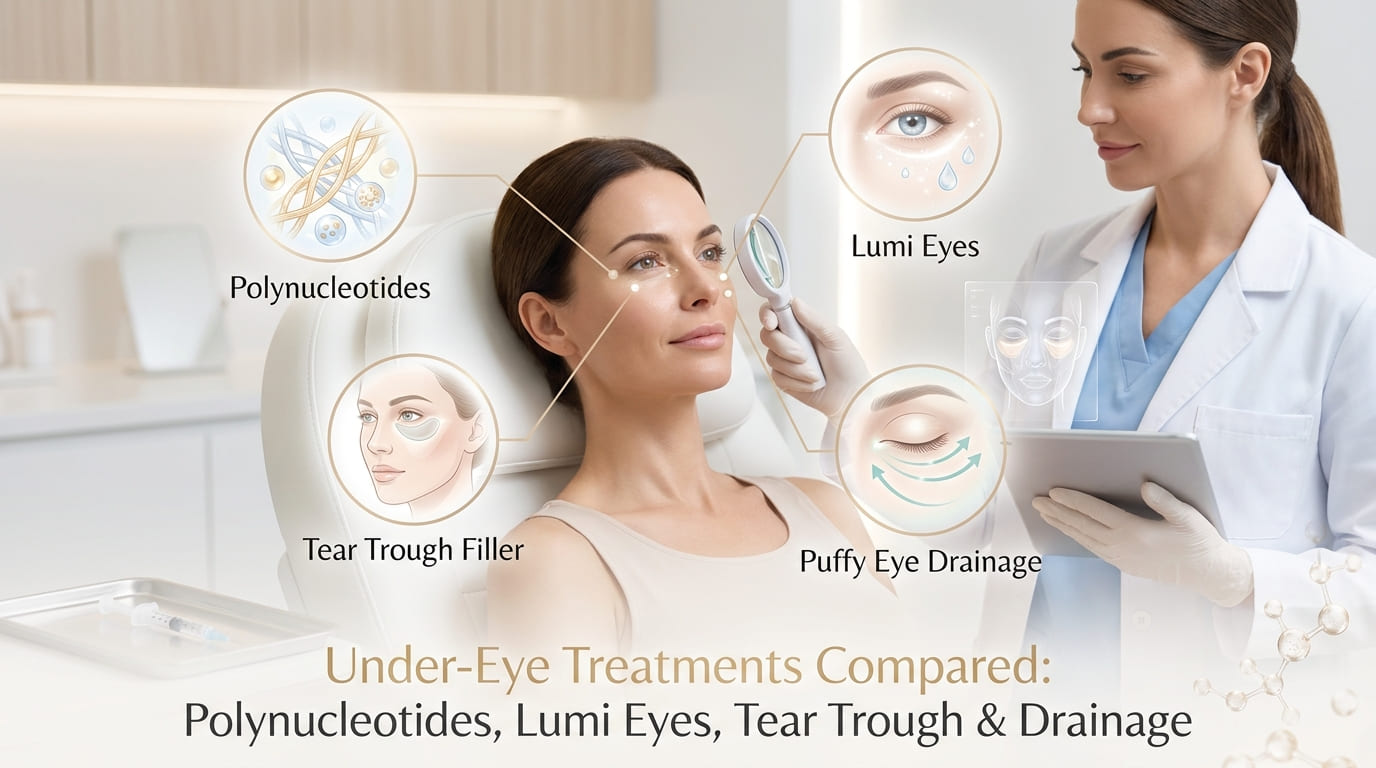
Tired eyes, dark circles, under-eye hollows, and fine lines are among the most common reasons people search for non-surgical under-eye rejuvenation. For years, tear trough filler was the obvious option for a refreshed look. Today, more people are asking whether polynucleotides under the eyes can offer a safer, softer, and more natural-looking alternative.
At Angel White Aesthetics in Littlehampton and Hove, under-eye treatment is never about simply “filling a dip”. The periorbital area is delicate, thin-skinned, and anatomically complex. It includes the tear trough, orbital fat, orbicularis oculi muscle, tiny blood vessels, lymphatic drainage pathways, and fragile skin that often shows ageing earlier than other areas of the face. That is why choosing between polynucleotides and tear trough filler depends on the cause of the concern, not just the appearance of the shadow.
What are polynucleotides under the eyes?
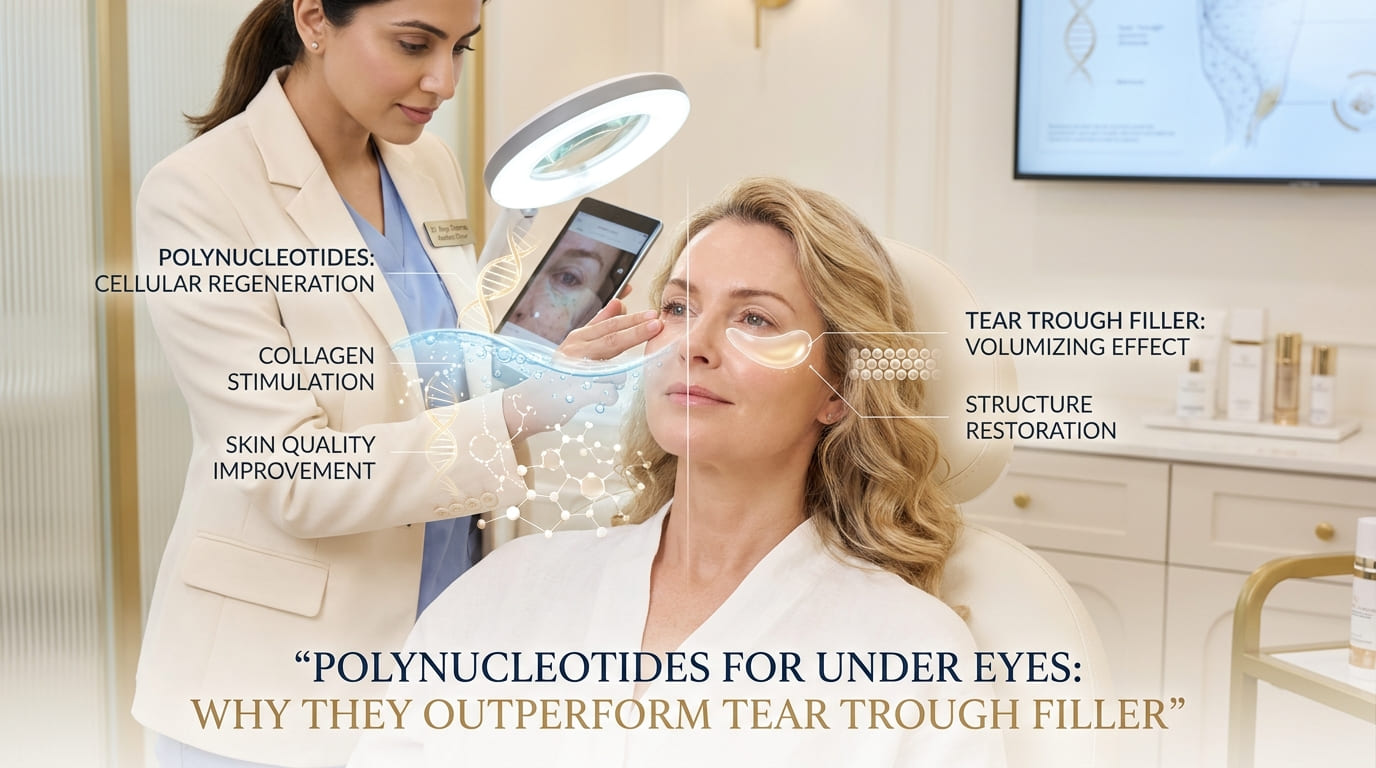
Polynucleotides are regenerative injectable treatments used to improve skin quality from within. Instead of adding volume like hyaluronic acid filler, they support skin repair, hydration, elasticity, and tissue regeneration. In the under-eye area, this makes them especially useful for thin skin, crepey texture, fine lines, tired eyes, and some types of dark circles.
People often search for eye polynucleotides UK because they want a treatment that looks subtle rather than overfilled. Polynucleotides work gradually, helping the skin behave more like healthier, better-functioning skin. This is why they are often described as a skin-quality treatment rather than a contour-changing treatment.
In simple terms, tear trough filler fills. Polynucleotides regenerate.
What does tear trough filler do?
Tear trough filler is usually a hyaluronic acid injectable placed beneath the under-eye hollow to soften shadowing caused by volume loss. It can be helpful when the main issue is structural hollowing, where the area beneath the lower eyelid looks sunken because of facial anatomy, ageing, or mid-cheek volume loss.
However, tear trough filler does not directly improve under-eye thin skin, pigment-related dark circles, skin texture, fine lines, or crepiness. It changes shape by adding volume. That is useful in the right patient, but less ideal when the concern is skin quality rather than hollowing.
This is the key difference: one treats volume, the other treats quality.
Why polynucleotides can outperform tear trough filler
Polynucleotides often outperform tear trough filler when the concern is tired-looking skin, crepey under-eyes, fine wrinkles, dullness, or vascular-looking dark circles. The reason is the mechanism. Hyaluronic acid filler attracts water and adds volume. Polynucleotides do not aim to inflate the area; they encourage periorbital regeneration and healthier skin behaviour.
This matters because the under-eye is highly sensitive to swelling. If someone already has puffy eyes, under-eye bags, poor lymphatic drainage, or mild fluid retention, adding a water-attracting filler can sometimes make the area look heavier. Polynucleotides are not a volumising filler, so they are often a more suitable option for patients who want improvement without the risk of looking puffy or overcorrected.
For many patients, the decision is not “smooth wrinkles vs glow skin”. It is more specific: fillers can improve hollowing, while polynucleotides improve the condition of the under-eye skin itself.
Polynucleotides for dark circles
Polynucleotides dark circles treatment is especially relevant when darkness is linked to thin under-eye skin, vascular show-through, dullness, or poor skin quality. If the skin is very thin, the blood vessels beneath can become more visible, creating a blue, purple, or tired appearance.
Dark circles can also be pigment-related or structural. Pigment-related dark circles are caused by melanin or skin tone changes. Structural dark circles come from shadowing due to hollow under-eyes or tear trough depth. Vascular dark circles are often worsened by thin skin and visible underlying vessels.
Polynucleotides are most useful when the skin needs strengthening, hydration, and regeneration. Tear trough filler may be more appropriate when the main issue is a deep hollow, and the skin itself is healthy enough to tolerate filler.
Polynucleotides tear through: do they replace filler?
Polynucleotides can be an excellent tear trough filler alternative, but they do not replace filler in every case. If someone has true volume loss, prominent hollowing, or a deep tear trough caused by facial structure, filler may still be useful.
However, if the patient has under-eye thin skin, mild bags, puffiness, fine lines, dark circles, or a tired appearance without major volume loss, polynucleotides may be the better first step. They can improve the skin canvas before any decision is made about adding volume.
This is why many people ask: polynucleotides or tear trough filler first? In many cases, skin quality should come first. Improving the tissue can create a smoother, brighter under-eye area and may reduce the amount of filler needed later, if filler is still required.
Bags under eyes, non-surgical: are polynucleotides suitable?
Bags under the eyes are not all the same. Some are caused by orbital fat, some by fluid retention, some by skin laxity, and some by filler-related swelling. Polynucleotides may help when the concern is skin quality, mild laxity, or tired-looking texture, but they will not remove significant orbital fat pads.
For patients with puffy under-eyes, careful assessment is essential. Adding hyaluronic acid filler into an already puffy area can make the under-eye look heavier in some cases. Polynucleotides are often preferred where the goal is under-eye rejuvenation without extra volume.
No eye area injectable is completely risk-free, and no treatment should be described as fully “vascular-safe”. The safer approach is vascular-aware, anatomy-led treatment planning by an experienced practitioner.
Polynucleotides vs filler: the practical comparison
| Concern | Polynucleotides under the eyes | Tear trough filler |
| Thin under-eye skin | Strong option | May not help skin quality |
| Fine lines and crepey texture | Strong option | Limited improvement |
| Dark circles from thin skin | Often helpful | May help only if shadow-related |
| Hollow under-eyes | Mild improvement only | Stronger option |
| Puffy under-eyes | Often considered before filler | Can worsen puffiness in unsuitable patients |
| Results | Gradual, regenerative | Immediate volume change |
| Look | Natural, subtle, skin-focused | Contour-focused |
| Treatment type | Regenerative skin treatment | Volumising filler treatment |
This is also why comparing polynucleotides to anti-wrinkle injections is different. Anti-wrinkle is more of a muscle vs skin treatment decision: one reduces muscle movement, the other improves skin quality. Tear trough filler is a volume treatment. Polynucleotides are a periorbital aesthetics treatment for skin regeneration.
What results can you expect?
Polynucleotide under-eye results are gradual. The skin usually begins to look more hydrated, smoother, and brighter over several weeks. Fine lines may soften, texture may improve, and the under-eye area may look less tired. Most patients need a course of sessions rather than one treatment, followed by maintenance depending on skin quality, age, lifestyle, and treatment goals.
At Angel White Aesthetics, treatment planning is personalised. Your practitioner will assess whether your dark circles are pigment-related, vascular, structural, or linked to skin thinning. This matters because the best treatment for hollow under-eyes is not always the best treatment for tired eyes or under-eye wrinkles.
For related options, you can explore:
Under-eye treatments in Littlehampton
Who is a good candidate?
Polynucleotides may be suitable if you have tired eyes, under-eye fine lines, crepey skin, mild dark circles, early ageing, dehydrated under-eyes, or thin skin around the periorbital area. They may also appeal to patients who want natural-looking results without adding visible volume.
Tear trough filler may be more suitable if your main concern is a deep hollow and you do not have significant puffiness, fluid retention, or very thin skin.
The best plan may also involve a combination treatment. In some cases, polynucleotides are used first to improve skin quality, followed later by conservative tear trough filler if structural volume loss remains.
Are polynucleotides safe for the under-eye area?
Polynucleotides are widely used in aesthetic medicine for skin regeneration and under-eye rejuvenation, but safety depends on correct patient selection, product choice, injection technique, and aftercare. Possible side effects include temporary swelling, small bumps, redness, tenderness, or bruising.
Because the under-eye area is delicate, treatment should only be performed after a consultation. Patients who are pregnant, breastfeeding, have an active skin infection, known allergy concerns, or a complex medical history should be assessed carefully before any injectable treatment.
Final thoughts
Polynucleotides under the eyes outperform tear trough filler when the real problem is skin quality, thin skin, fine lines, dullness, or certain types of dark circles. Tear trough filler still has a role when the concern is genuine volume loss or deep hollowing.
The smartest approach is not to choose the trendiest treatment. It is to diagnose the cause of the under-eye concern first. At Angel White Aesthetics, the focus is on natural-looking, evidence-led treatment planning for the delicate eye area, helping you refresh tired eyes without looking overfilled.
FAQs
Are polynucleotides good for the under eyes?
Yes, polynucleotides are good for the under-eye area when the concern is thin skin, fine lines, crepey texture, mild dark circles, or tired-looking skin. They work by improving skin quality gradually rather than adding volume like a tear trough filler.
Are polynucleotides better than tear trough filler?
Polynucleotides are better than tear trough filler for skin quality, fine lines, thin under-eye skin and some dark circles. Tear trough filler may be better for true hollowing or volume loss. The best choice depends on your anatomy.
Do polynucleotides help with dark circles under the eyes?
Polynucleotides can help with dark circles under the eyes when darkness is linked to thin skin, dullness, or visible vessels. They may not fully correct pigment-related dark circles or deep structural shadows, so consultation is needed to identify the cause.
How many polynucleotide sessions do I need for dark circles?
Most people need two to three polynucleotide sessions for dark circles, depending on skin quality, age, under-eye thinness, and treatment goals. Results are gradual, so maintenance may be recommended after the initial course to support longer-term improvement.
Are polynucleotides safe for the under-eye area?
Polynucleotides are generally considered suitable for the under-eye area when performed by a trained practitioner after consultation. Temporary swelling, redness, bruising, or small bumps can occur. The periorbital area is delicate, so careful technique is essential.
Should I get polynucleotides or tear trough filler first?
Many patients benefit from polynucleotides first if the under-eye skin is thin, crepey, puffy, or dark. Tear trough filler may be considered later if genuine hollowing remains. Starting with skin quality often creates a safer, more natural result.