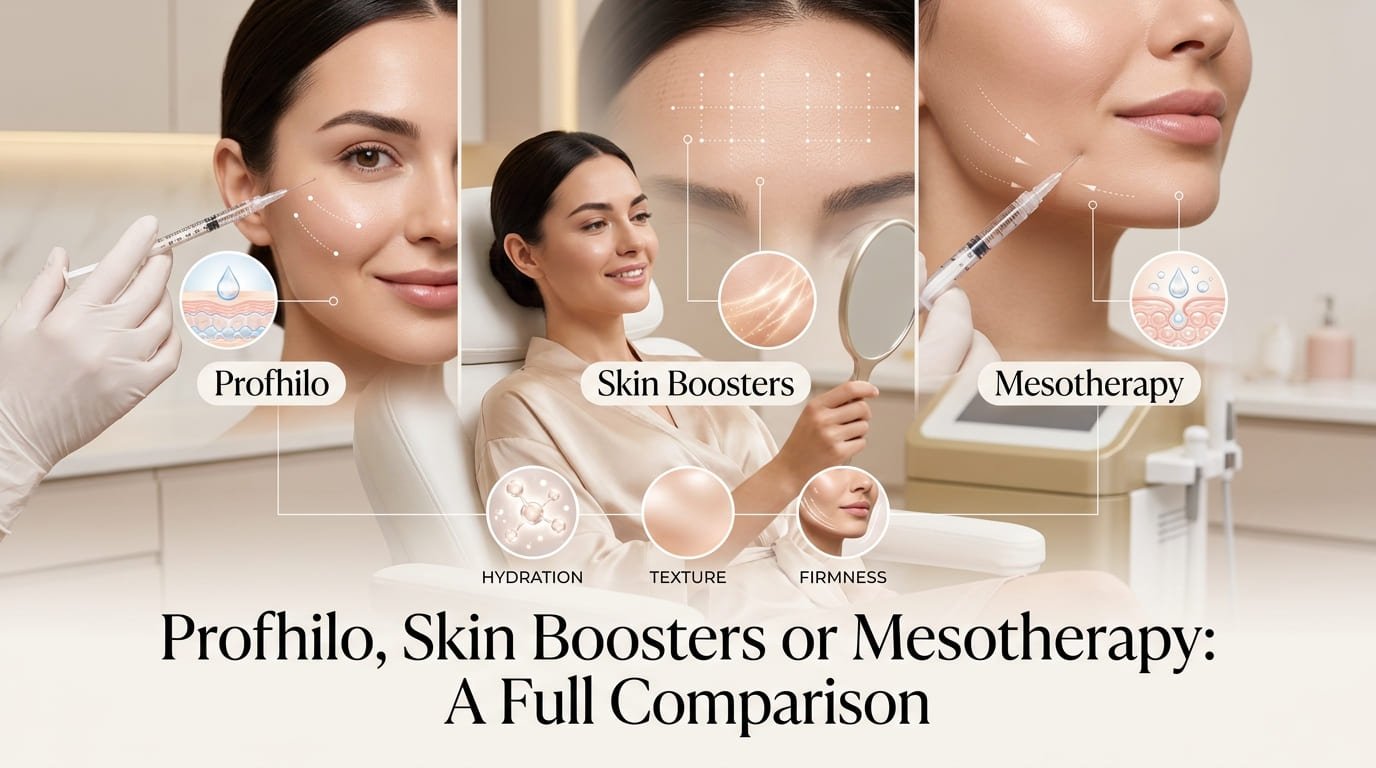
These three treatments come up together constantly. Patients mention them in the same breath. Clinics list them side by side on treatment menus. They all involve injectable skin improvement, and they all promise a better complexion. Beyond that, the similarities begin to break down in ways that actually matter when you are deciding which one to book.
The confusion is understandable. The language around injectable skin quality treatments is inconsistent across the industry. Some clinics use the terms interchangeably. Others use them to mean quite specific things. A patient who has read about all three and still cannot articulate the difference between them is not uninformed. They are responding accurately to a lack of clarity in how these treatments are typically described.
This article is designed to resolve that confusion with a treatment-by-treatment explanation of how each one works, what it is genuinely best suited to, and how the three compare across the factors that actually influence a booking decision.
Profhilo: What It Is and How It Works
Profhilo is a specific, branded injectable treatment made from a very high concentration of non-cross-linked hyaluronic acid. The non-cross-linked formulation is what defines it. Because the hyaluronic acid in Profhilo is not cross-linked into a gel structure, it does not sit in a fixed location after injection. It spreads through the tissue from a small number of specific injection points, diffusing through the dermis and stimulating the fibroblast activity that drives collagen and elastin production.
This is why Profhilo is described as a bio-remodelling treatment rather than a hydration treatment, though it does both. The primary clinical goal is to trigger genuine structural improvement in the skin from within, not simply to deposit hydration at the surface. The results build over weeks as the collagen stimulation takes hold and they are most visible around eight weeks after completing the two-session course.
Profhilo suits patients who have skin laxity, crepiness, or a general loss of firmness and bounce that goes beyond simple dryness. It is appropriate for the face, neck, and décolletage and works at a deeper level than treatments designed purely for surface hydration. The injection technique involves five specific points on each side of the face, which means fewer injection points than either skin boosters or mesotherapy deliver.
The two-session protocol spaced four weeks apart is not optional. It is the clinical structure the treatment is designed around and the mechanism depends on both sessions being completed.
Skin Boosters: What They Are and How They Work
Skin boosters use lightly cross-linked hyaluronic acid delivered through a series of fine micro-injections placed in a grid pattern across the treatment area. The cross-linking distinguishes them from Profhilo. It means the product is designed to stay closer to where it is placed rather than spreading through the tissue. The result is a more controlled, even distribution of hydration across the treatment zone.
Because skin boosters are placed precisely across a grid of injection points, they deliver a consistent level of hydration across the entire mapped area. This even distribution makes them particularly well suited to improving surface skin texture, addressing fine superficial lines, and correcting the kind of patchy dryness and dullness that does not respond adequately to topical skincare alone.
The injection experience with skin boosters involves more points than Profhilo across the same treatment area, though each individual point delivers a smaller volume. Most practitioners apply topical numbing cream before the procedure and most patients find it very tolerable.
Skin boosters work well for patients whose primary concern is surface-level dryness and texture rather than deeper laxity. They are also commonly used on areas with delicate or thin skin where a lighter, more controlled application is preferable, including under-eye areas, the back of hands, and the neck.
A standard course is typically two to three sessions a few weeks apart with maintenance sessions every few months to sustain the hydration effect.
Mesotherapy: What It Is and How It Works
Mesotherapy is the broadest category of the three and the one that encompasses the most variation between providers and products. The term describes a technique rather than a specific product. Mesotherapy involves the injection of a cocktail of active ingredients into the mesoderm, which is the middle layer of skin, using multiple fine needle injections across the treatment area.
The cocktail injected varies significantly between practitioners and products. It typically includes hyaluronic acid in a light, non-cross-linked form alongside combinations of vitamins, minerals, amino acids, antioxidants, peptides, and sometimes growth factors or plant extracts depending on the product line being used. The exact formulation makes a significant difference to what the treatment delivers and is one of the reasons mesotherapy results vary more widely between patients and providers than Profhilo or skin booster results do.
The mechanism of mesotherapy is multi-targeted by design. The multiple ingredients address different skin concerns simultaneously. Hyaluronic acid hydrates. Vitamins and antioxidants support cellular health and reduce oxidative stress. Amino acids provide the building blocks for collagen synthesis. Peptides signal specific cellular responses depending on which ones are included.
Mesotherapy suits patients who have multiple concurrent skin quality concerns they want to address in a single treatment. It is particularly popular for dull, tired-looking skin where several contributing factors are present at once rather than a single dominant concern. It is also commonly used for scalp health and early hair thinning where the nutritional support delivered to the scalp environment supports follicle function.
The technique typically involves more injection points than either Profhilo or skin boosters and the treatment area is covered more densely. Some patients find this more uncomfortable than the other two treatments despite numbing cream, though the needles used are very fine.
How the Three Compare Across the Factors That Matter
Understanding how these treatments differ in mechanism and indication is only part of the decision. How they compare across the practical factors that influence which one to book is what most patients actually need before a consultation.
On depth of effect, Profhilo works most deeply of the three because its spreading non-cross-linked formula reaches further into the tissue and the bio-remodelling effect it drives is structural rather than surface-level. Skin boosters work at a shallower, more precise level suited to surface texture and controlled even hydration. Mesotherapy works at an intermediate depth and addresses multiple concerns in parallel rather than one primary mechanism.
On injection experience, Profhilo has the fewest injection points per session. Skin boosters involve more points but each is very fine and precise. Mesotherapy typically involves the most injection points and the densest coverage of the three.
On result onset, skin booster hydration is often noticeable quite quickly after treatment. Profhilo's structural improvement builds over weeks. Mesotherapy results are progressive across a course and the multiple-ingredient approach means different elements of the result develop at different rates.
On maintenance requirements, skin boosters typically need more frequent top-up sessions to sustain the hydration effect than Profhilo requires to sustain its bio-remodelling result. Mesotherapy maintenance frequency depends on the product and the concern being treated and varies more between patients.
On versatility of indication, mesotherapy addresses the widest range of concurrent skin concerns in a single treatment. Profhilo is the strongest option for skin laxity and structural quality decline. Skin boosters are the most precise option for controlled, even surface hydration.
On combination potential, all three work well alongside other treatments. Profhilo is commonly combined with dermal filler in a planned programme. Skin boosters layer well with resurfacing treatments. Mesotherapy complements polynucleotide treatments where multiple aspects of skin health are being addressed together.
Which One Is Right for You
The honest answer is that this depends entirely on what your skin is actually doing and what you are trying to address. This is not a deflection. It is the only clinically accurate answer.
If your primary concern is skin looseness and a loss of firmness that has developed over time, Profhilo has the strongest mechanism for addressing that directly.
If your primary concern is surface dryness, fine texture irregularity, and a dull complexion without significant laxity, skin boosters address that concern with precision and consistency.
If you have several concurrent concerns including dullness, uneven tone, fine lines, and general skin fatigue and you want a single treatment that targets multiple contributing factors simultaneously, mesotherapy is the most appropriate starting point.
If you are not certain which of these describes your skin most accurately, a consultation is the only way to find out. Choosing a treatment based on what a friend had or what appeared most on your social media feed is how patients end up in the wrong chair getting the wrong treatment and wondering why their result does not match their expectation.
Many patients benefit from a combination of these treatments planned in sequence as part of a longer skin quality programme. None of them are mutually exclusive and the right practitioner will help you understand how they might work together for your specific skin rather than recommending one in isolation.
Frequently Asked Questions
Can I have all three treatments as part of the same programme?
Yes in most cases. The three treatments address different mechanisms and different depths of skin concern. A programme combining them in the right sequence can produce better results than any single treatment alone. Your practitioner will advise on appropriate timing and sequencing.
Which of the three is best for the neck and décolletage?
All three are used in these areas. Profhilo is particularly well suited to the neck given its laxity-addressing mechanism. Skin boosters are popular for the décolletage where even surface hydration is the primary goal. Your practitioner will assess the specific concerns in each area before making a recommendation.
How do I know which product my clinic is using for skin boosters or mesotherapy?
Ask directly. Reputable clinics are transparent about the specific products they use and can explain why they have chosen them. The product quality and formulation matter significantly to the result you get.
Is one of these treatments better for mature skin?
Profhilo has the strongest case in mature skin where laxity and structural decline are the dominant concerns. That said, the right treatment for mature skin depends on the specific presentation rather than age alone.
Are these treatments suitable during pregnancy or breastfeeding?
None of these injectable treatments are recommended during pregnancy or breastfeeding. This applies regardless of the ingredients involved. Always disclose pregnancy or breastfeeding status at consultation.
Not sure which skin quality treatment is right for your skin? Book a consultation at our Littlehampton or Hove clinic and we will assess your skin properly before recommending anything.
Book a Consultation in Littlehampton or Book a Consultation in Hove