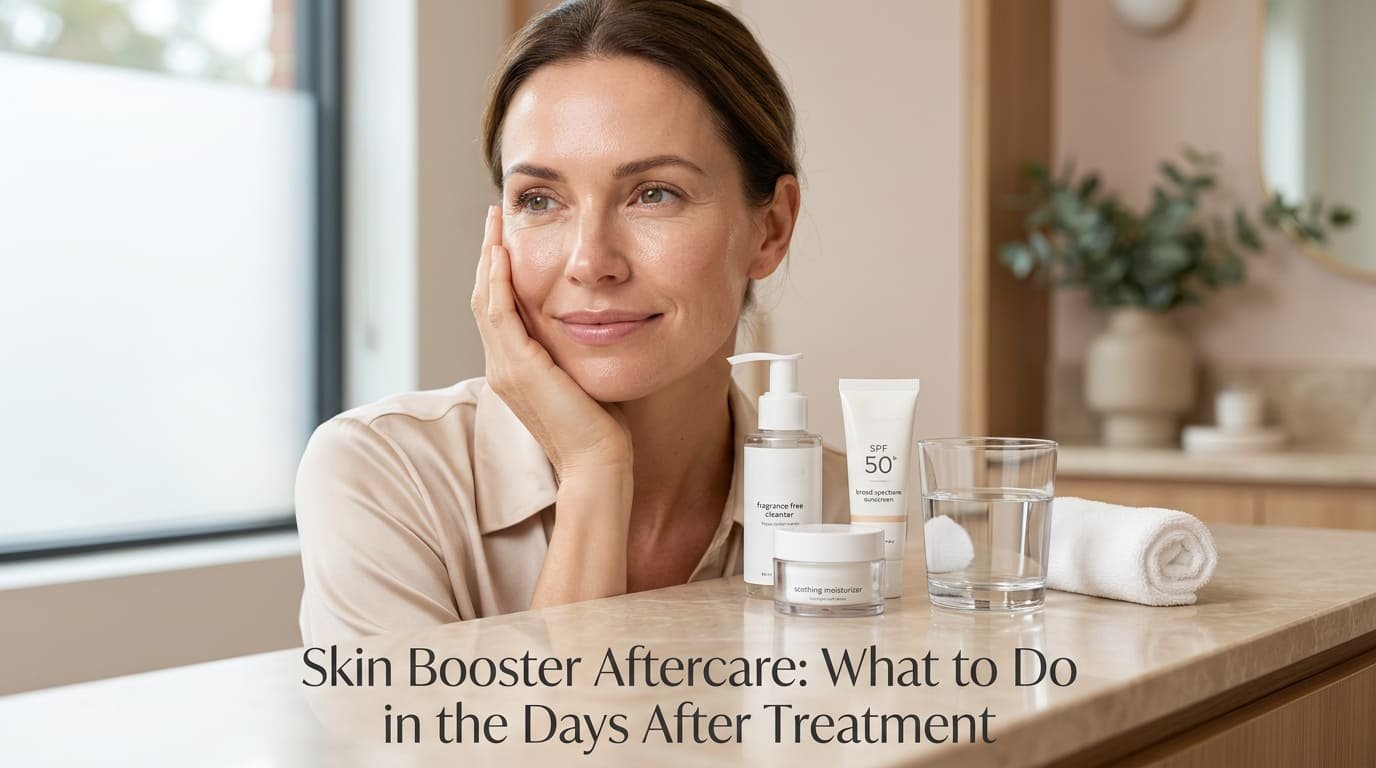
Skin booster treatment is one of the most straightforward injectable experiences available in clinic. The injections are fine. The session is quick. The immediate change to the skin surface is subtle enough that most patients walk out wondering if anything has actually happened yet.
Something has. A series of precisely placed hyaluronic acid micro-injections have been delivered into the dermis across the treatment area. The hydration response, the cell signalling, and the collagen stimulation that makes skin boosters worth having are all beginning to take effect in the tissue. What you do in the hours and days that follow has a direct bearing on how cleanly that process runs and how well your result develops.
Skin booster aftercare is not difficult. But knowing the reasoning behind each instruction makes the difference between following a set of rules you do not fully understand and making informed decisions that genuinely support your result.
The First Two Hours After Treatment
The first two hours represent the most sensitive window in the entire aftercare period. The injection points are fresh. The hyaluronic acid has been deposited precisely where it was placed and is beginning the process of integrating into the surrounding tissue. The skin surface at each injection point has a microscopic break in it that needs time to close before anything is applied over it.
Keep your hands away from the treatment area during this window. This instruction is given routinely and just as routinely ignored by patients who touch their face without thinking. Pressing, rubbing, or even repeatedly touching the injection sites in the hours immediately after treatment introduces bacteria directly to small openings in the skin. It also displaces the product from where it was carefully placed before it has had time to settle.
Do not apply makeup for the first two to four hours after treatment. The skin needs this window to allow the micro-injection sites to close. Applying foundation, concealer, or any other product before this has happened pushes foreign material into those openings. Arriving to a skin booster appointment without makeup, or with minimal makeup you plan to remove before treatment, is the most practical approach.
Avoid touching the treated area to check whether the small bumps from the injection points are still there. They are, for now. They settle on their own over the following hours. Pressing them to see if they have reduced does not accelerate the process and applies exactly the kind of pressure the skin does not need in this window.
The Rest of Day One
Once the initial two-hour window has passed, life returns largely to normal. There are a small number of specific things worth avoiding for the remainder of the day.
Avoid alcohol on the day of your treatment. Alcohol dilates blood vessels and increases circulation throughout the body, including to the face. In the context of fresh micro-injections, this increased vascular activity can worsen bruising at the injection sites and contribute to unnecessary swelling. Waiting until the following day is a straightforward precaution.
Avoid intense exercise for the rest of the treatment day. The same reasoning applies. Cardiovascular exercise raises heart rate and blood pressure, increasing circulation to the face and worsening the bruising and swelling that sometimes accompanies skin booster treatment. A gentle walk is completely fine. A spin class or gym session is better left for the next morning.
Avoid saunas, steam rooms, hot baths, and any other source of significant heat on the day of treatment. Heat dilates blood vessels and raises skin temperature in a way that is counterproductive in the immediate post-treatment period. A lukewarm shower is fine. A long hot bath on the evening of your appointment is not ideal.
Avoid any other facial treatment on the same day. Facials, facial massage, exfoliation, chemical peels, microneedling, and any other treatment applied to the same area interfere with how the skin booster settles. Give the treatment the space it needs to integrate without competing inputs.
From the evening of your treatment day, gentle skincare can be reapplied. A mild cleanser and a gentle moisturiser are appropriate. Avoid retinoids, exfoliating acids, vitamin C serums at high concentration, and any other active ingredient that is designed to penetrate the skin. These can irritate the skin at the micro-injection points while they are still in the early stages of healing. Active ingredients can be reintroduced once the skin feels settled, which is typically within two to three days for most patients.
Days Two and Three
The micro-injection points from skin booster treatment typically close and become invisible within 24 to 48 hours. The small papules or bumps that appear immediately after treatment settle during this window as the hyaluronic acid begins to spread and integrate from each injection point. This is the process working as it should and requires nothing from you beyond allowing it to happen without interference.
Some patients experience mild bruising at one or more injection points. This is not universal, but it is common, and it does not indicate that anything went wrong. Bruising after skin booster treatment is a mechanical consequence of the needle passing through tissue near a small blood vessel, not a sign of incorrect technique or an adverse reaction. It fades in the same way any bruise does, typically within five to seven days.
Light redness across the treatment area in the first one to two days is also within the normal range. Skin that has received a series of fine needle injections will show some degree of inflammatory response in the immediate aftermath. This usually settles within 48 hours and leaves no lasting mark.
From day two, begin applying a broad spectrum SPF 50 every morning without exception. This is not generic skincare advice grafted onto an aftercare guide. It is a clinically relevant instruction because hyaluronic acid-based treatments leave the skin in a state of heightened UV sensitivity in the days immediately following injection. UV exposure during this window can trigger post-inflammatory pigmentation at the injection sites, particularly in patients with medium or deeper skin tones. Consistent SPF from day two onward protects the skin while it is most vulnerable and supports the overall result of the treatment.
Continue avoiding heat sources through day two and into day three if possible. The five-day avoidance of saunas, steam rooms, and sunbeds is a standard precaution for all injectable skin treatments and applies here.
Days Four to Seven
By days four to seven, the immediate post-treatment phase is largely complete for most patients. Bruising should be fading. Any redness has settled. The injection sites are closed. The hyaluronic acid from the skin booster is integrating into the tissue, and the hydration and cellular signalling effects are developing.
This is often when patients first start noticing a change in how their skin feels. Skin boosters deliver hydration through the hyaluronic acid itself and can produce a noticeable improvement in surface plumpness and moisture within the first week for many patients. Some patients see this change sooner, some slightly later. Both are within the normal range.
Normal skincare routines, including active ingredients, can be fully reintroduced during this window for most patients. If the skin felt sensitive or slightly reactive earlier in the week, a gentle approach for another few days is appropriate. There is no fixed rule for when retinoids can be reintroduced beyond ensuring the skin is no longer showing signs of sensitivity or irritation from the treatment itself.
SPF should be a consistent part of every morning during this period and beyond. The UV sensitivity from the injections has reduced by this point, but the role of daily SPF in maintaining and extending any injectable skin treatment result is permanent rather than time-limited.
The Two-Week Mark and Beyond
Skin boosters typically produce results that develop and improve over two to four weeks from each session as the hyaluronic acid integrates fully and the hydration, texture, and radiance improvements accumulate. The change between day three and day fourteen is often more noticeable than the change on day one.
Most skin booster courses involve two to three sessions spaced two to four weeks apart. Each session builds on the progress of the previous one. The aftercare instructions are identical for each session in the course. Applying the same consistent approach after each appointment supports the cumulative improvement across the full course.
After completing a course, maintenance sessions every three to four months sustain the hydration and skin quality environment the treatment creates. Without maintenance, the hyaluronic acid from skin booster treatment gradually breaks down and the skin returns toward its pre-treatment baseline over the following months. This is not a failure of the treatment. It is the predictable biological behaviour of hyaluronic acid in the tissue and it is why maintenance is built into the treatment model rather than being an optional add-on.
What Is Normal and What Is Worth Contacting Your Practitioner About
Understanding the difference between the expected post-treatment experience and the signs that warrant clinical attention is something every patient deserves to know before they leave the clinic.
Small papules at the injection sites settling within 48 hours is completely normal. Mild redness across the treatment area settling within one to two days is normal. Minor bruising at one or more injection points fading over five to seven days is normal. A tight or slightly plumped feeling to the skin in the first few days is normal. Mild tenderness at the injection sites when pressed is normal for the first two to three days.
Contact your practitioner if swelling is increasing rather than settling after 48 hours. Contact them if you notice any skin that looks white, blanched, or develops a mottled discolouration in a pattern that follows a vascular distribution rather than the irregular shape of a bruise. Contact them if you have pain that is intensifying beyond the first day or two rather than gradually easing. Contact them if you see any sign of developing infection, including spreading redness, warmth to the touch, or discharge from an injection site.
Vascular complications from skin booster treatment are very rare because the product does not require injection near the deeper vascular structures that carry the highest risk in other filler treatments. But knowing the warning signs is still the responsible thing for any patient who has received an injectable treatment, regardless of the risk level of the specific product.
How to Support Your Results Between Sessions
The aftercare period in the immediate days after treatment is important. The choices you make between sessions over the following weeks and months are equally important for the overall quality and longevity of your result.
SPF every morning without exception is the single most impactful thing you can do between skin booster sessions. Hyaluronic acid in the skin is vulnerable to UV-induced degradation, which means consistent sun protection directly extends how long each session's result holds and how much cumulative benefit you see across a course.
Staying well hydrated internally supports the hyaluronic acid in the skin in retaining water as it is designed to do. Skin that is well hydrated from the inside responds better to hyaluronic acid-based treatments and maintains results better between sessions.
A consistent and gentle skincare routine supports the skin barrier and keeps the treatment environment healthy between sessions. A good cleanser, a moisturiser appropriate for your skin type, SPF in the morning, and a tolerated retinoid used regularly in the evening are the basics that support every injectable skin quality treatment and that no additional product can compensate for if they are consistently absent.
How Skin Booster Aftercare Differs From Profhilo Aftercare
Patients who have read about Profhilo aftercare sometimes wonder whether the same instructions apply to skin booster treatment. The broad principles are the same because both are hyaluronic acid-based injectable treatments. There are some differences in the details worth knowing.
Profhilo uses five specific BAP injection points on each side of the face, and the non-cross-linked formula spreads through the tissue from those points. The aftercare emphasis on not disturbing those specific points in the first four hours reflects the spreading mechanism and the importance of not displacing the product before it integrates.
Skin boosters use a grid of multiple fine micro-injections across the treatment area. The product is cross-linked and designed to stay closer to where it is placed rather than spreading widely. The aftercare emphasis is on avoiding anything that irritates or infects the micro-injection sites while they close and on not applying pressure that displaces the individual deposits before integration. The four-hour upright guideline for Profhilo is less critical for skin boosters for this reason, though avoiding lying face down immediately after any facial injectable treatment is still sensible.
Both share the same core requirements around avoiding heat, exercise, alcohol, and facial manipulation on the day of treatment, and both require the same daily SPF commitment from the following day onward.
Frequently Asked Questions
How soon can I wear makeup after skin booster treatment?
Most practitioners advise waiting two to four hours before applying makeup. This allows the micro-injection sites to close before any product is applied over them. From the following day, normal makeup application is fine.
Can I go back to work the same day as my skin booster appointment?
Yes, for most patients. The treatment produces mild redness and small papules at injection points that settle over the following hours. Whether these are noticeable in a professional setting depends on your skin and your workplace. Many patients schedule morning appointments and return to desk-based work in the afternoon without issue.
My skin looks the same immediately after treatment. Is that normal?
Yes. Skin boosters produce a gradual hydration and texture improvement that develops over days to weeks rather than an immediate visible change. The result at day ten often looks meaningfully different from day one, even when day one looks almost identical to before treatment.
Can I have my skin booster and lip filler on the same day?
In many cases, yes, depending on the areas involved and your practitioner's clinical assessment. Combining treatments from the same session is common practice. Your practitioner will advise on what is appropriate during your consultation.
How long before a special event should I have skin booster treatment?
Allow at least two weeks between your skin booster treatment and any important event to ensure the micro-injection marks have fully resolved and the result has had time to develop. Three to four weeks is more comfortable if your schedule allows.
Is it normal to see small white bumps under the skin after treatment?
Very small papules at the injection points in the immediate aftermath of skin booster treatment are normal and settle within 24 to 48 hours. If you notice any firm or persistent lump beyond this window, contact your practitioner for assessment.
When should I book my next session?
This varies based on the product used and your individual response. Most skin booster courses involve a second session two to four weeks after the first. Your practitioner will advise on the optimal timing based on how your skin responds to the first treatment.
Can I exercise the day after my skin booster appointment?
Yes. The exercise avoidance applies to the day of treatment and specifically to intense cardiovascular activity. Normal exercise from the following day is fine for most patients.
If you have questions about your skin booster aftercare or want to discuss how your skin is responding after treatment, contact our Littlehampton or Hove clinic. We are always happy to hear from patients between appointments.
Book a Skin Booster Consultation in Littlehampton or Book a Skin Booster Consultation in Hove