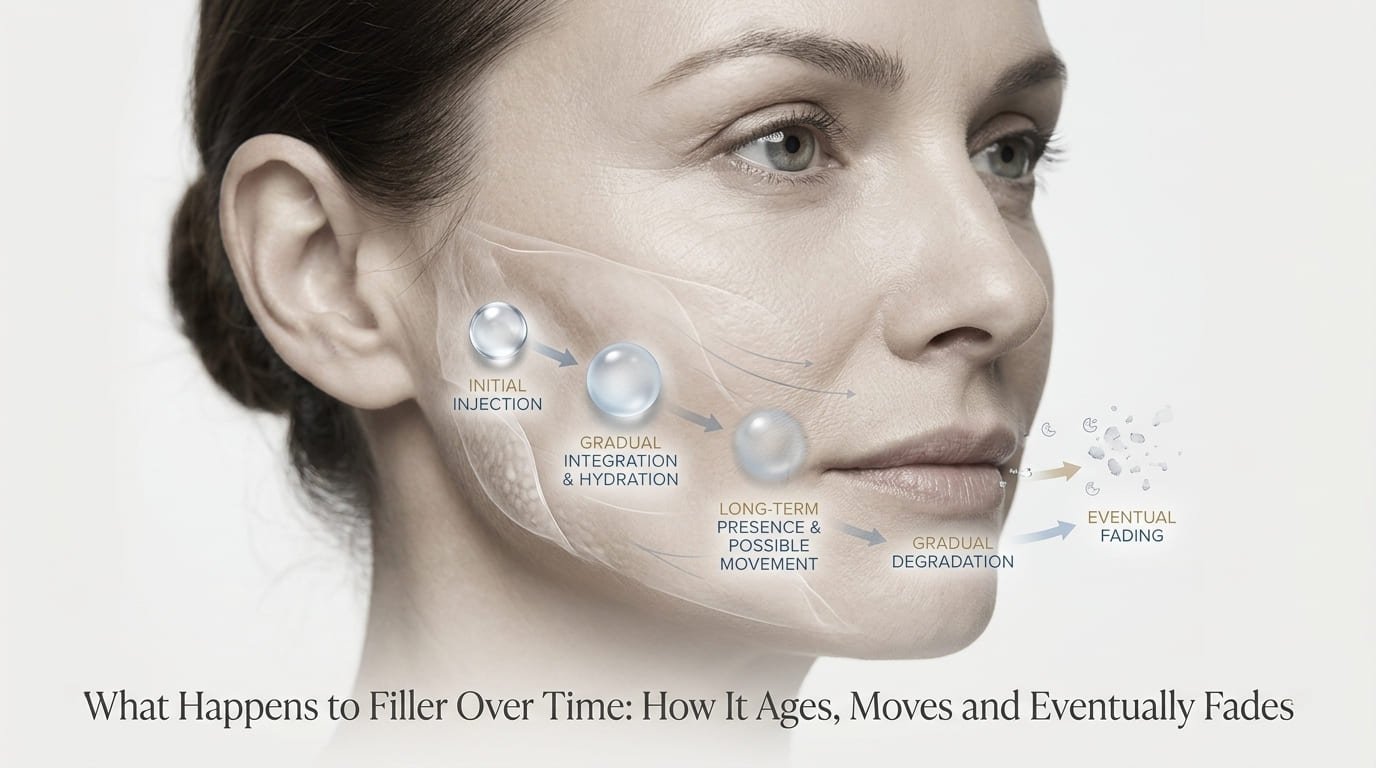
Most patients understand that dermal filler is not permanent. It goes in, it looks good for a period of time, and eventually it fades. That general outline is accurate. What almost nobody explains is what actually happens in between. What the filler is doing in the tissue in the weeks, months, and sometimes years after injection. How it changes. Why it sometimes moves from where it was placed. Why some filler seems to last much longer in some patients than others. And what it means for the skin and tissue when filler that has been in place for years is eventually dissolved.
These are questions that matter practically because the answers affect decisions about when to top up, whether to dissolve, and how to understand what you are seeing when your filler result changes over time.
What Hyaluronic Acid Filler Is Before It Goes In
Hyaluronic acid filler starts as a synthetic HA gel that has been cross-linked through a chemical process to make it more stable and slower to degrade than the natural HA the body produces. The degree of cross-linking, the concentration of HA, and the particle size of the gel determine how firm the product is, how much it resists degradation, and what tissue environment it is designed for.
Softer, less cross-linked gels are used in areas requiring delicate integration and natural movement, such as the lips and superficial skin layers. Firmer, more heavily cross-linked gels are used in structural areas like the jawline and deep cheek, where they need to hold shape under the mechanical demands of facial movement and gravity.
Once injected, the filler exists as a foreign material in the tissue. The body recognises it as such and begins a slow process of degrading and removing it. This process is biological, gradual, and happens at different rates in different patients and different areas.
The First Few Weeks: Integration and Settling
In the first two to four weeks after injection, filler undergoes a settling process in the tissue. Swelling from the injection procedure resolves. The filler integrates into the surrounding tissue to varying degrees depending on the product and the area. Some products integrate tightly and produce a result that feels very natural very quickly. Others sit as a more discrete gel mass that takes longer to blend with the surrounding tissue.
The filler also absorbs water during this early period. Hyaluronic acid is hydrophilic, meaning it attracts water molecules. As the filler settles in the tissue, it takes on water from the surrounding dermis and subdermal tissue, which causes some degree of expansion beyond the immediate post-injection volume. This is why the result at two to four weeks often looks and feels slightly different from the result on the day of injection.
The water absorption property is one of the reasons overfilling in certain areas is problematic. A product that looks proportionate on injection day may look disproportionate at four weeks when the hydrophilic expansion is at its most pronounced. Experienced practitioners account for this when planning volumes.
Months One to Six: Gradual Enzymatic Degradation
Once filler is in the tissue, the body's immune and enzymatic systems begin working to break it down. The primary mechanism is enzymatic degradation by naturally occurring hyaluronidase, which is an enzyme the body produces as part of normal tissue remodelling processes. This endogenous hyaluronidase gradually cleaves the cross-links in the synthetic HA gel, breaking it into smaller fragments that are progressively metabolised and cleared.
The rate of enzymatic degradation depends on several factors. More heavily cross-linked products resist degradation more effectively and therefore last longer than less cross-linked ones. Areas of high movement, such as the lips and perioral region, experience more mechanical stress that accelerates the breakdown process. Areas with less movement, such as the deep cheek and jawline, tend to show longer filler longevity partly because the product is under less constant mechanical demand.
Metabolic rate is a genuine and variable factor. Patients who metabolise substances quickly in general tend to break down HA filler faster than those with slower metabolic rates. This is one of the most consistent explanations for why two patients who receive identical products in identical areas by the same practitioner can have results that last significantly different lengths of time.
The vascular supply to the treatment area also influences degradation rate. Well-vascularised areas with high tissue turnover metabolise HA faster than areas with less active tissue metabolism.
The Migration Question: Does Filler Move?
Filler migration is one of the most discussed and most misunderstood phenomena in aesthetic medicine. It is real. It happens. Understanding how and why it occurs matters because it informs both product selection and realistic expectations.
Migration refers to the movement of filler away from the original injection site to a position in the tissue that was not intended. It is not the same as the gradual diffusion of product within the expected tissue plane during the normal settling process. Migration describes filler that ends up in a noticeably different position from where it was placed.
Several mechanisms contribute to migration. Repeated mechanical pressure on the treated area moves product over time. This is most clinically relevant in the lip area, where the constant movement of the lips through speaking, eating, and expression creates a sustained mechanical force on any product placed within the lip body. Filler that migrates above the lip border, producing the characteristic white ridge sometimes visible above the upper lip, has typically moved there through repeated mechanical pressure rather than through a single traumatic displacement event.
Injection into the incorrect tissue plane is another mechanism. Product placed too superficially or in a plane that does not provide adequate surrounding tissue resistance is more susceptible to migration than product placed at the correct depth in a well-supported tissue environment. This is a technical issue reflecting placement decisions rather than an inherent property of the filler itself.
Highly hydrophilic products used in large volumes can move along tissue planes following pressure differentials as they absorb water. This is more relevant to superficial placements in areas with less dense surrounding tissue.
The tissues themselves change over time in response to filler. Fibrotic capsule formation, which is the development of a thin fibrous shell around a filler deposit in some patients, can contribute to a consolidated mass that behaves differently from integrated filler.
Years One to Two: What Long-Term Filler Looks Like
The popular understanding that filler completely fades within six to eighteen months is not accurate for all products in all areas. Published histological studies examining tissue from patients who had received HA filler have identified filler deposits still present in the tissue at two years and beyond, long after the expected longevity of the products used.
This persistence occurs for several reasons. Some deeply placed structural filler in low-movement areas degrades more slowly than surface estimates suggest. Repeated top-up treatments in the same area can accumulate filler beyond what any single treatment's longevity would predict. Product placed in certain anatomical compartments has less exposure to enzymatic degradation than product in more vascularised zones.
What long-term filler looks like clinically varies. In many patients it simply looks like a maintained result that has gradually softened from its peak. In some patients it looks like a subtle change in the tissue that was not present before treatment, such as a slightly different shape to the area than expected, a firmness or palpability under the skin, or a visible change that is not explained by the volume of product still present if the tissue itself has also changed in response.
The tissue response to long-term HA filler presence includes changes in the collagen architecture surrounding the product and the development of fibrous tissue around filler deposits in some cases. The skin and dermis above chronically filled tissue can also change over time in ways that become apparent when filler is eventually dissolved, and the tissue beneath is assessed.
What Happens When Filler Fades
As filler degrades over time, the volume and structural support it provided gradually reduces. The face begins to reflect more of its underlying anatomy rather than the enhanced anatomy the filler created.
This fading process is gradual rather than sudden. Patients often describe it as not noticing a significant change for a period and then one day realising their result has softened more than they registered at the time. The gradualism of the process means it rarely produces the dramatic reversal that patients sometimes fear.
The face that emerges as filler fades has not been damaged by the filler's presence. The tissue is essentially the same as it was before treatment in terms of its baseline structure, though age continues during the period the filler was in place. A patient who first had cheek filler at 42 and is now having it fade at 44 will see the face of a 44-year-old rather than the face of a 42-year-old, which is sometimes perceived as the filler making things worse rather than time simply having continued.
What Happens When Accumulated Filler Is Dissolved
Dissolving filler that has been present for a long time, or that has been repeatedly topped up over several years, is a different clinical process from dissolving a single recently placed treatment.
Hyaluronidase dissolves the HA components of accumulated filler effectively. What it cannot dissolve is any fibrotic tissue that has formed around filler deposits in the years of the product's presence. The fibrous response to long-term filler is a tissue change rather than a filler deposit, and it is not affected by hyaluronidase.
In patients who have had significant amounts of filler over a long period, dissolving the HA may reveal that some of the structural appearance they had was partly from fibrosis rather than purely from the filler product itself. This can mean the result of dissolving looks different from what was expected because the tissue architecture has changed in ways that were not visible from the outside.
This is not a complication of hyaluronidase use. It is a reflection of long-term filler interaction with the surrounding tissue and one of the reasons a thorough assessment before dissolving a long-standing or repeated filler history is clinically important.
How Understanding This Changes Treatment Decisions
Knowing how filler ages and behaves over time informs several practical decisions that patients make.
It explains why regular top-up treatments in the same area over several years carry the risk of product accumulation beyond what is visible at any single appointment. A practitioner who assesses a returning patient for filler before automatically adding more, considers what may already be present and whether dissolving and resetting is a better starting point than continued addition, is approaching the treatment more carefully than one who simply adds to what is already there.
It explains why the same product in the same area by the same practitioner produces different longevity in different patients. Metabolism, movement, vascular supply, and individual tissue characteristics all contribute to a genuinely variable biological outcome rather than a predictable fixed duration.
It explains why dissolving filler in an area that has been treated repeatedly over years sometimes requires more hyaluronidase than expected and why the tissue after dissolving does not always look exactly as it did before treatment started.
And it explains why the decision to continue adding filler to an area or to dissolve and reassess is not simply a preference question but a clinical decision that benefits from being made by a practitioner with a thorough understanding of what happens to filler between appointments.
Frequently Asked Questions
Does filler dissolve completely on its own eventually?
For most HA fillers in most areas, yes. Enzymatic degradation by naturally occurring hyaluronidase gradually breaks down the cross-linked HA over months to years. Some deep structural filler in low-movement areas may persist longer than expected, and fibrotic tissue that forms around long-term filler deposits is not dissolved by the body's own enzymes.
Is it true filler can last for years in some areas?
Yes. Histological studies have identified HA filler still present in tissue at two years and beyond in some patients and some areas. Deeply placed structural filler in areas of limited movement, particularly under the eyes and in deep structural positions in the cheek, shows the longest tissue persistence.
Can I tell from the outside whether filler has moved?
Sometimes. Migration that produces a visible ridge, lump, or asymmetry in a different position from the intended treatment area can often be seen or felt. Subtle migration within the expected tissue zone is less visible and requires a practitioner's assessment to identify.
Should I dissolve filler before having more added?
This depends on how much filler is already present, how long it has been in place, and what the new treatment is trying to achieve. A practitioner who assesses the current tissue state before recommending either addition or dissolution is making the more clinically thorough decision.
Does the tissue underneath filler change while it is in place?
Yes, to a degree. Fibroblast activity, collagen architecture, and fibrous tissue formation can all be influenced by long-term filler presence. The most significant changes occur with larger volumes over longer periods. Dissolving long-term filler can reveal these tissue changes in ways that weren't visible while the filler was in place.
If my filler looks good, should I leave it alone even if it has been a long time?
If the result looks good and feels natural, there is no clinical requirement to dissolve it simply because time has passed. Assessment of what is present, where it is, and whether it is behaving appropriately is more relevant than the calendar. A review consultation with your practitioner is always the most useful starting point for this decision.
If you have questions about existing filler, want to discuss whether topping up or dissolving is the right approach for your situation, or want to plan your first filler treatment with a full understanding of how the product behaves over time, book a consultation at our Littlehampton or Hove clinic.
Book a Consultation in Littlehampton or Book a Consultation in Hove