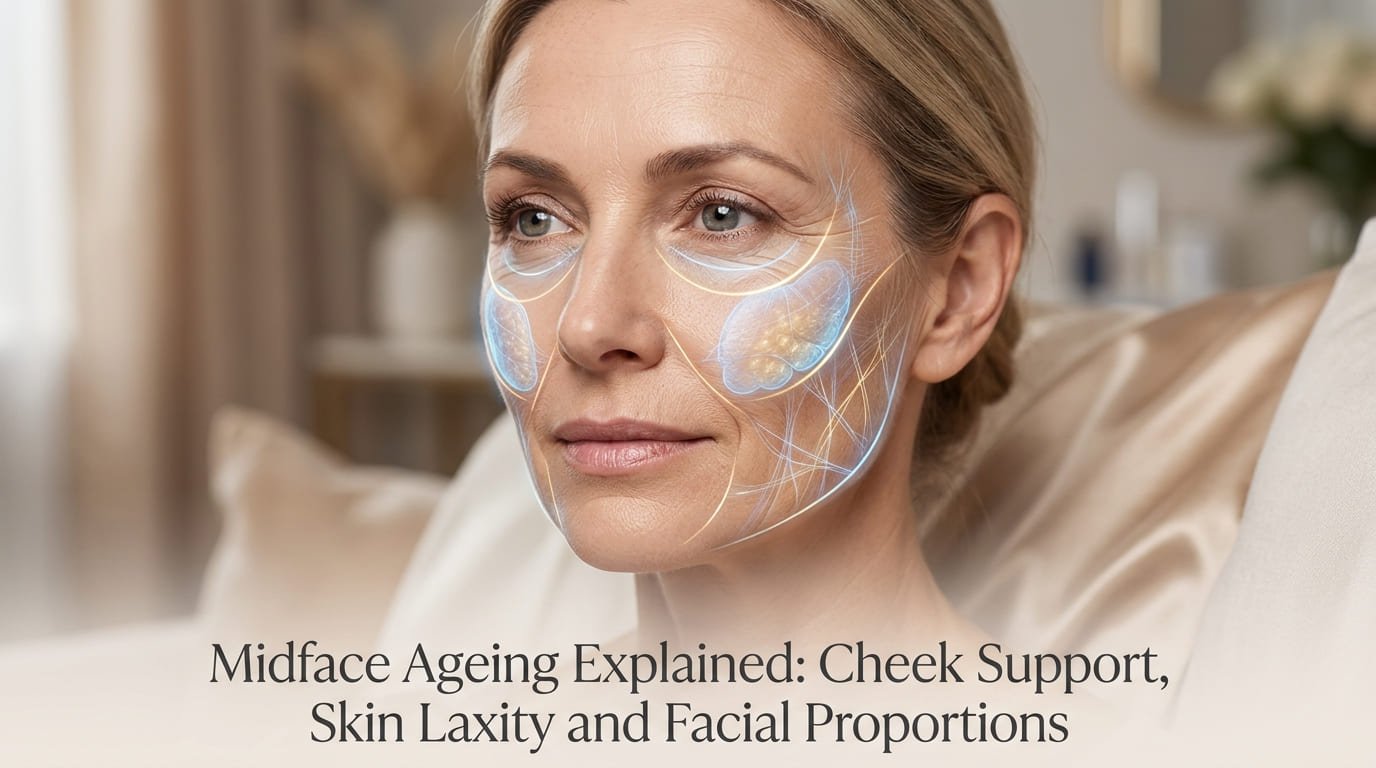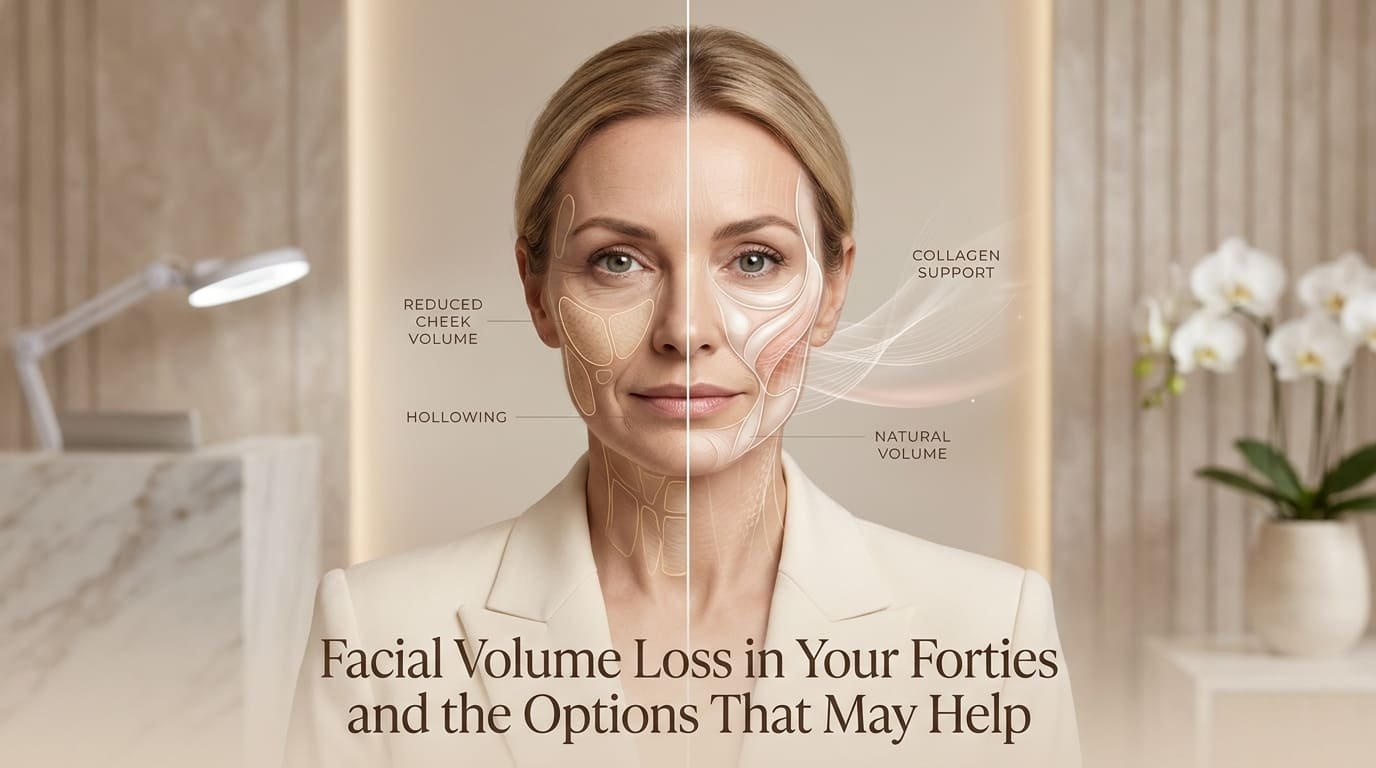
You may notice that your face looks slightly different in your forties, even when your weight has remained stable and your skincare routine has not changed. Your cheeks might appear less full. The area beneath your eyes may look more hollow, or the natural definition around your jawline may seem softer.
These changes can happen gradually. They are not always linked to wrinkles or loose skin. Sometimes, the main difference is a change in the volume and support beneath the skin.
Facial volume loss is a normal part of ageing, but it does not happen at the same rate or in the same pattern for everyone. Genetics, facial structure, sun exposure, lifestyle and changes in body weight can all influence how the face develops over time.
Understanding what is changing is the first step towards choosing an appropriate approach. Some people may benefit from skincare and treatments that improve skin quality. Others may want to explore carefully planned volume restoration. In some cases, non-surgical treatments may not be enough to address the concern.
This guide explains why facial volume can change during your forties, which areas may be affected, and what options are worth discussing with a qualified aesthetic practitioner.
Why Does Facial Volume Change During Your Forties?
Facial ageing involves several processes happening beneath and within the skin. It is not simply a matter of losing collagen or developing wrinkles.
The face contains different layers of tissue, including bone, fat compartments, muscles, ligaments, and skin. These structures work together to maintain facial shape and support. Changes in one layer can influence the appearance of the others.
During adulthood, the facial skeleton gradually changes. Certain areas may lose some of their underlying support. Fat compartments can also become smaller or change position, while the ligaments that help support facial tissues may gradually weaken.
At the same time, the skin produces less collagen and elastin than it did earlier in life. This can affect firmness and its ability to maintain a smooth appearance.
These changes may become more noticeable during the forties because several processes are happening together. A reduction in cheek support, for example, can make the lower face appear heavier. Reduced volume around the temples can also change the balance of the upper face.
For a more detailed explanation of the underlying causes, read our guide to what causes volume loss in the face and how it can be addressed.
Common Signs of Facial Volume Loss in Your Forties
There is no single appearance that defines facial volume loss. Some people notice changes around their cheeks, while others become more aware of hollowing around the eyes or a softer jawline.
The following are common areas where changes may become visible.
1. Flatter Cheeks and Reduced Midface Fullness
The cheeks contribute significantly to facial shape and proportion. They provide support to the tissues around the lower eyelids and the area beside the nose and mouth.
As the deeper fat compartments change, the cheeks may appear flatter or less rounded. The transition between the lower eyelid and cheek can also become more noticeable.
Some people describe this as looking tired, even when they are sleeping well. Others feel that their face has lost some of its previous definition.
However, flatter cheeks do not always mean that filler is needed. Natural facial structure, weight changes, and skin laxity can produce similar appearances. An assessment should identify the main cause before treatment is considered.
2. Hollowing Around the Temples
The temples sit on either side of the forehead, between the outer eye area and the hairline.
Changes in the soft tissue around this region can create a hollow appearance. The temples may look less full, and the upper face can appear narrower.
Temple hollowing is not always obvious in the early stages. It may become more noticeable in photographs or when comparing the face with earlier years.
This area requires particular care when considering injectable treatment because important blood vessels and anatomical structures are present. Any treatment decision should be made by a practitioner with appropriate anatomical knowledge and experience.
3. More Noticeable Lines Around the Nose and Mouth
Nasolabial folds run from the sides of the nose towards the corners of the mouth. Their appearance is influenced by several factors, including facial structure, skin quality, tissue movement, and changes in midface support.
When the cheeks lose some of their fullness, the transition between the cheek and lower face may become more noticeable.
It is tempting to assume that the line itself needs filling. However, treating only the visible fold may not address the reason it has become more prominent.
A practitioner should assess the surrounding areas and determine whether volume changes, skin laxity, or natural facial anatomy are contributing.
4. Changes Around the Jawline
The jawline may appear less defined as facial tissues change with age.
Reduced structural support, changes in skin elasticity, and the downward movement of soft tissue can contribute to a softer lower face. Some people also notice early jowling around the sides of the chin.
These changes are not always caused by volume loss alone. Excess tissue, localised fat, chin projection and the natural shape of the lower jaw can all influence the appearance.
Our guide to non-surgical options for jowls explains why different concerns may require different approaches.
What Can Make Facial Volume Loss More Noticeable?
Ageing is one factor, but it is not the only influence on facial appearance.
Changes in body weight
Significant weight loss can reduce fullness in the face as well as elsewhere on the body. This may make the cheeks and temples appear more hollow. Repeated weight fluctuations can also affect how the skin sits over the underlying tissues.
Sun exposure
Long-term exposure to ultraviolet radiation contributes to collagen and elastin damage. This can affect skin firmness and make existing changes more visible. Daily sun protection is an important part of maintaining skin health.
Smoking
Smoking is associated with premature skin ageing. It can affect the skin's appearance and contribute to changes in texture and elasticity.
Genetics
Some people naturally have fuller cheeks or more prominent facial fat compartments. Others have a naturally leaner facial structure. These differences influence how facial ageing appears.
Hormonal changes
Hormonal changes during midlife can influence skin hydration, thickness and elasticity. The timing and extent vary between individuals. These changes may affect facial appearance alongside other age-related processes.
It is important to remember that facial volume loss is not necessarily a sign of poor health or inadequate skincare. It is a natural process, and its visible effects differ from one person to another.
Which Options May Help With Facial Volume Loss?
The right approach depends on what has changed. A treatment designed to improve hydration will not necessarily restore lost volume. Similarly, adding volume will not correct every concern related to loose skin or tissue descent.
A consultation should establish whether the main concern is reduced volume, skin quality, laxity, or a combination of these factors.
1. Dermal Fillers for Selected Areas of Volume Loss
Dermal fillers may be considered when reduced volume or structural support is contributing to changes in facial shape.
Hyaluronic acid fillers are commonly used to restore volume in selected areas. Depending on the individual's anatomy and treatment goals, a practitioner may assess the cheeks, chin, jawline, or temples.
The purpose is not simply to make the face fuller. Treatment should consider the relationship between different facial areas and preserve natural proportions.
For example, adding volume to the cheeks may be considered when reduced midface support contributes to a tired appearance. Chin or jawline treatment may be discussed when lower face proportions and definition are the main concerns.
Not everyone is suitable for filler. The amount, product selection, and injection sites require individual assessment.
Fillers also carry risks. These include swelling, bruising, infection, lumps and, rarely, serious vascular complications. Patients should understand these risks before deciding whether to proceed.
2. Liquid Facelift for Multiple Facial Concerns
Some people notice changes in several areas rather than one isolated hollow.
A liquid facelift is a non-surgical treatment approach that may use dermal fillers in selected areas to address volume, contour, and facial balance. The treatment plan depends on the individual's facial structure and the degree of change.
It should not be understood as a surgical facelift. Injectable treatments cannot remove significant excess skin or reproduce the full effects of surgery.
A carefully planned approach may be considered when several areas need assessment together. You can learn more about what a liquid facelift involves.
3. Radiesse and Collagen Support
Radiesse contains calcium hydroxylapatite microspheres in a gel carrier. It is used in selected aesthetic treatments to provide support and stimulate collagen production.
Its purpose and suitability differ from those of hyaluronic acid fillers. Product choice depends on the area being treated, the patient's anatomy, and the practitioner's assessment.
It is important to understand that Radiesse is not a direct substitute for every type of filler. It cannot be dissolved using hyaluronidase in the same way as hyaluronic acid filler.
A practitioner should explain the product's limitations, risks, and expected behaviour before treatment.
4. Skin Quality Treatments
Not every person with facial ageing needs volume restoration.
If the main concern is dryness, reduced skin elasticity or uneven texture, treatments focused on skin quality may be more relevant. Options such as Profhilo and selected skin boosters are designed to support hydration and improve aspects of skin quality.
These treatments do not replace significant lost facial volume. Their role is different from that of structural dermal fillers.
For a clearer comparison, read our guide to choosing between hydration, texture and volume treatments for mature skin.
5. Surgical Options for More Significant Changes
Non-surgical treatments have limitations. Where there is substantial volume loss, significant skin laxity or considerable tissue descent, injectable treatments may not provide the level of change someone wants.
Surgical options may be worth discussing with an appropriately qualified surgeon. Fat transfer, for example, involves taking fat from another area of the body and transferring it to selected facial areas.
A facelift addresses certain effects of tissue descent and excess skin. It does not automatically replace lost volume, so the appropriate approach depends on the individual concern.
A responsible practitioner should explain when a non-surgical treatment is unlikely to meet expectations and when a surgical opinion may be more suitable.
Can Skincare Prevent Facial Volume Loss?
Skincare plays an important role in maintaining the condition of the skin. However, it cannot fully prevent the structural changes that happen beneath it.
A consistent routine can help support skin health.
Daily broad-spectrum SPF helps protect against ultraviolet damage. A moisturiser supports the skin barrier and can improve the appearance of dryness. Retinoids may help improve aspects of skin texture and the appearance of fine lines when suitable for the individual.
A balanced diet, adequate sleep and avoiding smoking can also support general skin health.
These habits are worthwhile, but expectations should remain realistic. A topical product cannot replace lost fat compartments or reverse changes in facial bone structure.
How to Choose the Right Treatment in Your Forties
Your age alone should never determine which aesthetic treatment you receive. Two people in their forties may have very different facial structures, skin conditions, and treatment needs.
Before making a decision, consider the following points.
Understand the main concern. Is the issue reduced cheek fullness, temple hollowing, loose skin, deeper folds, or a combination of changes?
Ask about alternatives. A suitable plan may involve skincare, a skin quality treatment, volume restoration, or no injectable treatment at all.
Discuss realistic results. Ask what the proposed treatment can improve and what it cannot change. Results vary, and no treatment can stop natural ageing.
Understand the risks. Ask about possible complications, recovery, aftercare, and the steps available if a problem develops.
Check practitioner experience. Choose an appropriately qualified and insured practitioner with relevant experience in facial anatomy and injectable treatments. You should feel comfortable asking questions and taking time before making a decision.
At Angel White Aesthetics, treatment suitability should be considered through an individual assessment rather than a standard approach based only on age or a particular facial feature.
Frequently Asked Questions
Is facial volume loss normal in your forties?
Yes. Changes in facial fat compartments, bone structure, connective tissue, and skin quality are part of the natural ageing process. Their timing and visibility vary between individuals.
Does facial volume loss always make you look older?
Not necessarily. Some people naturally have less facial fullness, while others retain volume for longer. The effect depends on facial proportions, skin condition, and the location of the changes.
Can facial exercises restore lost cheek volume?
There is no reliable evidence that facial exercises can restore lost fat compartments or reverse age-related changes in facial bone structure. They should not be considered a replacement for professional assessment.
Are dermal fillers the only option for facial volume loss?
No. The appropriate approach depends on the cause of the concern. Skincare and skin quality treatments may help when the main issue is skin condition. Surgical options may be considered for more significant changes. Some people may not need treatment.
Will filler make my face look unnatural?
A natural-looking result depends on patient selection, product choice, placement and the amount used. Excessive or poorly planned filler can alter facial proportions. A conservative approach and a full facial assessment are important.
When should I seek advice about sudden facial volume loss?
Gradual changes over several years are often associated with normal ageing. However, sudden or unexplained facial changes, particularly when accompanied by unintentional weight loss or other symptoms, should be discussed with a healthcare professional rather than assumed to be an aesthetic concern.
Understanding Your Options Before Making a Decision
Facial volume loss in your forties can affect the cheeks, temples, area around the mouth, and lower face. These changes may happen gradually, and several different factors can contribute to the way they appear.
The most useful starting point is understanding what has changed rather than choosing a treatment based on a single visible line or hollow. Dermal fillers may help selected areas where volume restoration is appropriate, while skin quality treatments address different concerns. More significant changes may require a surgical opinion.
A personalised assessment can help you understand the available options, their limitations and the risks involved.
If you are considering treatment, you can explore the Angel White Aesthetics clinic FAQs or arrange a consultation to discuss your concerns and whether any treatment is appropriate.