Anti-wrinkle injections are consistently among the most requested treatments in UK aesthetics. For healthcare professionals considering a move into aesthetic practice, the foundation anti-wrinkle course is typically one of the first qualifications they pursue and one of the most important decisions they make in shaping their early aesthetic career.
What is covered on the course, who should be considering it, and what needs to be in place after qualifying before independent patient treatment begins are questions that deserve more thorough answers than most training providers give them. This article covers all three.
What Anti-Wrinkle Treatment Actually Involves
Before covering what the training course teaches, it helps to understand what anti-wrinkle treatment actually involves clinically, because the training curriculum is built around this mechanism and its implications.
Anti-wrinkle injections use botulinum toxin type A, a prescription-only medicine that temporarily blocks the signal between the motor nerve and the target muscle. When this signal is reduced, the muscle cannot contract with its normal force. The overlying skin, which was repeatedly creased by that muscle's movement, has less opportunity to fold. Dynamic lines that form during expression soften significantly. Static lines that are present at rest improve to a degree that reflects how much collagen and elastin the skin has retained alongside the reduction in mechanical folding.
The treatment areas most commonly addressed at foundation level are the glabellar complex, which is the muscles responsible for frown lines between the brows, the frontalis, which drives horizontal forehead lines, and the orbicularis oculi at the lateral canthus, which creates crow's feet. These three areas form the standard foundation scope because they are the most frequently requested, they have the most established evidence base, and they provide a manageable learning curve for a new injector without the higher anatomical complexity of areas like the lower face, jaw, and neck.
Botulinum toxin is a prescription-only medicine in the UK. Its use requires a prescriber to be involved, either as the person injecting or as the supervising prescriber who authorises and oversees the treatment. This prescribing requirement is one of the most important practical realities of anti-wrinkle practice and the training course covers it as a clinical governance and legal responsibility element rather than an administrative footnote.
What the Foundation Anti-Wrinkle Course Covers
A well-designed foundation anti-wrinkle training course covers a range of content that moves from the theoretical foundation to the practical application, with complications management woven through rather than added as a brief closing section.
The anatomy relevant to anti-wrinkle treatment is covered in meaningful depth. This means the muscles of the upper face, their origin and insertion points, their depth relative to the skin surface, and the relationship between their contractile action and the lines they create. It also means the vasculature of the upper face, the danger zones where injection carries higher risk of spreading product to unintended muscle groups, and the anatomical factors that vary between patients and require individual assessment at consultation.
The pharmacology of botulinum toxin type A is covered as a clinical subject rather than a product marketing topic. This includes the mechanism of action at the neuromuscular junction, the reconstitution and storage requirements that affect product stability and clinical outcome, the onset and duration profile, and the factors that influence how patients respond including muscle mass, metabolism, and prior treatment history.
Patient assessment and consultation skills are a substantial and genuinely important part of a well-designed course. Knowing how to inject is only one dimension of safe and effective anti-wrinkle practice. Knowing how to assess a patient before injection, identify contraindications that make a specific patient inappropriate for treatment, set realistic expectations for what the treatment can and cannot achieve, and manage a consultation that supports informed consent rather than rushing to treatment is what separates a practitioner who is genuinely safe from one who has technical injection skills without the clinical context to use them appropriately.
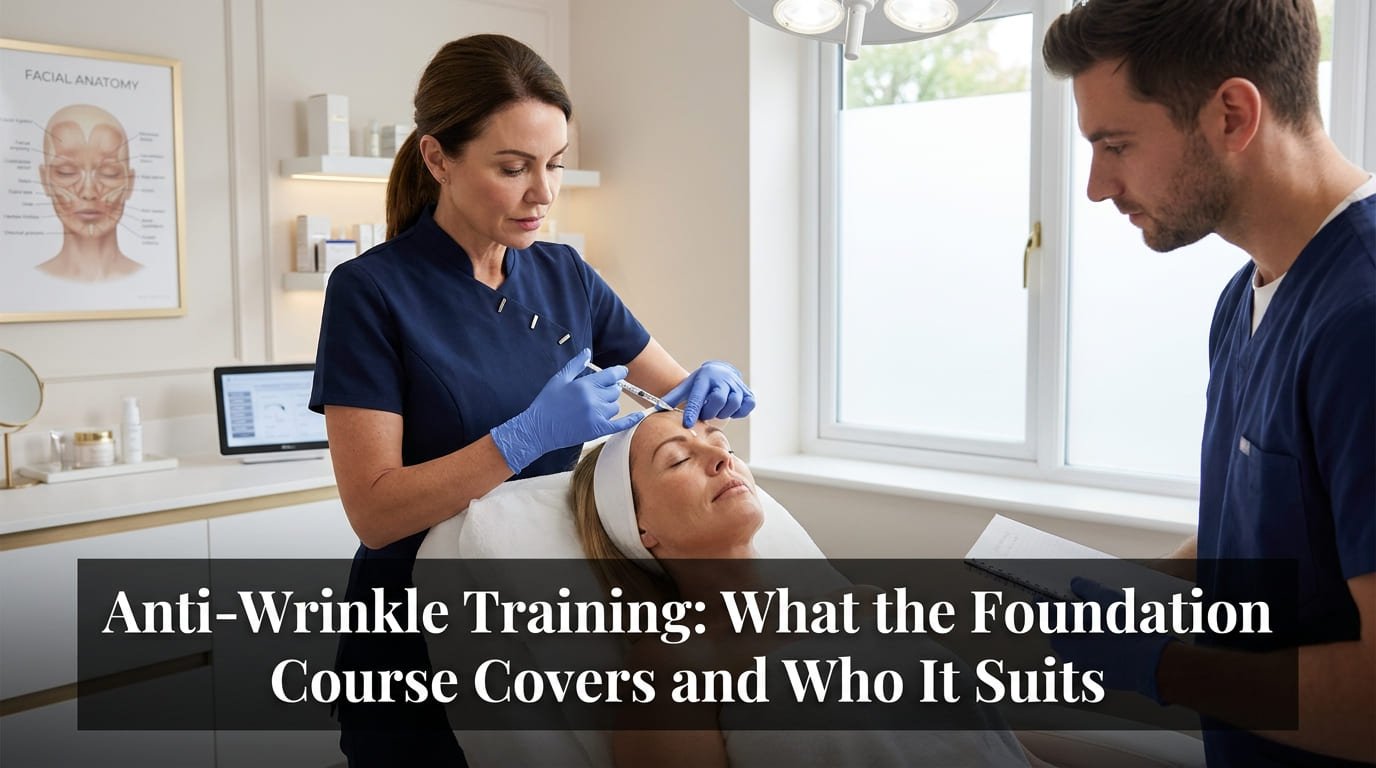
The practical injection element covers technique for each of the three standard areas. Students practise reconstitution and drawing up, the correct injection depth for each area, the placement of injection points within each muscle group, and how to assess the patient's muscle anatomy during the session to adapt placement to the individual rather than following a fixed template regardless of anatomy.
Dosing is a subject that deserves significant course time and a good training provider gives it. Dosing for anti-wrinkle treatment is not a fixed prescription. It varies by treatment area, by the strength of the muscle being treated, by the patient's goals, and by the practitioner's clinical judgement about what the anatomy indicates. Learning to think about dosing as a clinical decision rather than a product instruction sets new practitioners up for better long-term outcomes than simply following a standard dose chart for every patient.
Complications management at foundation level must cover at minimum the recognition and management of the most common and most serious complications associated with anti-wrinkle treatment. Ptosis of the brow or eyelid, asymmetry, spread to adjacent muscle groups, and the steps a new practitioner should follow when any of these occurs are non-negotiable content for a training course that is preparing someone to treat real patients.
Who the Foundation Anti-Wrinkle Course Is Designed For
Foundation anti-wrinkle training is designed for regulated healthcare professionals who want to enter aesthetic injectable practice. The same entry requirement framework described in the entry requirements article on this blog applies to anti-wrinkle training as it does to filler training.
Registered nurses with a current NMC PIN, doctors registered with the GMC, and dentists registered with the GDC are the primary professional groups for whom this training is appropriate. Other regulated healthcare professionals may qualify depending on their specific scope of practice, prescribing access, and indemnity insurance position, which is something worth confirming with a specialist aesthetic insurer before enrolling in any training.
The foundation anti-wrinkle course is appropriate for practitioners who have no prior aesthetic injectable training and who are starting from a healthcare professional background. Prior clinical injection experience from nursing or medical practice provides a useful foundation in terms of manual dexterity and patient management, but aesthetic injection technique is sufficiently specific that previous healthcare injection experience does not substitute for dedicated aesthetic training.
Practitioners who have completed foundation filler training but have not yet trained in anti-wrinkle injections may find the anti-wrinkle course follows naturally from their existing foundational knowledge of facial anatomy, consultation skills, and complication management. The two areas are typically trained in either order depending on the practitioner's primary clinical interest and the patient population they intend to serve.
The Training Format at Angel White Aesthetics
The foundation anti-wrinkle course at Angel White Aesthetics is delivered by Dr Irina Prikulis, whose clinical background spans over fourteen years of aesthetic injectable practice across both patient treatment and practitioner education. The clinical depth of the teaching reflects genuine patient treatment experience rather than a teaching background built primarily on the training literature.
Both group and one-to-one formats are available. The considerations that distinguish these formats for anti-wrinkle training mirror those for filler training covered in the dedicated article on this blog. The group format provides peer learning, exposure to different patient presentations within a single training day, and a more accessible entry price point. The one-to-one format provides maximum hands-on time with each patient model and the most direct and personalised feedback on technique during the practical sessions.
For anti-wrinkle training specifically, the practical element benefits from the type of immediate and specific feedback that the one-to-one format provides, because subtle differences in injection depth, angle, and muscle placement have meaningful effects on outcome. The number of injection points in anti-wrinkle treatment is smaller than in many filler treatments, which means the quality of each individual point matters more rather than less. Practitioners who want the most refined technical feedback on each injection often find the one-to-one format particularly valuable for anti-wrinkle training.
What You Need in Place After Qualifying
Completing a foundation anti-wrinkle course and receiving a certificate of completion does not mean a practitioner is ready to immediately begin treating patients independently. Several practical elements need to be in place before independent treatment is appropriate.
A prescribing pathway is the first essential. Botulinum toxin is a prescription-only medicine. Treatment requires a prescriber to be involved. For nurses who are independent prescribers or who work within a clinical governance structure that provides prescribing access, this may already be in place. For nurses who are not prescribers, access to an appropriate prescriber for their aesthetic practice needs to be established. For doctors and dentists with prescribing rights within their registration, this is part of their existing scope. The training course will cover this as a governance topic, but ensuring it is practically resolved before treating patients independently is the practitioner's responsibility.
Specialist aesthetic indemnity insurance must be in place before treating any patient. This is separate from NHS indemnity, which does not cover private aesthetic practice. A specialist insurer who covers the specific treatments being performed must be confirmed before the first patient appointment. Most insurers require evidence of training to confirm coverage of specific treatment areas, and the certificate from your training course is part of this documentation.
Clinical governance structures, including a documented consultation process, informed consent procedures, medical history recording, and complication management protocols with hyaluronidase available for injectable treatments, need to be in place before practice begins. A training course that has not covered these as substantive content has not fully prepared a graduate for independent clinical practice.
Post-course support from Angel White Aesthetics means graduates are not left to navigate these early months of practice in isolation. Questions that arise when treating real patients for the first time, which are different in character from questions asked in a training environment, are part of the support that makes the transition from training to practice a safer and more confident process.
How Anti-Wrinkle Training Relates to Career Progression
Foundation anti-wrinkle training is the beginning of a clinical journey rather than the complete qualification it is sometimes presented as. The three standard treatment areas covered at foundation level represent the most accessible entry point into facial injectable practice, but aesthetic medicine as a clinical field extends significantly beyond these areas.
Progression from foundation anti-wrinkle training typically moves toward more advanced anti-wrinkle applications including lower face treatment, masseter reduction, hyperhidrosis management, and nefertiti neck lift, alongside the development of filler skills if these have not already been trained. Complications management as a dedicated course, covered separately on this blog, is a strongly recommended next step for any practitioner completing foundation training in either area.
The practitioners who build genuinely skilled and respected aesthetic careers are those who approach continuing professional development with the same seriousness they brought to their initial training rather than treating the foundation certificate as the destination.
Frequently Asked Questions
Can I train in anti-wrinkle at the same time as foundation filler?
Many practitioners train in both areas in close succession or sometimes in the same programme. Whether this is appropriate depends on the individual's clinical background, their capacity to absorb two distinct areas of new knowledge and skill simultaneously, and whether the training provider offers a structure that allows both to be covered adequately in terms of hands-on time and clinical depth.
Do I need to be a prescriber to train in anti-wrinkle injections?
No. You need a prescribing pathway in place before treating patients independently, but training itself does not require you to be a prescriber. Many nurses train before establishing their prescribing access and then confirm their governance structure once training is complete.
How long does the foundation anti-wrinkle course take?
A properly structured foundation course including sufficient theory and meaningful practical time typically requires a full day at minimum. Training that is significantly shorter than this cannot cover the content, consultation skills, and hands-on time that prepare a practitioner for safe independent practice.
Will the course certificate be accepted by aesthetic insurers?
Aesthetic insurers assess the qualification, the training provider, and the practitioner's professional background together. A certificate from an accredited course delivered by a qualified medical professional is the standard that most specialist insurers recognise. Confirming with your chosen insurer before enrolling is the most reliable way to ensure the qualification you are pursuing meets their specific requirements.
Is there a minimum number of patient treatments required during training?
Training providers vary in how many patient models are provided during the practical element. Asking directly how many patients or models will be available, and how hands-on time is distributed across delegates in a group setting, gives a more accurate picture of the practical experience than simply asking about course duration.
What happens if I have a question about a patient after the course is finished?
Angel White Aesthetics provides post-course support to graduates navigating their early patient caseload. The clinical questions that arise in the first weeks and months of independent practice are often different from those that come up during training, and having access to an experienced practitioner to discuss them is part of what makes the transition from training to safe practice a supported one.
If you are considering foundation anti-wrinkle training and want to discuss whether the course is the right fit for your professional background and your clinical goals, get in touch with the Angel White Aesthetics training team before you book.
Explore the Foundation Anti-Wrinkle Course or Contact the Training Team