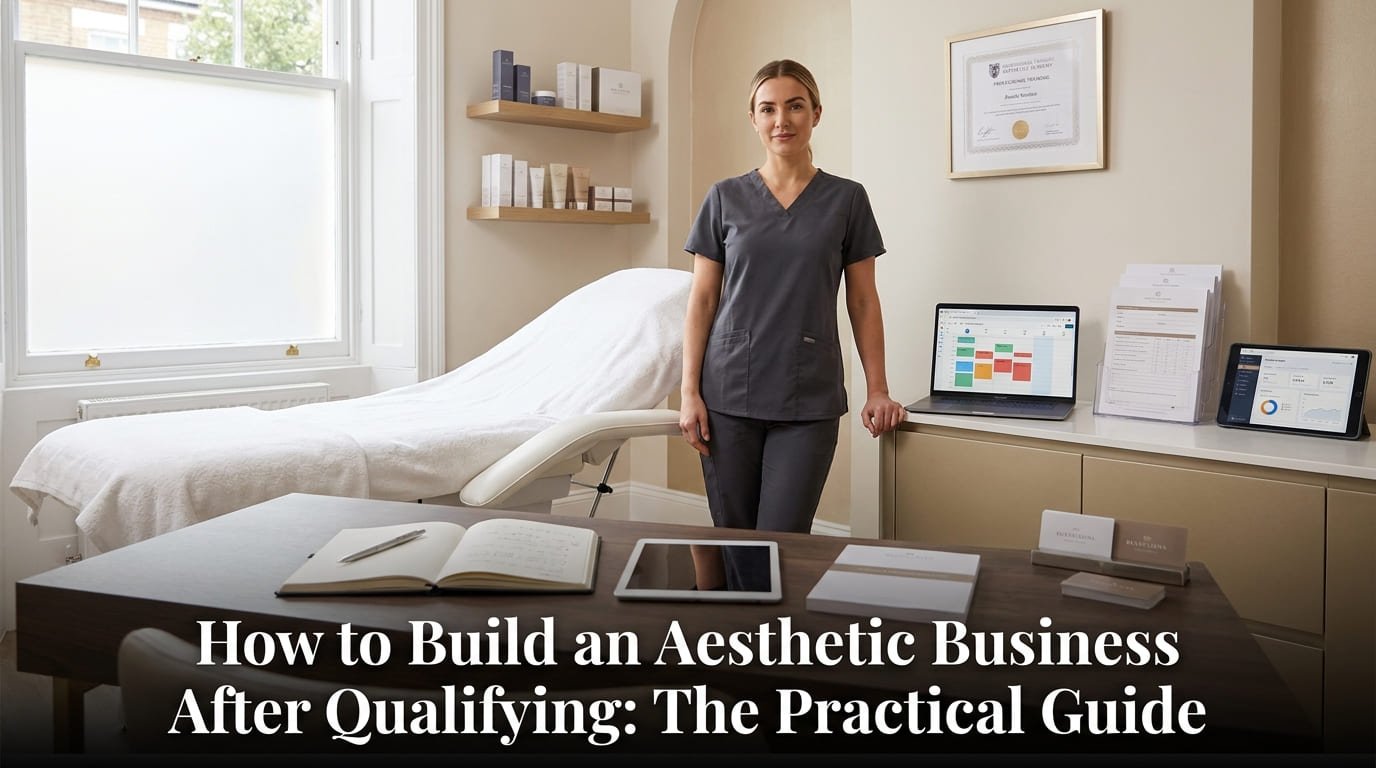
Completing an aesthetic training course is a significant milestone. It is also the point at which the real work begins, and the point that most training providers spend very little time preparing you for.
The skills and clinical knowledge from your training course are the foundation. But building a practice that generates consistent bookings, maintains patient safety, stays compliant with the regulatory and insurance landscape, and grows over time into something sustainable requires a completely different set of decisions and actions. Most new practitioners discover this relatively quickly and start searching for guidance that was not included in the training curriculum.
This guide covers the practical steps that matter after qualifying, in the order they need to be addressed.
Step One: Get Your Clinical Governance in Order Before You Treat Anyone
This is not the first step most new practitioners think about. Most are thinking about their first patient. But clinical governance needs to be fully established before the first patient is seen, and doing this in the wrong order exposes you to significant professional and legal risk.
Clinical governance for aesthetic practice covers several specific elements that need to be confirmed and documented.
Your prescribing pathway needs to be in place before you administer any prescription-only injectable treatment. Botulinum toxin and dermal fillers are both prescription-only medicines. Legal and safe administration requires either that you are an independent prescriber yourself, or that you work within a clinical governance framework that provides prescribing access from a named prescriber who has assessed the patient. Nurses who are not independent prescribers need to establish a prescribing arrangement before treating patients. This is not optional, and it is not something to address after starting.
Your documentation templates need to be in place before your first consultation. This means a medical history form that captures all relevant contraindications for the treatments you plan to offer, an informed consent form that reflects the specific treatment being performed and is signed by the patient before any treatment begins, a treatment record that documents what was used, where, and in what volume, and aftercare instructions that are given to every patient in a format they can refer to later. These documents protect your patients, and they protect you if a complaint arises.
A clear emergency protocol needs to be written and practised before you treat anyone. This means knowing exactly what you will do in the event of a vascular occlusion during filler treatment, including where your hyaluronidase is, what your dissolution protocol is, when to call 999, and how to communicate with a patient who is frightened. Walking through this protocol before you need it is different from knowing it theoretically. Consider completing or refreshing your complications management training if this feels uncertain.
Patient photography needs to be part of your standard appointment process from day one. Consistent before and after photographs in the same lighting and from the same angles are medically and legally important, and they are the foundation of any evidence base you build about your clinical outcomes over time.
Step Two: Establish Your Insurance Before Taking a Penny
Specialist aesthetic indemnity insurance is not the same as NHS indemnity or general medical malpractice cover. Most NHS-employed practitioners are not covered by their NHS indemnity for private aesthetic work. This is a common and dangerous assumption that needs to be clarified before any private aesthetic treatment is performed.
Specialist aesthetic insurers include Hamilton Fraser COSMETICS, Cosmetic Insure, and a small number of others. They assess coverage based on your professional registration, your training qualifications, and the specific treatments you plan to offer. Your training certificate is part of the evidence they need to confirm coverage.
Before committing to a training course, confirming that the qualification you are about to pursue will be accepted by specialist insurers for the treatments you intend to practise is the most important due diligence step you can take. A certificate from a course that insurers do not recognise has no practical value regardless of the quality of the training.
Indemnity insurance for aesthetics typically needs to be renewed annually. Review the specific scope of coverage each year as your treatment menu expands, because treatments not listed in your policy are not covered even if your general policy is active.
Step Three: Choose Your Working Environment Carefully
Where you practise aesthetics matters clinically, legally, and commercially. New practitioners typically start in one of a few environments, and the right choice depends on your specific situation.
Working from a rented clinical room in an established aesthetic or medical clinic gives you a professional environment, an existing patient base in some cases, and a degree of clinical governance infrastructure that is already in place. The rent may be higher than a home setup, but the credibility and infrastructure often justify this, particularly in the early months when your own patient flow is building.
Working from home is legal if the room used is appropriate for clinical treatment, meaning it can be adequately cleaned, the lighting is suitable for clinical assessment, and the environment is appropriate for receiving patients professionally. The regulatory requirements for home-based aesthetic practice are real and documented. Check your local authority requirements and your insurer's requirements for home-based treatment before setting this up.
Working at mobile locations, meaning attending patients at their homes or at third-party venues, is a choice some practitioners make, but it carries specific challenges. Maintaining adequate hygiene standards, having emergency equipment and hyaluronidase immediately available, and managing the clinical environment in a space you do not control are all more complex than working from a fixed clinical setting.
Renting space within an existing salon is a common starting point. The commercial advantages are real. The clinical disadvantage is that a beauty salon environment is not a medical environment, and you need to be confident that your clinical standards are not compromised by the setting.
Step Four: Build Your Patient Base Methodically
Getting your first patients is the challenge most new practitioners find most daunting. The temptation to take every opportunity, discount heavily to attract volume, and spread yourself across too many different treatments before you have genuine confidence in any of them is one of the most consistent patterns in early aesthetic practice. It is also one of the most reliable ways to undermine both your clinical outcomes and your reputation.
A more effective approach is to start with a small treatment menu covering the areas you trained in most thoroughly and feel most clinically confident delivering. Treating a smaller range of patients to a higher standard in the early months builds your confidence, your outcomes, and your reputation simultaneously. Expanding the treatment menu as confidence grows is much safer than attempting to offer everything from day one.
Model patients are the most practical way to build early clinical experience with the support structure of lower commercial pressure. A model patient understands they are receiving treatment at a reduced rate in exchange for the practitioner developing their skill. They need to be consented appropriately as patients, not treated as training dummies, but treating a manageable number of model patients before moving to full commercial pricing gives you a realistic assessment of your actual clinical skill rather than an optimistic assumption.
Word of mouth is the most effective long-term patient acquisition channel in aesthetics without exception. A patient who has a good experience tells people. A patient who has a poor experience also tells people, and in the digital age they tell significantly more people more publicly. The investment in clinical quality, appropriate management of expectations, and thorough aftercare in the early months pays dividends that no marketing spend can replicate.
Step Five: Build Your Online Presence Thoughtfully
Social media is the primary patient acquisition channel for most aesthetic practitioners and the one that most new practitioners feel most uncertain about. The rules around aesthetic advertising in the UK are specific and worth understanding before posting anything publicly.
The ASA and CAP codes govern aesthetic advertising. Claims about treatments must be accurate and not misleading. Before and after photographs must not be used to create unrealistic expectations. Testimonials must be genuine. Price promotions must comply with specific rules around how discounts are presented. The specific rules around botulinum toxin marketing are particularly important because cosmetic procedure advertising faces specific restrictions.
A website is a more controlled environment than social media and should be established early. It provides a professional first impression, a place to host treatment information and consultation booking, and a platform that you own and control rather than a social media page where algorithm changes can affect your visibility without notice.
Google Business Profile is free and significantly influences local search visibility. Claiming and maintaining your profile with accurate location information, treatment areas, and opening hours is a basic step that many new practitioners overlook.
Reviews are one of the most influential factors in patient decision-making for aesthetic treatments. Systematically ask satisfied patients to leave a Google review, and respond professionally to all reviews, including negative ones, to build the social proof that influences prospective patients who find you through search.
Step Six: Invest in Continuing Professional Development From Day One
The biggest differentiator between aesthetic practitioners who build genuinely successful long-term careers and those who plateau or leave the field within a few years is a commitment to ongoing learning.
Foundation training qualifies you to begin practising. It does not qualify you to practise indefinitely without further development. The anatomy, the products, the techniques, and the regulatory environment in UK aesthetics all evolve. Practitioners who engage with continuing professional development, whether through formal advanced training courses, peer study groups, industry conferences, or dedicated complications management training, consistently produce better clinical outcomes and attract and retain patients more effectively than those who rely on their foundation qualifications indefinitely.
Complications management training is the most immediately important development priority for any new practitioner who has not yet completed a dedicated course. The complications management course article on this blog covers why this matters and what is involved.
Step Seven: Understand Your Financial and Legal Obligations
Running an aesthetic business involves financial and legal obligations that are separate from the clinical ones and that new practitioners sometimes underestimate until they encounter them.
Register as self-employed with HMRC if you are not already. Keep accurate records of all income and expenditure from your aesthetic practice from the first day. Understand the difference between allowable business expenses, which reduce your taxable income, and non-allowable ones, which do not.
Consider the appropriate legal structure for your practice. Operating as a sole trader is the simplest setup but may not always be the most appropriate as income grows. Taking advice from an accountant who understands aesthetic businesses is a worthwhile early investment.
Data protection obligations under UK GDPR apply to any business that holds personal data, which includes patient medical records, contact information, and photographs. Registering with the ICO as a data controller, maintaining appropriate records, and understanding your obligations around data storage, retention, and patient access requests are part of running a compliant practice.
Frequently Asked Questions
How long does it take to build a full patient list in aesthetics?
This varies enormously depending on location, the setting you practise in, your professional background, and how effectively you build your local reputation. Some practitioners reach a sustainable patient list within six months. Others take two years. Patience, clinical quality, and consistent presence in your chosen marketing channels are more reliable predictors of success than any particular shortcut.
Do I need a separate business bank account?
Legally you do not if you are a sole trader, but practically it makes bookkeeping significantly simpler and is strongly advisable from the start.
Can I claim my training course as a business expense?
Aesthetic training costs incurred after you are already operating as an aesthetic practitioner are typically allowable as continuing professional development expenses. The treatment of initial foundation training costs depends on the specific circumstances and is worth clarifying with your accountant.
Should I set my prices to match local competitors?
Price research in your local area is useful but matching or undercutting competitors is not always the right strategy. Your pricing should reflect your costs, your professional background, and the quality of service you provide. Significantly underpricing creates its own problems, both in sustainability and in the implicit signal to patients about the quality of what they are receiving.
How do I handle a patient complaint?
Respond promptly, listen without becoming defensive, document the complaint and your response, and, where clinical assessment is needed, offer an appointment to review the patient in person. Most complaints in aesthetics arise from unmet expectations rather than clinical errors, and how they are handled determines whether they escalate or resolve. Your insurer should be informed of any complaint that may lead to a claim.
If you have recently qualified in aesthetics or are in the process of training and want to talk through the practical steps of building your practice, the Angel White Aesthetics training team is happy to help. Contact us at our Littlehampton or Hove clinic.
Contact the Training Team or Explore Further Training Courses