Thread lifting is one of the most misunderstood categories in non-surgical aesthetics. Patients hear the term and assume it means one specific treatment. In reality, thread lifting covers a range of products, materials, and techniques that produce quite different results and suit different patients and different indications.
The most common point of confusion is between Aptos threads and standard PDO threads. Both are used to lift and reposition facial tissue without surgery. Both are inserted through the skin using a needle or cannula. Both stimulate collagen production as the material dissolves. Beyond those broad similarities, the two are built differently, behave differently in the tissue, last for different lengths of time, and suit different clinical presentations.
If you are researching thread lifting and trying to understand which type is appropriate for what you want to achieve, the difference between these two options is genuinely worth understanding before you book a consultation, let alone a treatment.
What Standard PDO Thread Lifts Are
PDO stands for polydioxanone, which is the same synthetic absorbable material used in dissolvable surgical sutures. PDO has been used safely in medicine for decades, and its biocompatibility and predictable absorption profile are well established. Its use in aesthetic thread lifting developed from that surgical suture background, and the material's properties make it well suited to the purpose.
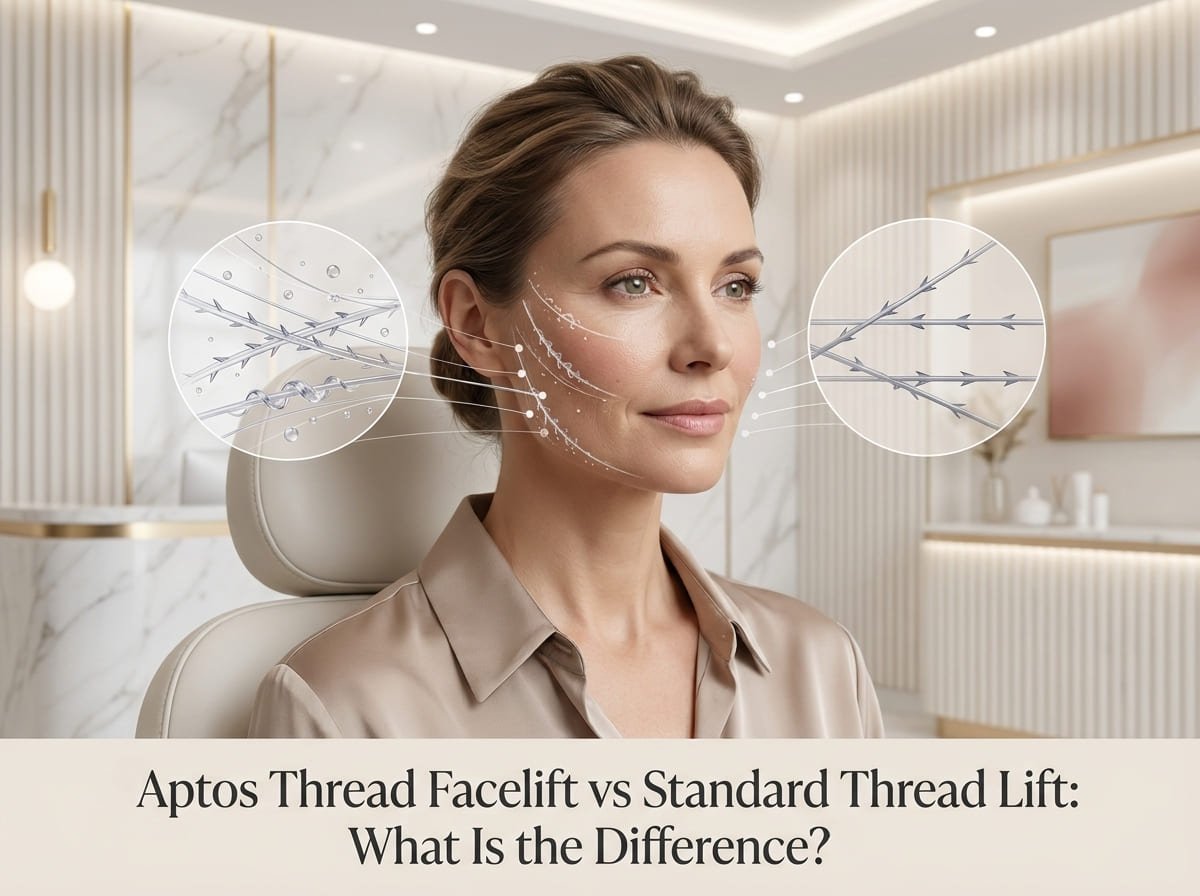
PDO threads used for facial lifting are manufactured with barbs along their length. These barbs point in specific directions depending on the thread design, and when the thread is inserted and the needle withdrawn, the barbs anchor into the surrounding tissue and provide a mechanical grip that allows the thread to hold lifted tissue in its repositioned position.
When a PDO thread is inserted and anchored, the immediate effect is a physical repositioning of the tissue along the vector of the thread placement. Jowling that was sitting below the jawline can be repositioned upward. Descended midface tissue can be lifted toward its more youthful position. The lift is visible immediately after the threads are placed.
The collagen stimulation phase begins as the body recognises the foreign PDO material and initiates a controlled wound healing response around it. This response involves fibroblast activity and the deposition of new collagen in the tissue surrounding the thread. As the PDO material gradually absorbs, the new collagen that has formed around it contributes to the overall improvement in tissue quality and firmness that persists beyond the thread itself.
PDO threads typically dissolve within approximately six to nine months of insertion. The collagen they stimulate during that absorption period is the mechanism that extends the visible result beyond the life of the thread material itself. Most patients with well-placed PDO thread lifts see meaningful results for twelve to eighteen months from treatment, with the lifting effect gradually diminishing as both the thread and then the stimulated collagen mature and remodel over time.
PDO thread lifts are generally more accessible in terms of cost than Aptos treatments, which reflects both the material cost and the treatment time involved. For patients with mild to moderate soft tissue descent, well-executed PDO thread lifting produces genuine and satisfying results within a timeframe and budget that suits a wide range of patients.
What Aptos Threads Are and How They Differ
Aptos threads are a specific branded thread lifting system with a clinical history spanning more than two decades. The Aptos system uses a different material from standard PDO, and the difference in material is at the centre of why Aptos threads perform differently.
Aptos threads are made from a blend of polylactic acid and polycaprolactone, commonly abbreviated to PCL. Polycaprolactone is a synthetic absorbable polymer that dissolves significantly more slowly than polydioxanone. Where PDO threads dissolve within six to nine months, PCL-based Aptos threads take approximately eighteen months to fully absorb. This longer absorption timeline is the primary reason Aptos threads produce results that outlast standard PDO threads.
The slower dissolution rate has a direct effect on the collagen stimulation phase. Because the material is present in the tissue for longer, the fibroblast activity and collagen deposition it drives continue over a more extended period. The collagen produced in response to an Aptos thread is stimulated across a longer window, which contributes to a more robust and longer-lasting structural improvement in the tissue surrounding the thread.
Aptos threads are also distinguished by their barb design. The barbs on Aptos threads are multidirectional, meaning they run in multiple directions along the length of the thread rather than a single direction. This multidirectional anchoring creates a more complex and more secure grip on the tissue, distributing the lifting force across a wider network of attachment points rather than along a single vector. The result is a more secure mechanical lift that is less prone to loosening over time.
A further distinguishing feature of Aptos threads is the hyaluronic acid coating applied to the thread surface. This HA coating serves a dual purpose. It reduces insertion trauma by providing lubrication as the thread passes through tissue, making placement smoother and reducing the inflammatory response associated with needle trauma. It also contributes a hydration and tissue quality benefit to the area surrounding the thread during the early phase of treatment. This is a meaningful addition because skin quality in the treated area is as relevant to the overall outcome as the mechanical lift itself.
Aptos threads are available in multiple configurations, including spring, spiral, and bidirectional designs, which allow the treating practitioner to select the thread architecture most appropriate for the tissue characteristics and the lifting vector needed for a specific patient and area.
How the Two Compare Across What Matters Most to Patients
On longevity, Aptos threads consistently demonstrate longer-lasting results than standard PDO threads. Clinical experience across practitioners who use both systems regularly describes Aptos results holding meaningfully for eighteen to twenty-four months in many patients, compared to the twelve to eighteen-month range more typical of PDO. Some patients report visible improvement beyond the two-year mark, where the collagen phase has been substantial.
On lifting strength, the multidirectional barb design and the longer material presence of Aptos threads generally produce a stronger and more durable mechanical lift than PDO threads deliver in comparable tissue. For patients with more significant soft tissue descent where a robust repositioning effect is the primary goal, Aptos threads have a clinical advantage over standard PDO in most cases.
On collagen stimulation, both thread types stimulate collagen as they absorb. The extended dissolution timeline of PCL means Aptos threads drive collagen production over a longer period, which contributes to the better longevity of results. PDO threads produce a faster collagen stimulation response that peaks and then diminishes as the material absorbs more quickly.
On skin quality improvement, the HA coating of Aptos threads adds a dimension that standard PDO threads do not provide. The hydration and tissue quality contribution of the HA surface in the early phase of treatment is a genuine clinical addition, particularly relevant in patients where skin quality alongside lifting is a concurrent concern.
On downtime and recovery, both thread types produce similar post-treatment experiences for most patients. Swelling and bruising in the first week are common to both, though the smoother insertion associated with Aptos threads and their HA coating is reported by many practitioners to result in slightly less post-procedural bruising and swelling compared to equivalent PDO treatments. Recovery for most patients involves social downtime of around one to two weeks as visible swelling and bruising settle.
On suitability for different severity of descent, PDO threads are appropriate for mild to moderate soft tissue descent where a moderate lifting effect and the collagen stimulation benefit are the main goals. Aptos threads are better suited to moderate to more significant descent where a stronger, longer-lasting lift is needed and where the investment in a longer-lasting system is clinically justified.
Who Each Thread Type Suits
Standard PDO thread lifting suits patients in their late thirties to mid-forties with mild to moderate jowling, early midface descent, or brow heaviness where a non-surgical lift would produce a meaningful improvement. It suits patients approaching thread lifting for the first time who want to experience the treatment and understand how their tissue responds before committing to a more substantial intervention. It suits those for whom cost is a more significant consideration in the treatment decision.
Aptos thread lifting suits patients in their mid-forties and beyond with moderate to more significant soft tissue descent where the robustness and duration of the lift matters as much as the biological collagen response. It suits patients who have already had PDO thread lifting and want a longer-lasting and structurally stronger option for their next treatment. It suits patients who want the best available longevity from thread lifting without moving to a surgical option, and for whom the higher investment in Aptos is justified by the extended duration of results.
It also suits patients where skin quality in the treatment area is a concurrent concern and where the HA coating of Aptos threads contributes a meaningful additional benefit to the tissue environment being treated.
What Neither Thread Type Can Do
Thread lifting, whether PDO or Aptos, is a non-surgical repositioning treatment. Both types reposition descended tissue and stimulate collagen, but neither addresses the excess skin that surgical facial lifting procedures remove. In patients with very significant skin laxity where the skin itself has stretched and accumulated beyond what repositioning alone can correct, thread lifting of either type will produce a partial result at best.
A practitioner who is honest about these limitations at consultation is more valuable than one who promises thread lifting can replicate surgical results. For the right patient, thread lifting produces genuinely impressive outcomes. For a patient whose presentation would be better served by surgery, the honest clinical advice matches the treatment to the actual need rather than to what is available in a non-surgical clinic.
Both thread types also require eventual retreatment. Neither provides a permanent structural change. The lifted tissue will gradually return toward its descended position over the months and years following treatment as the thread absorbs and the collagen it stimulated matures and remodels. Understanding the maintenance dimension of thread lifting before starting it is part of what good consultation preparation provides.
The Consultation Question That Matters Most
The single most important question to take to a thread lifting consultation is not whether you need Aptos or PDO. It is whether thread lifting is the right approach for your specific tissue presentation at all, and if it is, which type and configuration serves your goals and your budget over the timeframe you are planning for.
A practitioner who assesses your tissue carefully before recommending anything and who can articulate specifically why they are recommending one thread type over another is doing the job properly. One who recommends a specific thread type before doing a thorough assessment of your face is not.
Frequently Asked Questions
Can I have Aptos threads if I have had PDO threads before?
Yes, in most cases. Depending on how recently the PDO threads were placed and how much residual thread material remains, your practitioner will assess the timing and suitability at consultation.
Do Aptos threads hurt more than PDO threads during treatment?
The HA coating on Aptos threads is specifically designed to reduce insertion friction and tissue trauma. Most practitioners report that Aptos thread insertion feels comparable or slightly more comfortable than PDO thread placement, though individual experience varies.
How visible is the result immediately after thread treatment?
An immediate improvement in tissue position is visible right away, though swelling from the procedure means the settled result is better assessed at two to three weeks. The result continues to improve as the collagen phase develops over the following months.
Is it true Aptos threads are the only ones coated in hyaluronic acid?
The HA coating is a distinctive feature of the Aptos thread system that standard PDO thread products do not currently replicate. This may change as the thread lifting market continues to develop new products.
Can thread lifting be combined with filler or anti-wrinkle treatment?
Yes, and combination approaches are increasingly common. Threads address soft tissue descent. Filler addresses volume loss. Anti-wrinkle treatment addresses dynamic lines. The three work on different aspects of facial ageing and are genuinely complementary when planned as a cohesive programme.
What should I avoid after thread treatment?
Avoid anything that applies significant pressure or manipulation to the treated area for several weeks following treatment. This includes vigorous facial massage, dental procedures if the lower face was treated, sleeping face down, and any skin treatment involving mechanical pressure over the thread placement areas.
How long before I can see my final result?
Initial swelling and the physical response to insertion mean the best time to assess results properly is around two to three weeks after treatment. The collagen phase continues to build for several months, so the result at three to four months often looks better than at two weeks.
If you want to understand which thread lifting option suits your specific facial tissue and your goals, book a consultation at our Littlehampton or Hove clinic. We offer both Aptos and standard thread treatments and will recommend the right approach based on a proper assessment.
Book a Consultation in Littlehampton or Book a Consultation in Hove