When patients ask about treatment for their jawline or cheeks, the conversation usually centres on filler. Which filler, how much, and how long it lasts. What does not get discussed anywhere near as often is whether filler is actually the right category of treatment for what they want to achieve, because there is another option that works fundamentally differently and that produces results in these specific areas that standard hyaluronic acid filler often cannot replicate.
Radiesse is that option. It is used for similar indications to HA filler in the jawline and cheeks, but the mechanism behind how it works, what it does to the tissue over time, and what kind of result it produces are different enough to matter in a real clinical sense. Understanding the difference is not about choosing the more expensive or more advanced-sounding treatment. It is about matching the right tool to the right goal, which is the basis of any treatment plan worth having.
What Standard Dermal Filler Is and How It Works
Most dermal fillers used in aesthetic practice are made from hyaluronic acid, a substance the skin produces naturally and that the body processes over time. HA fillers are cross-linked into a gel structure with a consistency calibrated for the specific area being treated. Thicker, more robust gels are used for structural areas like the jawline and cheeks where firmness and lift are needed. Softer gels are used in more delicate areas where tissue integration and movement matter more.
When HA filler is injected into the cheeks or along the jawline, it adds immediate, visible volume. The gel sits in the tissue, physically lifting and supporting the structures above it. The result is visible right away, minus initial swelling, and settles into its final form over two to four weeks.
HA filler in these areas typically lasts between 12 and 18 months depending on the product, the volume used, where it is placed, and how quickly an individual metabolises it. As the HA is gradually broken down by the body's own hyaluronidase enzyme, the volume fades, and the area returns toward its pre-treatment appearance.
The structural benefit of HA filler is that it provides controlled, predictable volume that a skilled practitioner can shape and place with precision. The limitation is that beyond providing the mechanical support of the gel itself, standard HA filler does relatively little to the underlying tissue biology. It adds volume. It does not meaningfully change the tissue surrounding it.
One important and genuinely reassuring property of HA filler is that it can be dissolved. If a result is not right, hyaluronidase can break the filler down quickly. This reversibility is a meaningful safety advantage that Radiesse does not share.
What Radiesse Is and How It Works Differently
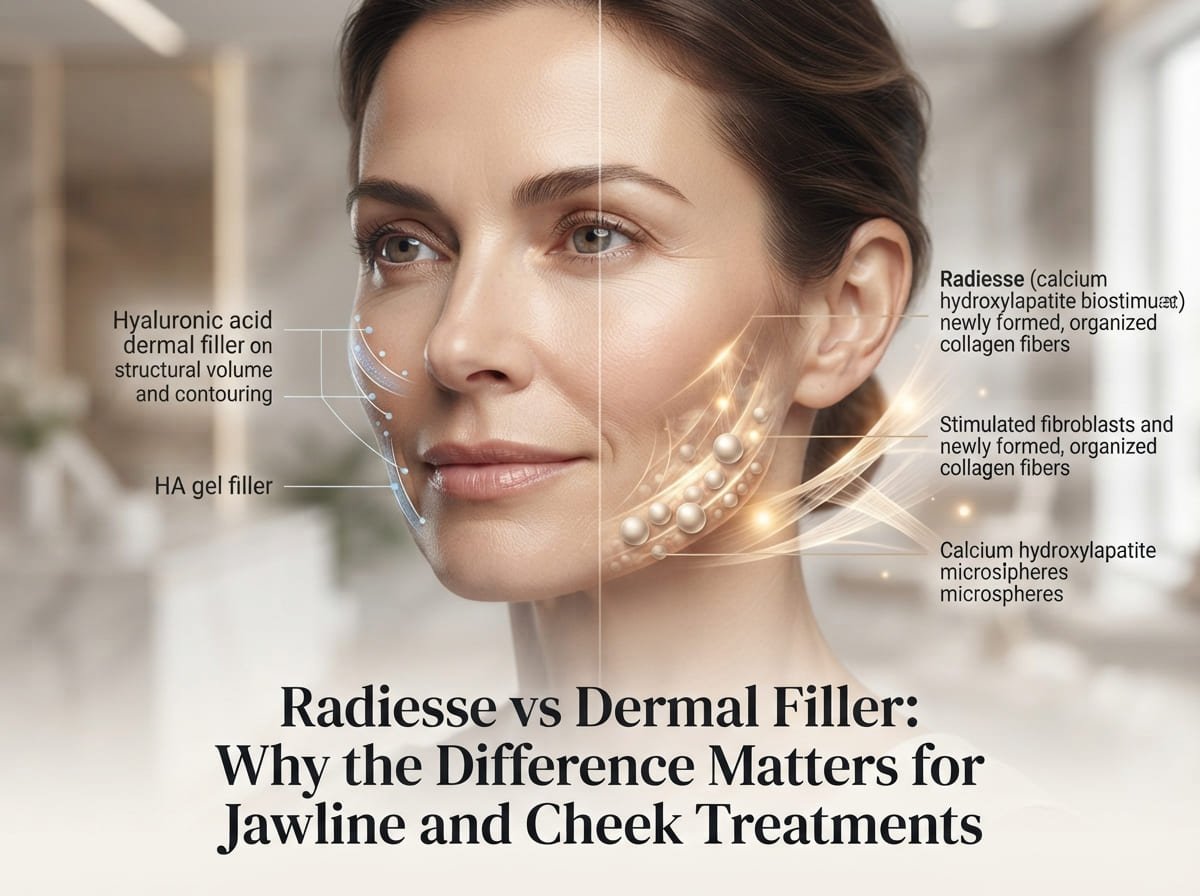
Radiesse is made from calcium hydroxylapatite, which is a mineral compound also found naturally in bone and teeth. The product consists of CaHA microspheres, which are tiny smooth spherical particles roughly 25 to 45 micrometres in diameter, suspended in a carboxymethylcellulose gel carrier. The two components do completely different jobs once the product is injected.
The carboxymethylcellulose gel carrier provides immediate volume on injection, similar in effect to what HA filler delivers. The gel fills the treated area right away, producing a visible lift and contour change immediately after treatment. This immediate volumising effect is what the patient sees leaving the clinic on the day of treatment.
What happens over the following months is where Radiesse diverges significantly from HA filler. As the CMC gel carrier gradually absorbs and dissipates over approximately three months, the CaHA microspheres remain in place. Fibroblasts in the surrounding tissue adhere to these microspheres and begin using them as a scaffold structure. The biological response to this scaffold is the production of new collagen, new elastin, and the regeneration of other extracellular matrix components in the tissue surrounding the microsphere network.
This process is described in peer-reviewed research as a cell-biomaterial-mediated interaction. The microspheres trigger a regenerative response in the tissue without causing significant inflammation, which is a clinically important distinction. The collagen production stimulated by Radiesse occurs through a non-inflammatory pathway, meaning the tissue improvement builds without the side effects associated with inflammatory healing responses.
At around six months post-injection, histological studies show the CaHA microspheres still present in the tissue, surrounded by thick new collagen and fibroelastic tissue. The microspheres themselves gradually biodegrade over 12 to 18 months as the collagen scaffold they created becomes self-supporting. By the time the product has fully degraded, a meaningful volume of newly produced collagen remains in the tissue where the microspheres were placed.
This is the fundamental difference between Radiesse and HA filler. HA filler provides volume while it is present and then fades. Radiesse provides immediate volume through the gel carrier, then drives the tissue to produce its own structural improvement that outlasts the product itself.
Why This Matters Specifically for Jawline and Cheek Treatments
The jawline and cheeks are structural areas where the clinical differences between Radiesse and HA filler matter most to patients.
The jawline is a definition treatment as much as a volume treatment. Patients who want a sharper, more defined jaw contour are asking for structural support and tissue firmness in an area that responds to movement and gravity constantly throughout the day. HA filler placed along the jawline provides the structural edge while it is present. In patients where some skin laxity exists alongside the volume concern, HA filler adds definition but does not address the tissue quality of the skin and dermis sitting above it.
Radiesse placed along the jawline does both. The immediate gel volume provides the definition. The collagen stimulation that follows improves the tissue quality of the dermis in the area, contributing to firmer-looking skin over the months that follow treatment. Patients who have Radiesse in the jawline often notice that the skin in the treated area looks and feels firmer six months after treatment than it did immediately after, which is the opposite of what happens with HA filler as it gradually absorbs.
The cheeks present a similar dynamic. Volume restoration in the midface lifts the overall face and restores the youthful projection that flat cheeks lack. HA filler achieves this through physical gel volume. Radiesse achieves it through the gel volume initially and then maintains a degree of structural improvement through the collagen it stimulates. For patients where skin quality in the midface is also a concern alongside volume loss, the dual action of Radiesse addresses both dimensions in a single treatment.
There is also a practical longevity argument for Radiesse in these structural areas. Results from Radiesse in the jawline and cheeks typically persist for 15 to 18 months from a single treatment, with some patients experiencing benefit beyond this period as the collagen produced during the regenerative phase continues to contribute to structural support. This compares favourably with the 12 to 18 month range most HA fillers produce in the same areas, particularly at the 18 month end of that range, which represents optimistic rather than average longevity for most patients.
Hyperdilute Radiesse: A Different Application of the Same Product
It is worth understanding that Radiesse is used in two distinct ways in clinical practice, and the hyperdilute technique represents an entirely different treatment category from the structural jawline and cheek work described above.
Hyperdilute Radiesse involves mixing the product with additional saline or lidocaine to a ratio that reduces its concentration significantly, typically 1 part Radiesse to 1 or 2 parts diluent. At this concentration, the product no longer provides meaningful immediate volume. Instead, it is spread across a larger area of skin or tissue to deliver a low-concentration biostimulatory effect across the whole area rather than structural volume to a specific zone.
Hyperdilute Radiesse is used for skin quality improvement in areas like the neck, décolletage, abdomen, inner arms, and the face as a skin-tightening rather than a volumising treatment. The collagen stimulation mechanism is the same. The application is completely different.
This distinction matters because patients researching Radiesse will encounter both applications and may not understand that the same product can be used in such different ways for such different purposes. The structural jawline and cheek application and the hyperdilute skin quality application are not interchangeable and require different clinical decisions and different treatment planning.
Radiesse Cannot Be Dissolved
This is the single most clinically important difference between Radiesse and HA filler from a patient safety perspective, and it deserves a clear, direct statement.
Radiesse is not reversible. There is no equivalent of hyaluronidase for calcium hydroxylapatite. Once Radiesse is placed, the result it produces evolves as the gel absorbs and the collagen phase develops, but it cannot be dissolved or reversed if the outcome is not as expected.
This makes patient selection and clinical assessment at consultation more critical with Radiesse than with HA filler. A practitioner recommending Radiesse needs to be confident in their understanding of the patient's facial anatomy, the appropriate volume and placement for the desired outcome, and the patient's goals and expectations before treatment rather than as an adjustment afterwards.
It also means Radiesse is generally not the right choice for patients who have never had structural facial treatment before and who are uncertain about how they will respond to volume in the jawline or cheeks. Having an initial experience with HA filler in these areas first gives a patient and practitioner the opportunity to assess the response and refine before committing to a non-reversible product.
Who Is Best Suited to Radiesse for the Jawline and Cheeks
Radiesse suits patients who have already had HA filler in these areas and know what volume and placement works well for their face. It suits those who want a longer-lasting structural result with the additional benefit of skin quality improvement in the treated zone.
It suits patients in their mid-forties and above where skin laxity and tissue quality decline in the midface and lower face are as significant as volume loss, because the dual-action mechanism addresses both dimensions.
It suits patients who want a more robust structural result in the jawline or cheeks than lighter HA products can provide, particularly where the aim is significant definition rather than subtle enhancement.
It does not suit patients who want the reassurance of reversibility, those having structural treatment in these areas for the first time, or those who have previously placed HA filler in the same areas and where incomplete dissolving of that filler could create unpredictable placement of the Radiesse. A full treatment history assessment at consultation addresses all of these factors before any recommendation is made.
Frequently Asked Questions
Can I have Radiesse if I have had HA filler in the same area before?
Possibly, but this requires careful assessment. Residual HA filler in the tissue affects how Radiesse integrates and the overall volume balance of the result. Disclosing previous treatments fully at consultation is essential.
Does Radiesse hurt more than HA filler?
Radiesse contains integrated lidocaine, which makes the injection experience very manageable for most patients. Discomfort is comparable to HA filler treatment with a similar anaesthetic.
How do I know whether I need Radiesse or HA filler for my jawline?
A clinical assessment of your facial anatomy, the degree of volume loss, the skin quality in the treatment area, and your goals determines which product is appropriate. This is not a self-selection decision. It is a clinical recommendation based on a proper consultation.
Is Radiesse more expensive than HA filler?
Pricing varies by clinic and by the amount of product needed. The longer duration of Radiesse results means the cost per month of maintained results is often comparable to HA filler despite any higher upfront cost.
Can Radiesse be used anywhere on the face?
Radiesse is used in several facial areas but is particularly well suited to structural zones like the jawline, cheeks, and temples. It is not used in areas like the lips where tissue movement and the risk of nodule formation make HA filler significantly more appropriate.
What happens when Radiesse eventually wears off?
The CaHA microspheres gradually biodegrade completely. The collagen produced during the regenerative phase does not disappear immediately and contributes to maintaining some structural improvement beyond the point when the product itself has fully absorbed. The face returns toward its pre-treatment baseline gradually rather than suddenly.
If you are considering treatment for the jawline or cheeks and want to understand whether Radiesse or HA filler is the more appropriate choice for your specific goals, book a consultation at our Littlehampton or Hove clinic.
Book a Consultation in Littlehampton or Book a Consultation in Hove