Marionette lines are the vertical grooves that run from the corners of the mouth downward toward the chin. They are named after the hinged wooden puppets whose mouths are separated from the rest of the face by exactly this kind of crease, and the comparison is apt in an uncomfortable way. Deep marionette lines give the lower face a drooped or downward-pulled expression that reads as sad, stern, or aged even when the face is at rest and the person feels none of those things.
They are also one of the lower face concerns that patients find most difficult to treat with a single approach, because they have multiple contributing causes that each respond to different treatment modalities. Understanding what is actually driving the marionette lines in a specific patient is the difference between a result that addresses the real problem and one that improves the appearance without resolving the underlying concern.
What Creates Marionette Lines
Marionette lines are not caused by a single anatomical event. They form at the convergence of several age-related changes in the lower face that each contribute a different dimension to the same visible groove.
The mandibular ligament runs vertically from the bone of the lower jaw and inserts into the overlying skin at the chin-jaw junction. This ligament is one of the osteocutaneous retaining ligaments of the face, structures that anchor skin and soft tissue directly to the underlying bone. Where a ligament attaches to the skin surface, it creates a fixed point. The tissue above this fixed point descends with age as soft tissue above the ligament loses volume and structural support and sags downward. The tissue at the ligament attachment cannot move because it is held in place. The result is a groove at the attachment point as the descended tissue above it and the fixed point create a relative shadow and fold.
The descending jowl fat adds to this. As the superficial fat compartment of the lateral lower face descends below the jaw margin, it creates the jowl. The medial edge of this descended fat mass sits against and above the marionette zone, pushing the tissue outward and downward in a way that deepens the vertical groove between the corner of the mouth and the chin.
Volume loss in the lower face and chin region contributes a third dimension. When the chin area and the perioral tissue lose subcutaneous fat and structural support, the tissue around the mouth has less internal scaffolding to maintain its position. It falls slightly, which compounds the downward pull around the corners of the mouth that the descended jowl has already created.
Muscle activity plays a role as well. The depressor anguli oris muscle, which runs from the mandible upward to insert into the corner of the mouth, acts to pull the corner of the mouth downward. In younger faces, this muscle is balanced by the orbicularis oris and other elevator muscles of the mouth. With age, the balance shifts as muscle mass and tone change, and the depressor anguli oris can produce a more pronounced downward pull at the corner of the mouth that contributes to the sad or stern expression that marionette lines create.
Collagen and elastin loss in the skin of the lower face reduces the tissue's ability to resist the mechanical forces from all of the above. Skin that retains good structural protein can absorb some degree of volume loss and tissue descent without immediate visible consequence. Skin with depleted structural proteins shows the effects of these forces more readily.
This convergence of ligamentous anatomy, fat descent, volume loss, muscle dynamics, and skin quality changes explains why marionette lines present at different ages and with different characteristics between patients, and why the same treatment does not work equally well for everyone.
Why Treating Marionette Lines Requires Understanding Which Cause Is Dominant
A patient in their early forties with relatively early marionette lines, where the descent above the mandibular ligament is mild, and the jowl contribution is minimal, has a fundamentally different presentation from a patient in their late fifties where significant jowling, pronounced fat descent, volume loss in the chin region, and years of depressor anguli oris hyperactivity have all contributed.
The younger patient with primarily volume loss and mild ligament attachment as the driver responds very well to targeted filler in the marionette zone combined with lower face volume restoration. The older patient with significant jowling and descended tissue as the dominant cause responds less completely to filler alone because the structural descent that is contributing to the groove is not corrected by adding volume at the groove itself.
This is one of the most common sources of treatment disappointment in lower face aesthetics. Filler placed directly into a marionette groove softens its appearance but does not lift the descended tissue above the mandibular ligament. If the jowl above the groove is the dominant cause, the result of filler alone is partial, and the patient may feel the treatment under-delivered when the treatment was simply addressing the wrong element of a multi-factorial concern.
Dermal Filler for Marionette Lines
Dermal filler is the most commonly used treatment for marionette lines, and in appropriate patients, it produces results that genuinely improve the lower face appearance significantly.
The most effective filler approach for marionette lines involves treating the contributing anatomy rather than simply filling the groove itself. In most cases, this means addressing the chin and prejowl area with structural filler to restore the volume and scaffolding that the lower face has lost, which reduces the relative prominence of the marionette groove from above rather than simply adding material to the groove itself.
Filler placed in the prejowl sulcus, which is the slight hollow that develops along the jaw margin as fat volume depletes, blends the transition between the jowl and the jaw and reduces the shadow effect that makes marionette lines appear deeper. Chin filler supports the perioral tissue from below and provides a structural platform that the overlying tissue can rest against rather than descending further.
Filler placed directly into the marionette groove itself works best when the groove is primarily a volume deficit rather than primarily a result of tissue descent. A practitioner assessing whether the groove fills adequately when the tissue above it is gently supported is evaluating whether direct groove filler is the appropriate primary approach or whether it should be secondary to more structural volume work in the perioral region.
The product used for marionette lines is typically a moderately firm HA filler with good lifting capacity and structural support characteristics, different from the softer products appropriate for lips or the periorbital area. The mechanical demands of the lower face, which is constantly in motion during speaking, eating, and expression, require a product robust enough to maintain its position and structure under this constant activity.
Radiesse is an alternative to HA filler in the lower face marionette and chin region for appropriate patients, providing immediate volume through the gel carrier and longer-lasting structural support through the collagen scaffold its CaHA microspheres stimulate. The full comparison between Radiesse and HA filler in structural areas is covered in the dedicated article on this blog.
Anti-Wrinkle Injections for Marionette Lines
The depressor anguli oris muscle component of marionette lines is the most specific indication for anti-wrinkle treatment in this area.
Small amounts of anti-wrinkle product placed into the depressor anguli oris at its insertion near the corner of the mouth reduce the downward pull of this muscle on the oral commissure. The result is a slight upward repositioning of the corner of the mouth that reduces the downward-turned appearance that deep marionette lines create and contributes to a more neutral or gently upward resting mouth expression.
This treatment is extremely dose-sensitive and requires precise anatomical knowledge. The depressor anguli oris sits in proximity to the depressor labii inferioris, which pulls the lower lip down. Injecting product into the wrong muscle produces an asymmetrical smile and uneven lower lip movement that is very noticeable and uncomfortable for the patient until the treatment wears off. Conservative doses placed with confidence in the anatomy produce a subtle and natural-looking improvement. Incorrect placement or excessive doses produce a visible asymmetry.
Anti-wrinkle treatment of the depressor anguli oris works best as an adjunct to structural filler rather than as a standalone treatment. The muscle component is rarely the sole cause of marionette lines. Reducing its downward pull while also restoring the volume and structural support that the lower face needs produces a more complete result than either approach alone achieves.
Thread Lifting for Marionette Lines
Where the dominant cause of marionette lines is the descent of tissue above the mandibular ligament, thread lifting offers a different approach from filler by physically repositioning the descended tissue rather than adding volume around it.
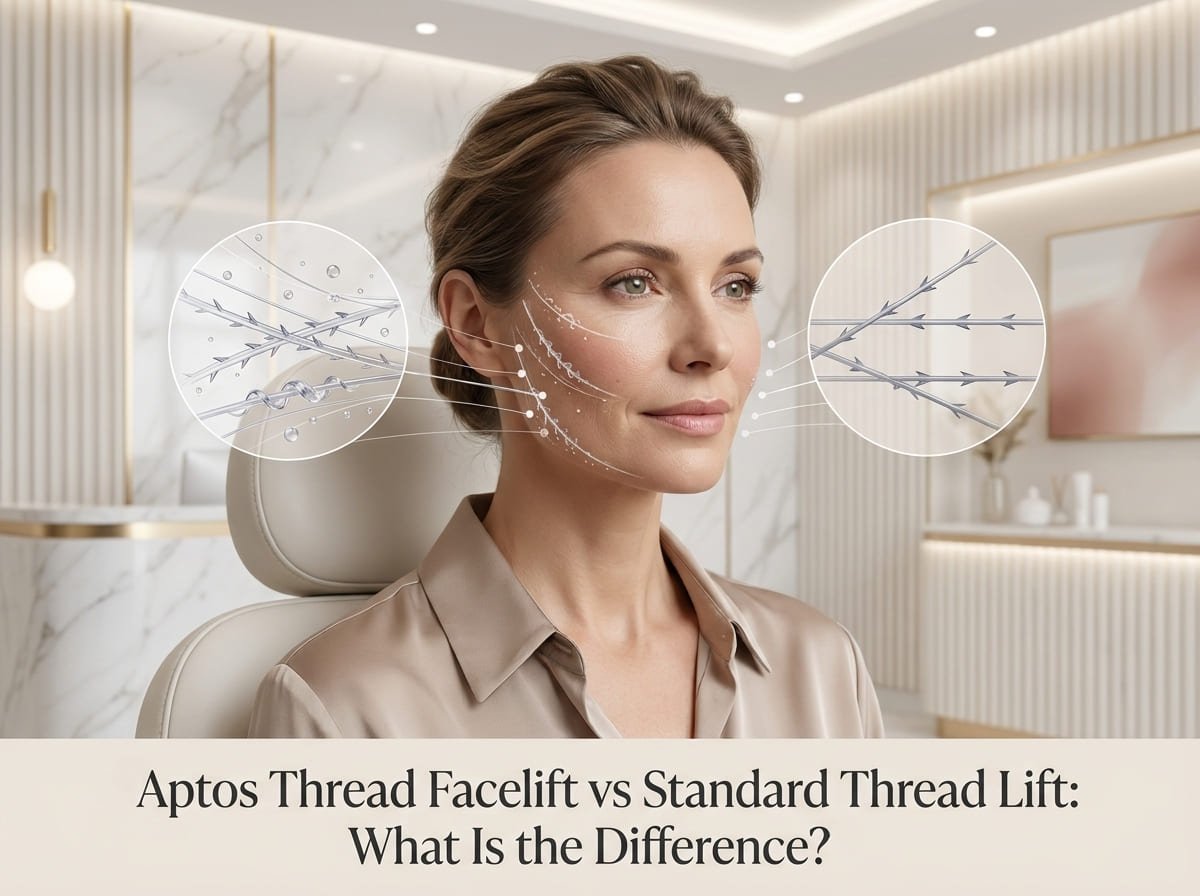
PDO or Aptos threads placed at the lateral lower face can mechanically lift the jowl tissue that is descending toward and contributing to the marionette zone. The lift repositions the tissue toward its more anatomically youthful position, which reduces the degree to which the descended mass is contributing to the groove from above.
Thread lifting for marionette lines is most appropriate in patients where jowling is a significant contributor to the concern and where the improvement from repositioning the descended tissue would be more meaningful than the improvement from volume addition alone. A patient with early marionette lines driven primarily by volume loss is less likely to benefit from thread lifting than one with visible jowling and descended lower face tissue.
The thread lift and filler comparison article on this blog covers this distinction in more detail for patients who are weighing the two approaches.
Profhilo and Skin Quality Treatments in the Lower Face
The skin quality dimension of marionette lines, which reflects the collagen and elastin depletion that reduces the lower face skin's resistance to the forces creating the groove, is best addressed with skin quality treatments used alongside the structural treatments described above.
Profhilo used in the lower face drives bio-remodelling that improves the collagen and elastin content of the skin and dermis in the treated area. Improved structural skin quality means the lower face tissue is more resilient and less susceptible to the ongoing descent and groove formation that the other contributing factors drive. Profhilo used in combination with structural filler for marionette lines consistently produces more satisfying and longer-lasting results than filler alone because both the structural deficit and the tissue quality deficit are addressed.
Polynucleotides in the lower face contribute the deeper regenerative signal that builds new collagen and elastin in the dermis through the PDRN mechanism. For patients with more significant collagen depletion in the lower face skin, polynucleotides provide a more intensive structural rebuilding than Profhilo alone. Used together in a programme, the two treatments address the tissue quality dimension comprehensively.
What a Realistic Treatment Plan Looks Like
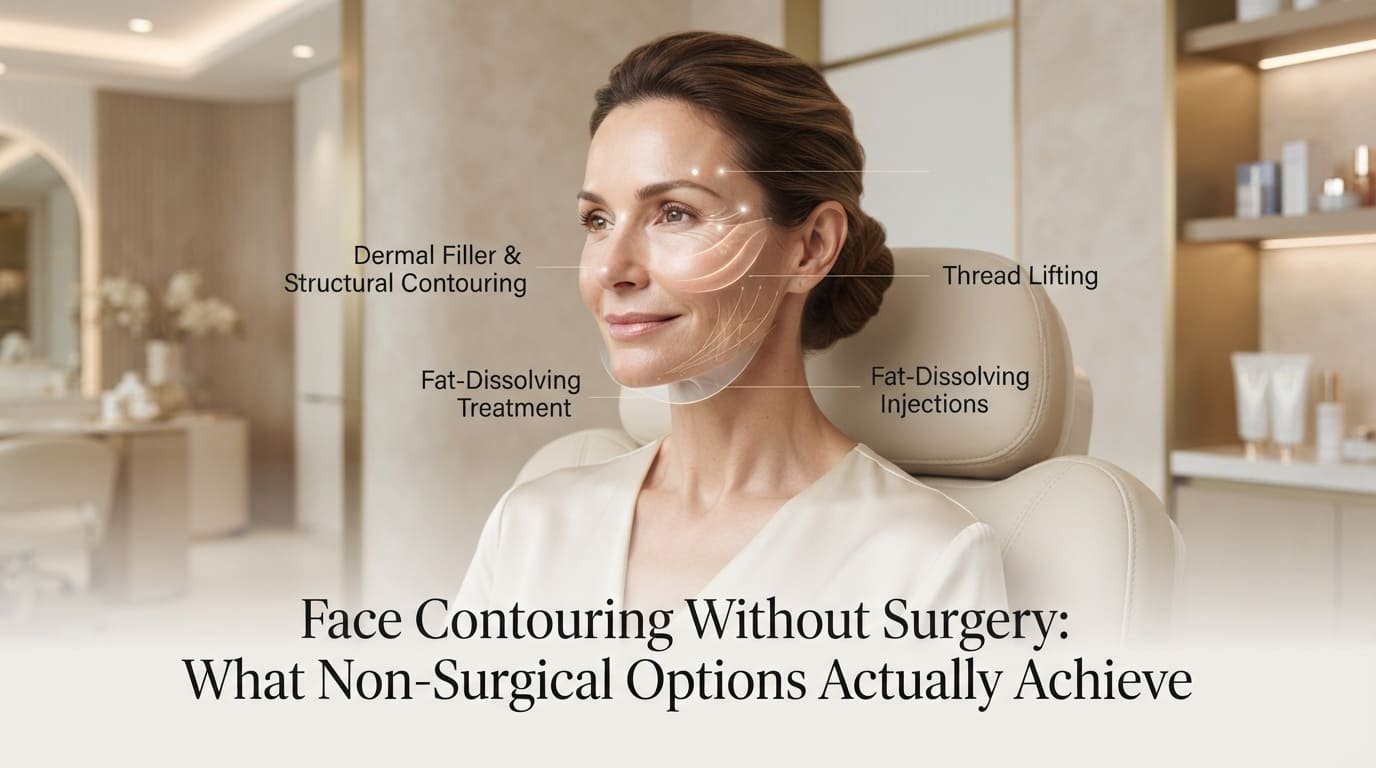
For a patient in their forties with moderate marionette lines where volume loss and early tissue descent are both contributing, a realistic treatment plan combines structural filler in the chin and prejowl region to restore the framework the lower face has lost, targeted filler in the marionette groove where direct volume is needed, anti-wrinkle treatment of the depressor anguli oris to reduce the downward muscle pull, and skin quality treatment with Profhilo or polynucleotides to improve the tissue resilience that determines how well the structural work holds over time.
For a patient with more significant jowling and descended tissue, the plan includes a thread lift component to reposition the tissue that structural filler alone cannot adequately correct, combined with the filler and skin quality elements above.
The timeline for visible improvement in marionette lines from a combination programme is typically four to six weeks for the filler and anti-wrinkle components, and three to four months for the full benefit of the skin quality treatments to become apparent.
Frequently Asked Questions
Can marionette lines be eliminated with treatment?
Significant reduction in the depth and prominence of marionette lines is achievable in most patients with an appropriately planned combination approach. Complete elimination is not a realistic goal for established lines, particularly where ligamentous anatomy and significant tissue descent are contributing. Meaningful improvement that makes a genuine visible difference to the resting expression of the face is what a well-planned programme delivers.
How long does filler last in the marionette area?
Marionette filler in the lower face typically lasts twelve to eighteen months. The constant movement of this area from speaking, eating, and expression means metabolic degradation is active throughout, though structural filler products selected for this area are designed to maintain their properties under these demands.
Will treating marionette lines change how my smile looks?
Structural filler in the chin and prejowl and targeted groove filler should not change the smile because they are placed at rest and not in the dynamic muscle zone. Anti-wrinkle treatment of the depressor anguli oris does affect how the corner of the mouth moves during expression, which is why conservative dosing and precise placement are critical. A well-dosed depressor anguli oris treatment produces a slightly more upturned resting position while leaving the smile movement looking natural.
My marionette lines are worse on one side than the other. Is that normal?
Yes. Natural facial asymmetry means that the contributing factors, ligamentous anatomy, fat descent, volume loss, and muscle dominance, are rarely perfectly equal between sides. A practitioner assessing your specific asymmetry at consultation will plan treatment that addresses the asymmetry rather than applying identical treatment to both sides.
Should I treat my jowls and marionette lines at the same appointment?
In most cases, yes. Jowling and marionette lines are part of the same anatomical picture, and the most effective treatment plans address both simultaneously rather than in isolation. Your practitioner will confirm whether the same appointment is appropriate based on the total volume of treatment planned.
Can marionette lines be improved without filler?
Skin quality treatments improve the tissue resilience and collagen content that partly determines how pronounced marionette lines appear, and thread lifting can improve the descended tissue component. For patients who specifically want to avoid filler, a combination of skin quality treatment and thread lifting can produce meaningful improvement, though the volume-specific component of marionette lines is most directly addressed by filler.
If you want to understand what specific factors are contributing to your marionette lines and what the most appropriate treatment plan would be for your lower face, book a consultation at our Littlehampton or Hove clinic.
Book a Consultation in Littlehampton or Book a Consultation in Hove