If you are searching for polynucleotide sessions in the UK, the practical answer is that most people need a series of injections, usually around 3 sessions, to see a meaningful cumulative improvement in skin quality. A common phased protocol is:
| Phase | Timing | What it means |
| Loading phase | Week 0 | First polynucleotide treatment |
| Loading phase | Week 3 | Second treatment to build the biostimulation cycle |
| Loading phase | Week 6 | Third treatment to strengthen cumulative results |
| Review phase | Around 8–12 weeks | Assess skin quality, texture, hydration, and under-eye response |
| Maintenance phase | Personalised | Top-ups planned depending on skin condition and goals |
At Angel White Aesthetics in Littlehampton and Hove, polynucleotides are approached through a consultation-led treatment plan rather than a fixed “one-size-fits-all” answer. Your practitioner will assess your skin, treatment area, expectations, and suitability before advising how many treatments you need.
What are polynucleotides?
Polynucleotides are injectable regenerative skin treatments used to support skin quality, hydration, elasticity, and repair. Instead of adding volume like dermal fillers, polynucleotide injections work more gradually through a biostimulation process.
They are commonly used for areas where the skin looks tired, thin, crepey, dehydrated, or less elastic. Popular treatment areas include the under-eyes, face, neck, décolletage, and sometimes acne-scarred or texture-damaged skin.
In simple terms, polynucleotides encourage the skin to behave in a healthier, more regenerative way. That is why results are usually cumulative rather than instant.
Polynucleotides: How many sessions do you usually need?
Most clients should expect a polynucleotide course of treatment, not a single appointment. The standard answer is often 3 sessions, especially when the goal is better skin quality, under-eye rejuvenation, hydration, firmness, and smoother texture.
However, the exact number can vary:
- 1 session may give an early glow or hydration boost, but it is usually not enough for full results.
- 2 sessions may suit mild concerns or clients wanting subtle improvement.
- 3 sessions is a common loading phase for visible cumulative results.
- 4 sessions or more may be advised for more advanced ageing, crepey skin, acne scarring, poor elasticity, or delicate under-eye concerns.
This is why the question is not only “how many treatments do I need?” but also “what is my skin trying to improve?”
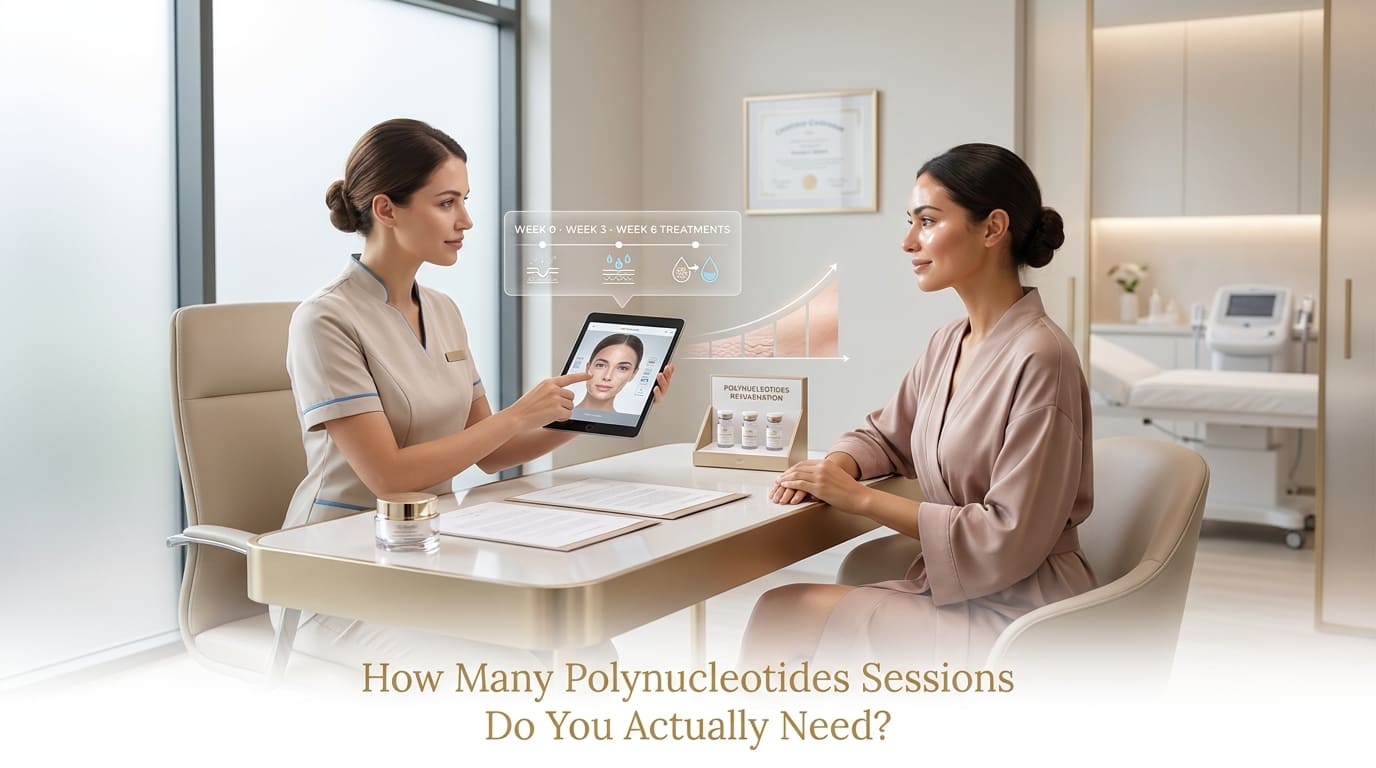
The standard 3-session protocol: week 0, week 3, week 6
A clear polynucleotide protocol helps clients understand the timeline. A common schedule is:
Week 0: First session
Your first session starts the biostimulation cycle. At this stage, the skin begins responding, but you should not expect a final result immediately.
Week 3: Second session
The second treatment reinforces the cellular repair process. This is often when clients begin to notice improvements in hydration, brightness, smoothness, or under-eye freshness.
Week 6: Third session
The third session completes the initial loading phase. This is where the cumulative effect becomes more important, especially for fine lines, wrinkles, crepey texture, dullness, and under-eye skin quality.
Weeks 8–12: Review window
Results continue to develop after the injection course. A review allows your practitioner to assess whether you need maintenance, another session, or a different supporting treatment.
This calendarised treatment plan is useful because polynucleotides work through phased skin regeneration, not instant volumising.
How often should I have polynucleotides?
For many clients, the frequency of polynucleotide injections is every 2–4 weeks during the initial course. A 3-week interval is commonly used because it gives the skin time to respond between appointments while maintaining the momentum of the biostimulation cycle.
Once the loading phase is complete, the maintenance phase depends on your skin and goals. Some clients may need top-ups sooner, while others may only need maintenance at longer intervals.
Your maintenance schedule may depend on:
- age and skin quality
- under-eye skin thickness
- fine lines or crepey texture
- lifestyle and sun exposure
- smoking, stress, and sleep quality
- whether the treatment is for prevention or correction
- how well your skin responds after the initial course
Minimum polynucleotide sessions to see results
The minimum polynucleotide sessions to see results can vary, but many people notice early improvement after one or two treatments. This may include better hydration, a fresher look, or smoother skin texture.
However, the full result usually needs the full treatment series. If your goal is under-eye rejuvenation, improved elasticity, reduced crepiness, or stronger skin quality, a single treatment may underrepresent what polynucleotides can do.
A useful way to think about this is:
| Concern | Likely session expectation |
| Mild dullness or dehydration | 2–3 sessions |
| Under-eye skin quality | Usually 3 sessions |
| Crepey or thin skin | 3–4 sessions |
| Neck or décolletage | 3–4 sessions |
| Acne scarring or rough texture | 3–4+ sessions |
| Maintenance after a completed course | Personalised top-up plan |
Do I need polynucleotide top-ups?
Yes, most clients who want to maintain results should plan for polynucleotide top-ups. Polynucleotides improve skin quality gradually, but skin continues to age due to natural collagen decline, lifestyle factors, sun exposure, and environmental stress.
A maintenance protocol helps preserve results after the initial course. Your practitioner may recommend a top-up depending on how your skin responds, how long your results last, and whether you are treating prevention, correction, or ongoing skin quality support.
Top-ups are not always urgent, but they can be useful for keeping the skin in a healthier regenerative state.
Polynucleotides treatment plan at Angel White Aesthetics
At Angel White Aesthetics, the polynucleotide eye treatment plan is consultation-led. This matters because two people can ask for the same treatment but need different protocols.
For example, someone with mild dehydration may need fewer sessions than someone with thin under-eye skin, deeper crepiness, or long-term texture damage. The treatment area also matters: under-eyes require careful planning because the skin is delicate and often responds gradually.
Angel White’s public treatment pathway focuses on assessment, suitability, expected outcome, treatment, aftercare, and follow-up planning. That makes the process clearer for clients who want a natural-looking result rather than a rushed injectable appointment.
Why are polynucleotide results cumulative?
Polynucleotides are different from treatments that create an immediate structural change. Their benefit is linked to treatment cumulativity, biostimulation kinetics, and repeated regenerative signalling.
That means each session builds on the previous one. The skin may become more hydrated first, then gradually appear smoother, brighter, firmer, and healthier. This is why a phased protocol is more realistic than expecting one appointment to do everything.
The cumulative effect is especially important for:
- fine lines
- under-eye crepiness
- dull or tired-looking skin
- poor skin texture
- loss of elasticity
- early laxity
- acne-scarred skin
- neck and décolletage ageing
Polynucleotides vs skin boosters, fillers, and anti-wrinkle injections
Polynucleotides are often compared with other injectable treatments, but they do a different job.
Polynucleotides vs skin boosters:
Skin boosters are often chosen for hydration and glow. Polynucleotides are more focused on regenerative skin quality and repair.
Polynucleotides vs dermal fillers:
Dermal fillers restore or enhance volume. Polynucleotides do not primarily volumise; they support skin quality.
Polynucleotides vs botulinum toxin injections:
Botulinum toxin injections soften movement-related lines. Polynucleotides are used for skin texture, hydration, elasticity, and repair.
In some treatment plans, these options may be discussed together, but the right choice depends on your skin and goals.
Who may need more than 3 sessions?
You may need more than the standard 3-session protocol if your skin needs stronger correction or a longer regenerative push. This may apply if you have:
- more advanced under-eye crepiness
- significant sun damage
- acne scarring
- thin or fragile skin
- deeper texture changes
- neck or décolletage concerns
- slower response after the first two sessions
- a longer gap between appointments
This does not mean everyone needs more treatment. It means your practitioner should review your response and adjust the plan safely.
Safety, downtime, and aftercare
Polynucleotide injections may cause temporary swelling, redness, small bumps, tenderness, or bruising at injection points. These effects are usually short-lived, but aftercare matters.
Your practitioner may advise you to avoid heavy exercise, alcohol, saunas, steam rooms, facial massage, and strong active skincare for a short period after treatment. You should also avoid touching or rubbing the treated area immediately after injections.
Suitability should always be checked during consultation, especially if you are pregnant, breastfeeding, have an active skin infection, have certain medical conditions, or are taking medication that may increase the risk.
So, how many polynucleotide sessions do you actually need?
For most clients, the best starting answer is 3 polynucleotide sessions, often scheduled at week 0, week 3, and week 6. This provides the skin with sufficient repeated stimulation to produce a more meaningful cumulative effect.
However, the right answer depends on your treatment area, skin condition, age, goals, and your skin's response. Some clients may need two sessions, while others may benefit from four or more. Maintenance top-ups can then be planned after your initial course.
If you are considering polynucleotides in Littlehampton or Hove, Angel White Aesthetics can assess your skin and guide you through a personalised treatment plan.
Ready to discuss your treatment series?
Book a consultation with Angel White Aesthetics and ask which polynucleotide protocol is right for your skin.
FAQs
Polynucleotides, how many sessions do I need?
Most people need around 3 polynucleotide sessions for visible cumulative improvement. Some clients may need 2 sessions for mild concerns, while under-eye crepiness, acne scarring, neck ageing, or poorer skin quality may need 3–4 or more.
How often should I have polynucleotides?
During the initial loading phase, polynucleotide injections are commonly spaced every 2–4 weeks. A week 0, week 3, and week 6 schedule is often used, followed by a review and personalised maintenance plan.
Do I need polynucleotide top-ups?
Yes, top-ups are usually recommended if you want to maintain results. The maintenance interval depends on your skin, treatment area, lifestyle, age, and goals. Your practitioner will normally review your response after the initial treatment course.
minimum polynucleotide sessions to see results?
Some people notice hydration, glow, or smoother texture after 1–2 sessions, but the full result usually needs a course. For stronger under-eye texture, elasticity, or crepey-skin improvement, 3 sessions are often more realistic.
Are polynucleotides a one-off treatment?
Polynucleotides are usually not planned as a one-off treatment. One session may give subtle early improvement, but the treatment works best as a series because results build through cumulative skin repair and biostimulation.
How long do polynucleotide results last?
Results vary by person, treatment area, and skin condition. After a completed course, many clients plan maintenance top-ups to support ongoing skin quality. Your practitioner should advise the best maintenance schedule after reviewing your response.