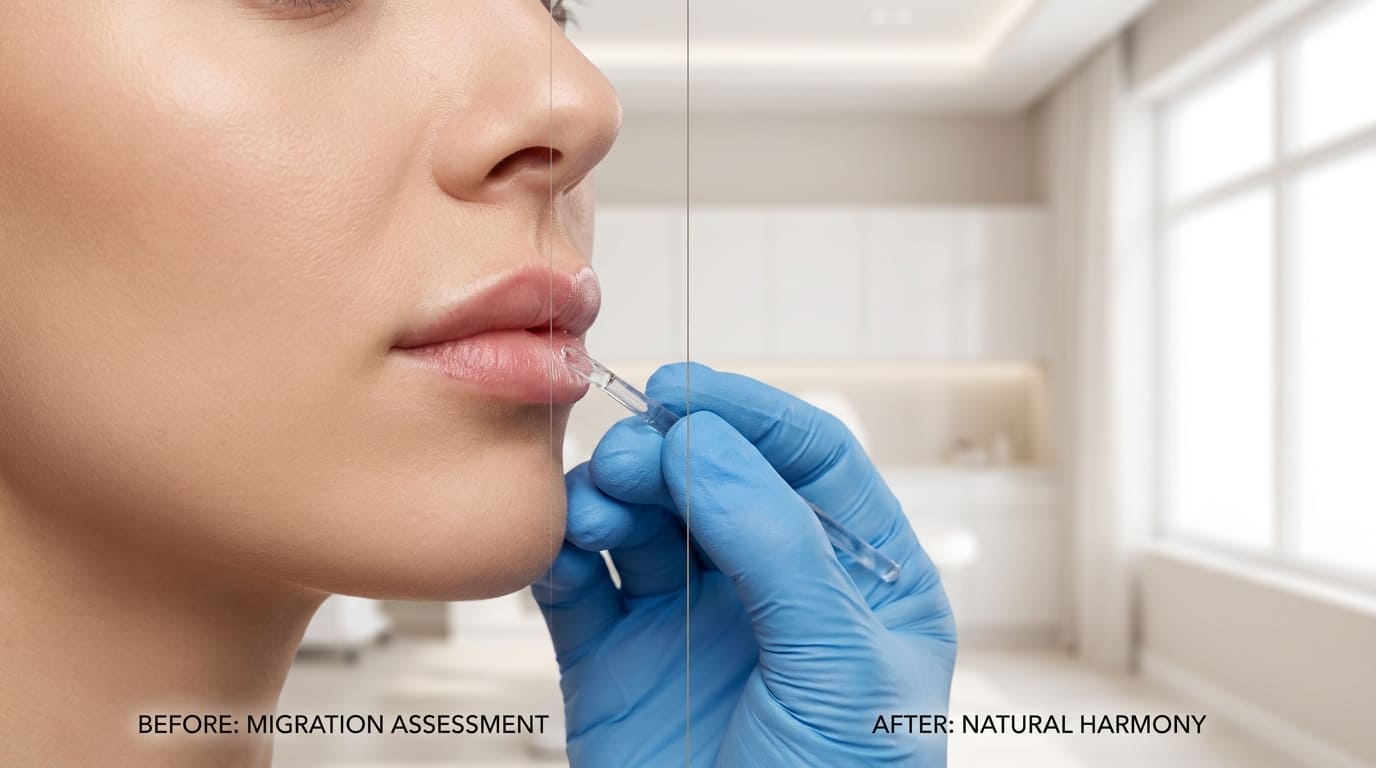
Lip filler migration is one of the most common concerns people search for after noticing that their lips look less defined, slightly puffy above the lip line, or different from the result they expected. It can appear as filler above the lip line, a soft lip filler moustache appearance, a lumpy upper lip from filler, or a blurred vermilion border.
At Angel White Aesthetics in Littlehampton, lip filler treatment is consultation-led, with a focus on balanced, natural-looking enhancement rather than overfilling. The clinic lists lip augmentation as part of its dermal filler treatments and positions its approach around personalised planning and natural results.
What is lip filler migration?
Lip filler migration happens when injectable filler moves beyond the area where it was originally placed. In lip treatments, this usually means hyaluronic acid filler has shifted outside the intended lip tissue, often above the upper lip or across the vermilion border.
The vermilion border is the natural edge where the pink part of the lip meets the surrounding skin. When filler crosses this border, the lip can lose crisp definition and develop a shelf-like or swollen look. Some people describe this as filler moved above the lip, a filler moustache, or an unnatural ridge around the mouth.
Not every lump, swelling, or unevenness is true filler migration. Early swelling after lip filler can temporarily distort the result. True migration is more likely when the fullness remains after healing, sits outside the natural lip border, or worsens after repeated treatments.
The three actual causes of lip filler migration
Most lip filler migration is not random. It usually comes down to three main causes: over-volumisation, wrong placement depth, and wrong product choice.
1. Over-volumisation
Over-volumisation means too much filler is placed into the lip tissue, either in one appointment or through repeated top-ups before the previous filler has fully settled or broken down.
The lips are mobile. They move when you speak, smile, eat, drink, and kiss. The orbicularis oris muscle surrounds the mouth and constantly places pressure on the lip tissue. When the lips are overfilled, the tissue may no longer hold the product cleanly in the intended plane. This increases the risk of product displacement.
This is why a conservative approach is often safer and more natural. Instead of trying to create a dramatic change in one session, careful treatment planning allows the practitioner to respect the natural lip shape, tissue capacity, and layer integrity.
2. Wrong placement depth
Placement technique is one of the biggest factors in filler complications. If filler is placed too superficially, too close to the skin, or in the wrong tissue plane, it may be more visible and more likely to spread beyond the lip border.
A published study comparing lip injection techniques found that needle direction affected filler distribution and migration towards the upper lip, showing that technique can influence how product behaves after injection.
This is why tissue plane respect matters. Skilled injectors consider placement depth, lip anatomy, product behaviour, and the natural structure of the vermilion border before injecting.
3. Wrong product choice
Different hyaluronic acid fillers behave differently. Some are softer and more flexible, while others are firmer or more volumising. Product hygroscopicity also matters, meaning how much water a filler attracts after placement.
A product that is too thick, too hydrophilic, or unsuitable for delicate lip tissue may increase swelling, heaviness, or visible distortion. This does not mean one filler is always “bad”; it means the product must suit the patient’s anatomy, treatment goal, and tissue capacity.
A review of filler migration reports found hyaluronic acid to be among the commonly encountered substances in migration cases, with lips listed among areas where migration is reported.
Signs your lip filler has migrated
Common signs of lip filler migration include:
- Filler above the upper lip line
- A lip filler moustache appearance
- A blurred or puffy vermilion border
- Lumpy upper lip from filler
- Loss of natural cupid’s bow definition
- Uneven lip contour
- A shelf-like ridge above the lip
- Lips that look overfilled but not well-shaped
- Swelling that does not settle after the healing period
If you are asking, “why does my lip filler migrate?” or “how do I know if my lip filler has migrated?”, the safest step is a professional assessment. Migration can look similar to swelling, poor shaping, or uneven filler placement, so diagnosis should not rely on photos alone.
Lip filler migration vs normal swelling
Swelling is normal after lip filler. It is usually most noticeable in the first few days and gradually settles. Bruising, tenderness, mild firmness, and temporary asymmetry can also happen during recovery.
Migration is different. It tends to sit outside the intended lip area and does not simply disappear once normal swelling settles. If the upper lip area looks puffy weeks or months later, or the border looks smudged rather than defined, migration may be involved.
How to prevent lip filler migration
The best way to avoid lip filler migration is to reduce the risk before treatment begins.
First, choose a qualified and experienced injector. Angel White Aesthetics describes its Littlehampton aesthetic services as doctor-led and consultation-focused, which supports a safer, assessment-based approach to cosmetic injectables.
Second, avoid over-treatment. Bigger lips are not always better lips. Natural-looking lip fillers depend on proportion, symmetry, and restraint. A gradual approach usually gives the tissue time to adapt and helps maintain a softer, more balanced result.
Third, make sure the treatment respects lip anatomy. The vermilion border, cupid’s bow, upper lip, lower lip, and surrounding muscle movement all influence how filler should be placed. Technique-dependent diffusion is a real issue, which is why placement depth and injection method matter.
Fourth, follow aftercare instructions. Avoid unnecessary pressure on the lips immediately after treatment unless your practitioner specifically advises massage. Avoid excessive heat, intense exercise, alcohol, and pressure on the area during the early recovery period.
Can migrated lip filler be fixed?
Yes, migrated hyaluronic acid filler can often be corrected. In many cases, the safest correction is dissolving filler with hyaluronidase. Hyaluronidase is an enzyme used to break down hyaluronic acid filler when correction is needed.
This may be suitable for people with filler above the lip line, lip filler moustache appearance, product displacement, or old filler that has created heaviness around the mouth. After dissolving, the lips are usually reassessed before any new filler is considered.
Should you refill after dissolving migrated filler?
Sometimes, yes, but not immediately for everyone. The lips need time to settle after dissolving. A good practitioner will reassess the natural lip shape, tissue quality, and previous filler pattern before deciding whether refilling is appropriate.
The goal should not be to recreate the same overfilled result. The goal should be to restore structure, improve definition, and avoid repeating the same migration pattern.
Why Angel White Aesthetics is relevant for lip filler concerns
People searching for lip filler migration are often worried, frustrated, or unsure whether their filler has gone wrong. The best content for this topic should not create panic. It should explain the mechanism clearly and guide readers toward safe professional assessment.
Angel White Aesthetics offers dermal fillers in Littlehampton, with lip augmentation listed from £125 and treatment times around 30 minutes to 1 hour. For patients concerned about migrated filler, the most relevant next step is not guessing from TikTok or trying home massage. It is a proper consultation.
FAQs
What is lip filler migration?
Lip filler migration is when hyaluronic acid filler moves outside the intended lip area, often above the upper lip line. It can create a puffy border, lip filler moustache appearance, blurred vermilion border, or uneven lip shape.
Why does my lip filler migrate?
Lip filler usually migrates because of over-volumisation, incorrect placement depth, unsuitable product choice, or repeated top-ups. The orbicularis oris muscle constantly moves the lips, so poor placement technique or excessive filler can increase product displacement.
How to prevent lip filler moustache?
To prevent a lip filler moustache, avoid overfilling, choose an experienced injector, use the right filler type, and respect the vermilion border. Conservative treatment planning and correct tissue plane placement reduce the risk of filler moving above the lip.
What are the signs my lip filler has migrated?
Signs include filler above the lip line, a puffy upper lip, blurred lip border, lumpy upper lip from filler, loss of cupid’s bow definition, or a shelf-like ridge. A professional should assess persistent swelling after healing.
Can migrated lip filler be dissolved?
Yes, migrated hyaluronic acid lip filler can often be dissolved with hyaluronidase. This enzyme breaks down hyaluronic acid filler and may help correct filler migration, overfilled lips, or product displacement before considering future treatment.
Is lip filler migration permanent?
Lip filler migration is not always permanent, especially if hyaluronic acid filler was used. Some filler may naturally reduce over time, but visible migration often needs professional correction with hyaluronidase for a cleaner, more predictable result.