Choosing between Radiesse and hyaluronic acid fillers is not just a question of which dermal filler lasts longer. It is a question of how the product works, where it is placed, how it behaves in the tissue, and whether it can be adjusted or dissolved later.
At Angel White Aesthetics, clients in Littlehampton and Hove often want natural-looking enhancement without looking overfilled. That is why understanding the difference between Radiesse vs hyaluronic acid filler matters. Both can improve facial balance, soften visible ageing, and restore volume, but they are not the same type of injectable.
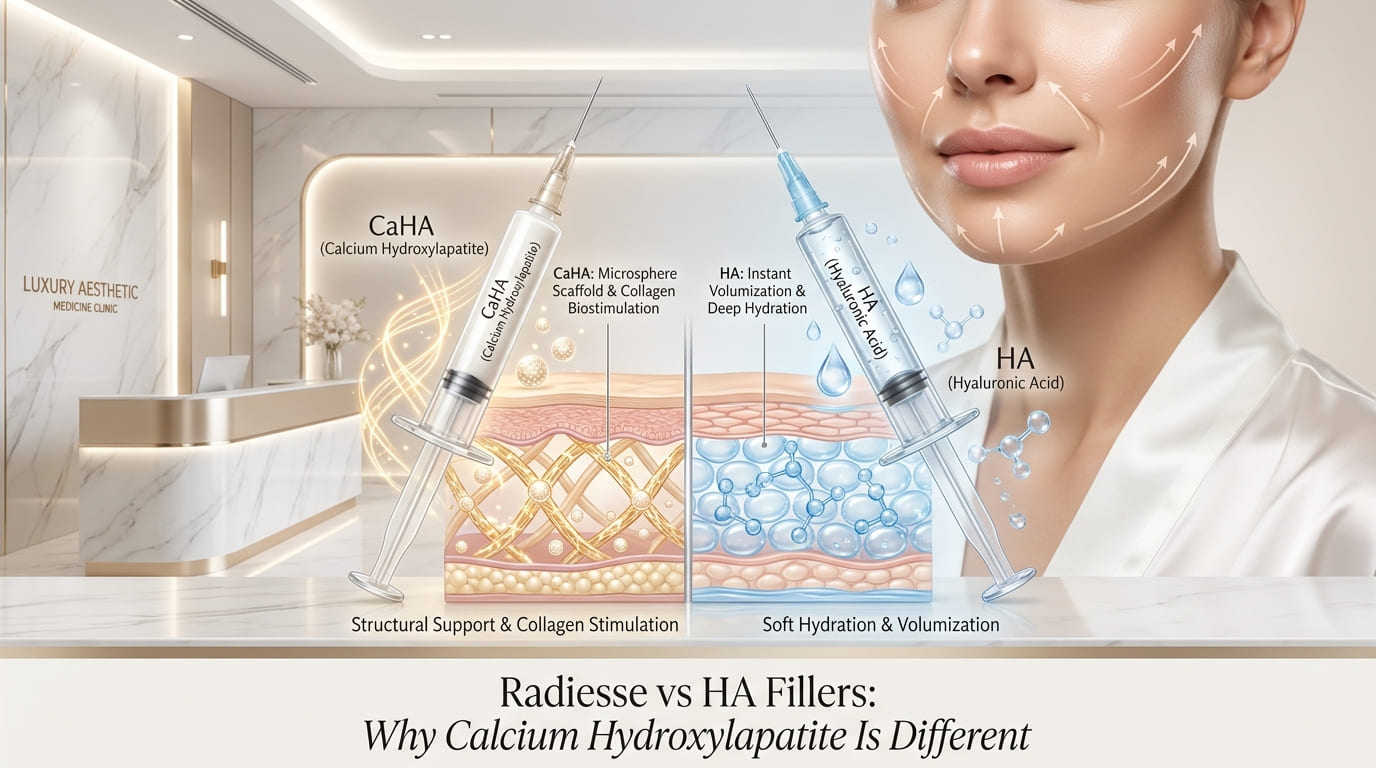
Radiesse is a calcium hydroxylapatite filler, also known as a CaHA filler. Hyaluronic acid fillers, often called HA fillers, include product families such as Juvederm, Restylane, and Teosyal. HA fillers are usually chosen for soft volumisation, hydration, lips, fine lines, and flexible correction. Radiesse is more commonly discussed as a structural filler and collagen-stimulating filler, especially when the goal is contour, lift, firmness, or longer-term tissue support.
Angel White’s own Radiesse pages position the treatment around consultation-led facial enhancement, structured treatment planning, and natural-looking results in both Littlehampton and Hove.
What is Radiesse?
Radiesse is an injectable biostimulatory filler made with calcium hydroxylapatite microspheres suspended in a gel carrier. Merz Aesthetics describes Radiesse as a calcium hydroxylapatite product in a carrier gel containing sterile water, glycerin, and sodium carboxymethylcellulose. The gel provides initial support, while the CaHA microspheres remain in the tissue as part of the longer-term effect.
This is the key difference: Radiesse is not only a volumising filler. It is also used as a collagen booster filler because CaHA can support collagen induction and tissue remodelling over time. That is why many people describe the Radiesse effect as volumetric vs regenerative: there is an immediate contouring effect, but also a longer-term biostimulatory response.
For clients considering Radiesse in Littlehampton or Radiesse in Hove, this makes Radiesse especially relevant when the aim is facial structure, lower-face support, cheek contour, jawline definition, or a more refreshed look without relying only on soft gel volume.
What are hyaluronic acid fillers?
Hyaluronic acid fillers are gel-based injectable fillers that use HA, a water-binding substance found naturally in the body. In aesthetics, HA fillers are used to add soft volume, smooth folds, improve definition, and hydrate certain treatment areas.
The FDA explains that HA used in fillers may be chemically modified or cross-linked to last longer, with effects often lasting approximately 6 to 12 months depending on the product and treatment area.
HA fillers are popular because they are versatile. They can be used for lips, cheeks, tear troughs, nasolabial folds, marionette lines, chin, and jawline depending on the exact product. Some HA fillers are soft and flexible; others are firmer and designed for contouring. This makes HA filler a useful choice when a client wants subtle enhancement, soft hydration, or a treatment that can be adjusted more easily.
Radiesse vs hyaluronic acid: the main difference
The clearest way to compare Radiesse vs hyaluronic acid is this:
HA fillers mainly provide volume through a gel that attracts and holds water. Radiesse provides structure through calcium hydroxylapatite and supports collagen stimulation over time.
That means Radiesse is often considered a long-acting injectable for clients who want lift, shape, and a firmer structural result. HA filler is often selected when the goal is soft volume, flexibility, hydration, or reversibility.
This does not mean one is always better than the other. The better option depends on the treatment area, skin quality, facial anatomy, previous filler history, and the client’s comfort with reversibility.
Radiesse longevity vs HA filler longevity
Radiesse longevity is one of the biggest reasons people compare it with HA fillers. Many HA fillers last several months to over a year, depending on density, movement in the area, and metabolism. Some advanced HA fillers may last longer in low-movement areas, but this varies by product and patient.
Radiesse is often chosen as a longer lasting filler because it works differently. It gives initial volume from the carrier gel and a longer-term tissue effect from calcium hydroxylapatite microspheres. Merz product information describes the result as long-term yet non-permanent restoration and augmentation.
This is why Radiesse is sometimes described by clients as a “one-and-done filler” option. However, that phrase should be used carefully. No injectable result is truly permanent, and maintenance may still be needed depending on the person’s ageing process, lifestyle, anatomy, and goals.
Can Radiesse be dissolved?
This is the safety-critical distinction every client should understand before choosing Radiesse vs hyaluronic acid.
HA fillers can often be dissolved with hyaluronidase, an enzyme used to break down hyaluronic acid filler when correction or complication management is needed. Hyaluronidase is specifically associated with HA filler reversal, not calcium hydroxylapatite reversal.
Radiesse cannot be dissolved like HA filler. Because Radiesse is a calcium hydroxylapatite filler, it does not respond to hyaluronidase in the same way. That does not make Radiesse unsafe when placed correctly, but it does make assessment, product choice, injection depth, and practitioner experience especially important.
This reversibility consideration is one of the most honest differences between Radiesse and HA fillers. If someone is new to filler, anxious about commitment, or wants a highly adjustable result, HA may be the more suitable starting point. If someone wants structural support, collagen stimulation, and a longer-term tissue effect, Radiesse may be discussed during consultation.
Is Radiesse better than Juvederm for jawline?
A common long-tail search is: is Radiesse better than Juvederm for jawline?
The answer depends on the desired outcome. Radiesse may be preferred when the aim is firmer support, definition, and a more structural filler effect. HA jawline fillers may be preferred when reversibility, flexibility, or a softer contouring approach is more important.
For jawline and lower-face work, injector skill is just as important as the product. The jawline requires knowledge of facial anatomy, proportions, symmetry, and safe injection planes. Angel White’s clinic positioning is built around medically led care, clinical assessment, advanced dermatological protocols, and personalised treatment planning, which is especially relevant for product-class comparisons like CaHA vs HA.
Who may suit Radiesse?
Radiesse may suit clients who want:
- More structure in the lower face
- Support for cheek or jawline contour
- A collagen-stimulating filler effect
- A long-acting filler option
- Natural-looking enhancement without excessive softness
- A consultation-led plan for facial balance
Radiesse may not be the first choice for lips, very delicate under-eye work, or clients who strongly prefer a dissolvable filler. For those goals, HA fillers are often considered because they are softer, more flexible, and reversible with appropriate medical management.
Who may suit HA fillers?
HA fillers may suit clients who want:
- Soft lip enhancement
- Fine line correction
- Hydration and plumpness
- Flexible facial volumisation
- A reversible filler option
- Gradual first-time filler treatment
HA fillers are also useful when the treatment plan requires careful layering, smaller adjustments, or a softer finish. For many patients, HA is the first step before considering a biostimulatory filler such as Radiesse.
Radiesse vs HA fillers: which should you choose?
The best choice is not based on trends. It is based on clinical assessment.
Choose Radiesse if your main priority is structure, firmness, collagen induction, and longer-term tissue support. Choose HA filler if your main priority is softness, hydration, flexibility, or reversibility. In some cases, both product classes may be used in a wider aesthetic plan, but they should not be treated as interchangeable.
At Angel White Aesthetics, the aim is not to push one filler as universally better. The aim is to match the injectable to your face, your goals, your anatomy, and your safety profile. That is why a consultation-first approach is essential before deciding between Radiesse and hyaluronic acid fillers.
Angel White currently lists Radiesse treatment on its Littlehampton and Hove clinic pages, with consultation-led care and treatment planning as part of the patient journey.
FAQs
How long does Radiesse last vs HA fillers?
Radiesse often lasts longer than many hyaluronic acid fillers because it provides structural support and stimulates collagen. HA filler duration varies by product, area, and metabolism. Radiesse is long-lasting but still non-permanent, so future maintenance may be needed.
Can Radiesse be dissolved?
Radiesse cannot be dissolved with hyaluronidase like hyaluronic acid fillers. This is one of the most important safety differences. Because it is not easily reversible, Radiesse should be placed only after careful consultation, assessment, and appropriate treatment planning.
Is Radiesse better than Juvederm for jawline?
Radiesse may suit jawline contouring when stronger structure, definition, and collagen stimulation are priorities. Juvederm and other HA fillers may suit clients who prefer flexibility and reversibility. The best choice depends on anatomy, goals, and injector assessment.
What is the difference between Radiesse and hyaluronic acid filler?
Radiesse is a calcium hydroxylapatite filler that gives structure and stimulates collagen. Hyaluronic acid filler is a water-binding gel that provides soft volume and hydration. HA fillers can usually be dissolved, while Radiesse cannot be dissolved the same way.
Is Radiesse a collagen-stimulating filler?
Yes, Radiesse is widely discussed as a collagen-stimulating filler because calcium hydroxylapatite microspheres can support collagen production and tissue remodelling. This makes it different from standard HA fillers, which mainly add soft volume and hydration.
Which filler is better for natural-looking results?
Both Radiesse and HA fillers can look natural when selected and placed correctly. HA may suit softer areas such as lips, while Radiesse may suit structural contouring. Natural-looking results depend more on consultation, anatomy, dosage, and injector skill than product alone.