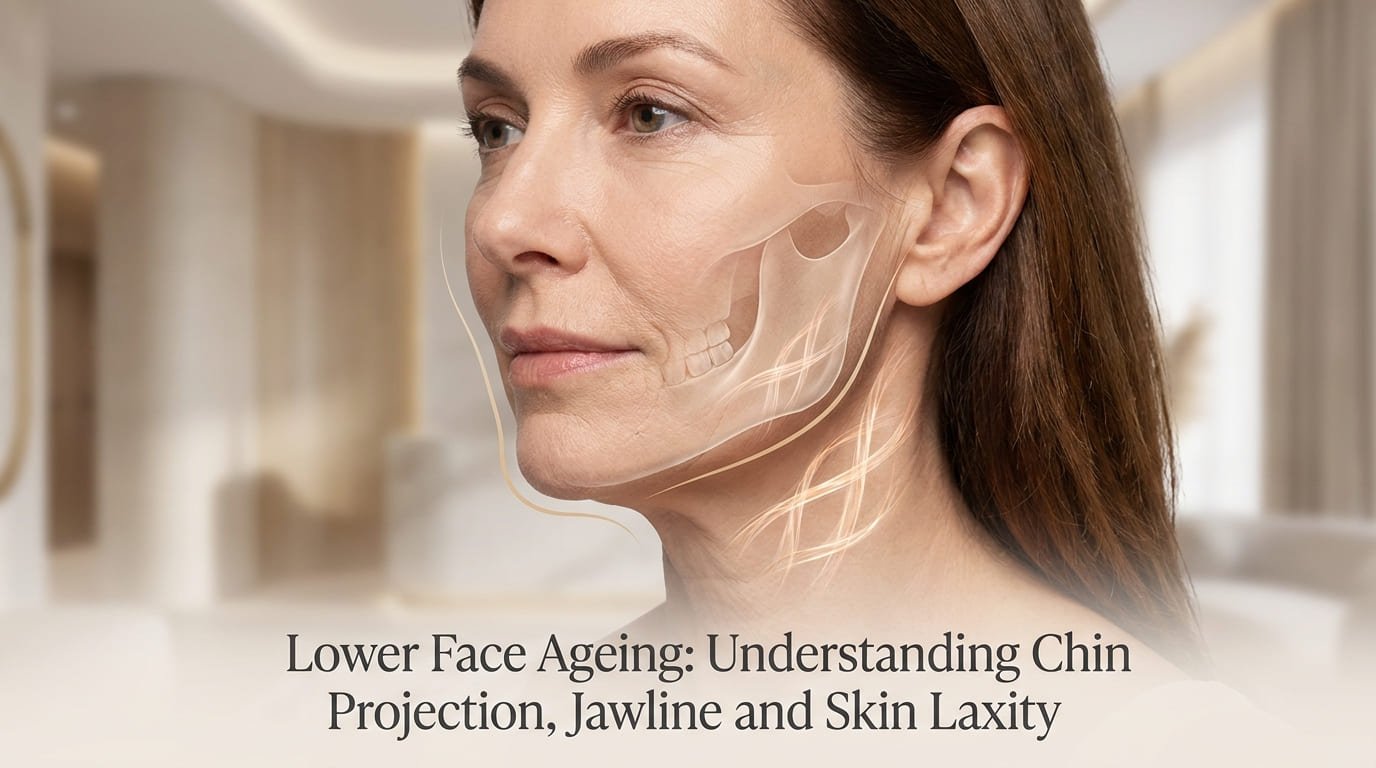
The lower face can change noticeably with age. The chin may appear less defined, the jawline can become softer, and loose skin may develop around the sides of the mouth and lower cheeks. These changes often happen gradually, so they may not be obvious at first.
For some people, the main concern is a loss of definition beneath the chin. Others notice early jowls or feel that their chin looks smaller in photographs. It is also possible to experience several of these changes at the same time.
Although they can create a similar appearance, these concerns do not always have the same cause. Chin projection, jawline structure, facial volume, and skin laxity each influence the shape of the lower face in different ways.
Understanding these differences is important before considering aesthetic treatment. A treatment that adds volume may help improve certain proportions, but it will not necessarily tighten loose skin. Similarly, a skin quality treatment cannot change the underlying projection of the chin.
This guide explains how the lower face changes with age, what contributes to a less defined jawline, and which options may be suitable for different concerns.
Why Does the Lower Face Change With Age?
The lower face is supported by several structures working together. These include the jawbone, chin, facial fat compartments, muscles, ligaments, and skin.
As the face ages, these structures gradually change. Bone remodelling can affect the support beneath the soft tissues. Fat compartments may lose volume or change position, while the skin produces less collagen and elastin than it did in earlier adulthood.
The ligaments that help support facial tissues can also become less effective over time. This may contribute to changes in the position of soft tissue and the appearance of the lower cheeks.
The result is not always the same. One person may develop visible jowls, while another mainly notices reduced chin definition or loose skin beneath the jaw.
Genetics, natural facial proportions, weight changes, sun exposure, and lifestyle can influence how these changes appear. Age is only one part of the picture.
1. Changes in Chin Projection
Chin projection describes how far the chin extends forward in relation to the rest of the face. It plays an important role in the side profile and the balance between the nose, lips, and lower face.
A chin with less forward projection may make the lower face appear shorter or less defined. It can also influence how prominent the area beneath the chin looks.
Some people have naturally recessed chins. Others notice that their facial proportions appear different as they age because of changes in surrounding soft tissue and skin support.
It is important to distinguish between a naturally small or recessed chin and changes caused by ageing. These are not necessarily the same concern.
Aesthetic assessment may consider chin shape, projection, width, and its relationship with the jawline. In selected cases, chin filler may be discussed to improve profile balance. However, filler cannot correct every structural concern, particularly where there is a significant skeletal or bite-related issue.
People with concerns about their bite, jaw function, or significant chin recession may need an assessment from an appropriately qualified dental or surgical professional rather than an injectable treatment.
2. Loss of Jawline Definition
A defined jawline creates a visible transition between the lower face and neck. Its appearance depends on bone structure, chin shape, soft tissue distribution, and skin firmness.
With age, this definition may become less noticeable. The skin can lose elasticity, and changes in the underlying tissues may soften the natural contour.
Some people notice that the angle of the jaw is less visible. Others find that the area between the chin and neck looks heavier than before.
Reduced jawline definition does not always mean that volume is missing. In some cases, tissue laxity or localised fat contributes more to the appearance.
This distinction matters when considering treatment. Adding filler to the jawline may improve selected contours, but it will not remove excess fat or tighten substantial loose skin.
You can explore the available options on our jawline and jowl treatment page.
3. What Are Jowls and Why Do They Develop?
Jowls are areas of soft tissue that become more noticeable along the lower edge of the jaw. They can create a less defined transition between the face and neck.
They develop through a combination of age-related changes. Reduced skin elasticity, changes in facial fat compartments, and weakening support structures can all contribute.
The appearance of jowls varies. Some people develop small areas of fullness beside the chin, while others experience more noticeable tissue descent along the jawline.
Weight changes can also influence the lower face. Gaining or losing weight may affect the amount and distribution of facial fat, which can make existing changes more visible.
Jowls should not be treated as a problem caused by one isolated structure. A proper assessment considers the cheeks, lower face, chin, and neck together.
This is one reason why a treatment plan based only on filling the visible area may not always produce a balanced result.
4. Skin Laxity Around the Lower Face
Skin laxity refers to a reduction in firmness and elasticity. It can affect the cheeks, jawline and area beneath the chin.
Collagen and elastin help the skin maintain its structure. As their production and organisation change with age, the skin may become less firm.
Sun exposure can contribute to this process by damaging collagen and elastin fibres. Smoking and other lifestyle factors may also influence skin quality.
Lower face laxity can make the jawline appear softer, even when there has been little change in facial volume.
It is important to separate loose skin from volume loss. A person may have adequate facial volume but still experience reduced definition because the skin has become less firm. Another person may have both concerns.
Treatments that focus on hydration and skin quality may improve the appearance of the skin, but they cannot remove significant excess tissue.
Chin Projection, Jawline Changes and Skin Laxity. What Is the Difference?
These concerns can overlap, but they describe different aspects of lower face ageing.
Chin projection relates to how far the chin extends forward and how it balances with the rest of the profile.
Jawline definition describes the visible contour of the lower jaw and its transition into the neck.
Jowls are areas of soft tissue that become more prominent along the lower edge of the face.
Skin laxity refers to reduced firmness and elasticity, which can contribute to sagging and a softer facial outline.
A person may have more than one of these concerns. For example, a naturally recessed chin combined with loose skin beneath the jaw may create a less defined profile.
Identifying the main contributing factors helps prevent unsuitable treatment choices.
Which Treatments May Help Improve Lower Face Definition?
There is no single treatment that addresses every form of lower face ageing. The most suitable option depends on facial anatomy, the degree of skin laxity, and the individual's expectations.
Dermal Fillers for Selected Areas
Dermal fillers may be considered when a lack of volume or structural support contributes to the appearance of the chin or jawline.
Hyaluronic acid fillers can be used in selected areas to improve contour and facial proportions. Chin treatment may help improve projection in suitable patients, while jawline treatment may be considered when additional definition is appropriate.
The aim should be to create balance rather than simply make the lower face look larger.
Not everyone is suitable for filler. Treatment requires an understanding of facial anatomy, appropriate product selection, and careful placement.
Possible complications include swelling, bruising, infection, lumps and, rarely, serious vascular complications. These risks should be discussed before treatment.
Explore the available options on our dermal fillers page.
Face Contouring
Face contouring considers how different areas of the face work together. Rather than focusing on one isolated feature, the practitioner assesses overall proportions.
For example, the relationship between the chin, cheeks and jawline may influence how balanced the lower face appears.
In selected cases, dermal filler may be used as part of a wider contouring plan. However, more filler is not necessarily better. Overcorrection can make facial proportions look unnatural.
You can learn more about face contouring treatments.
Liquid Facelift
A liquid facelift is a non-surgical approach that may combine injectable treatments in selected facial areas. It aims to address certain concerns involving volume, contour, and facial balance.
It is not the same as a surgical facelift. It cannot remove significant excess skin or reproduce the results of surgery.
For someone with changes across several facial areas, a practitioner may consider whether a broader treatment plan is appropriate.
Read more about the approach on our liquid facelift treatment page.
Thread Facelift Treatments
Thread lift treatments use specially designed threads placed beneath the skin to provide a lifting effect in selected cases.
They may be considered for some people with mild to moderate tissue descent. Suitability depends on skin condition, facial anatomy, and the degree of laxity.
Thread lifts are not suitable for everyone, and results are not equivalent to surgical lifting. Patients should understand the possible risks, limitations, and recovery requirements.
You can find further information about thread facelift treatment and Aptos thread facelift options.
Treatments That Focus on Skin Quality
When the main concern is skin texture, hydration, or early changes in firmness, treatments focused on skin quality may be discussed.
Profhilo and selected skin boosters are designed to improve aspects of skin quality. They do not rebuild the jawbone, correct a recessed chin, or remove significant loose skin.
Their role is different from structural filler treatment.
You can explore Profhilo treatment and skin booster options to understand how these approaches differ.
Can Lifestyle Changes Prevent Lower Face Ageing?
No lifestyle routine can completely prevent natural changes in facial structure. However, certain habits can support skin health and help limit avoidable damage.
Daily broad-spectrum sun protection helps reduce ultraviolet damage, which contributes to collagen breakdown and premature skin ageing.
Avoiding smoking is also important. Smoking is associated with premature skin ageing and can affect the skin's appearance.
Maintaining a stable weight may help avoid repeated changes in facial fullness. A balanced diet, adequate sleep, and a consistent skincare routine can also support general skin health.
These measures are useful, but they cannot restore lost bone support or reverse significant tissue descent.
How to Choose the Right Treatment for Your Lower Face
Before choosing an aesthetic treatment, it is important to understand what is creating the concern.
A consultation should consider the chin, jawline, cheeks, and neck rather than focusing only on the area that appears different in the mirror.
Useful questions to discuss include:
- Is the main concern reduced chin projection, loss of jawline definition or loose skin?
- Is there a change in facial volume or a shift in the position of soft tissue?
- Would a skin quality treatment be relevant, or is structural support the main concern?
- What results are realistic without making the face look overtreated?
- What are the possible risks, limitations and recovery requirements?
Choose an appropriately qualified and insured practitioner with relevant experience in facial anatomy and the treatment being considered. You should receive clear information about alternatives and be given time to make an informed decision.
If the concern involves significant skin excess, jaw function or skeletal structure, a non-surgical aesthetic treatment may not be the most appropriate option. A referral for a relevant medical, dental or surgical assessment may be more helpful.
Frequently Asked Questions
Does the chin become smaller with age?
Changes in the underlying facial skeleton and surrounding soft tissues can affect the chin's appearance. However, not everyone experiences the same changes. A naturally recessed chin should also be distinguished from age-related changes.
Can jawline filler get rid of jowls?
Jawline filler may improve certain contours in suitable patients, but it does not remove excess skin or significantly reposition descended tissue. An assessment is needed to determine whether filler is appropriate.
Is skin laxity the same as facial volume loss?
No. Skin laxity refers to reduced firmness and elasticity. Volume loss involves changes in the fat compartments and other structures that contribute to facial fullness. Both can occur together.
Can Profhilo improve a loose jawline?
Profhilo is a skin quality treatment. It may help improve aspects of hydration and skin condition, but it should not be considered a treatment for significant loose skin or structural jawline changes.
Is a thread lift better than jawline filler?
Neither option is universally better. They have different purposes. Filler may be considered for selected volume and contour concerns, while thread lifts may be considered for certain cases of tissue descent. Suitability depends on the individual's anatomy and treatment goals.
Understanding the Lower Face Before Choosing Treatment
Lower face ageing involves more than wrinkles or loose skin. Changes in chin projection, jawline structure, facial volume and skin elasticity can all influence the appearance of the profile.
The most important step is identifying which factors are contributing to the concern. Chin filler, jawline contouring, thread lift treatments and skin quality options have different purposes and limitations.
A personalised assessment helps establish whether a non-surgical approach is suitable, what improvement may be realistic and when another type of professional opinion would be more appropriate.
At Angel White Aesthetics, you can discuss your concerns and explore available options through an individual consultation. The aim should always be a considered treatment plan that respects your natural facial proportions and prioritises safety.