Lines around the mouth are among the facial changes people often notice as they get older. Some become more visible when smiling or talking. Others remain noticeable when the face is at rest.
Two common concerns are smile lines and marionette lines. They can appear close together, which makes them easy to confuse. However, they are not the same. They form in different areas of the face and can have different contributing factors.
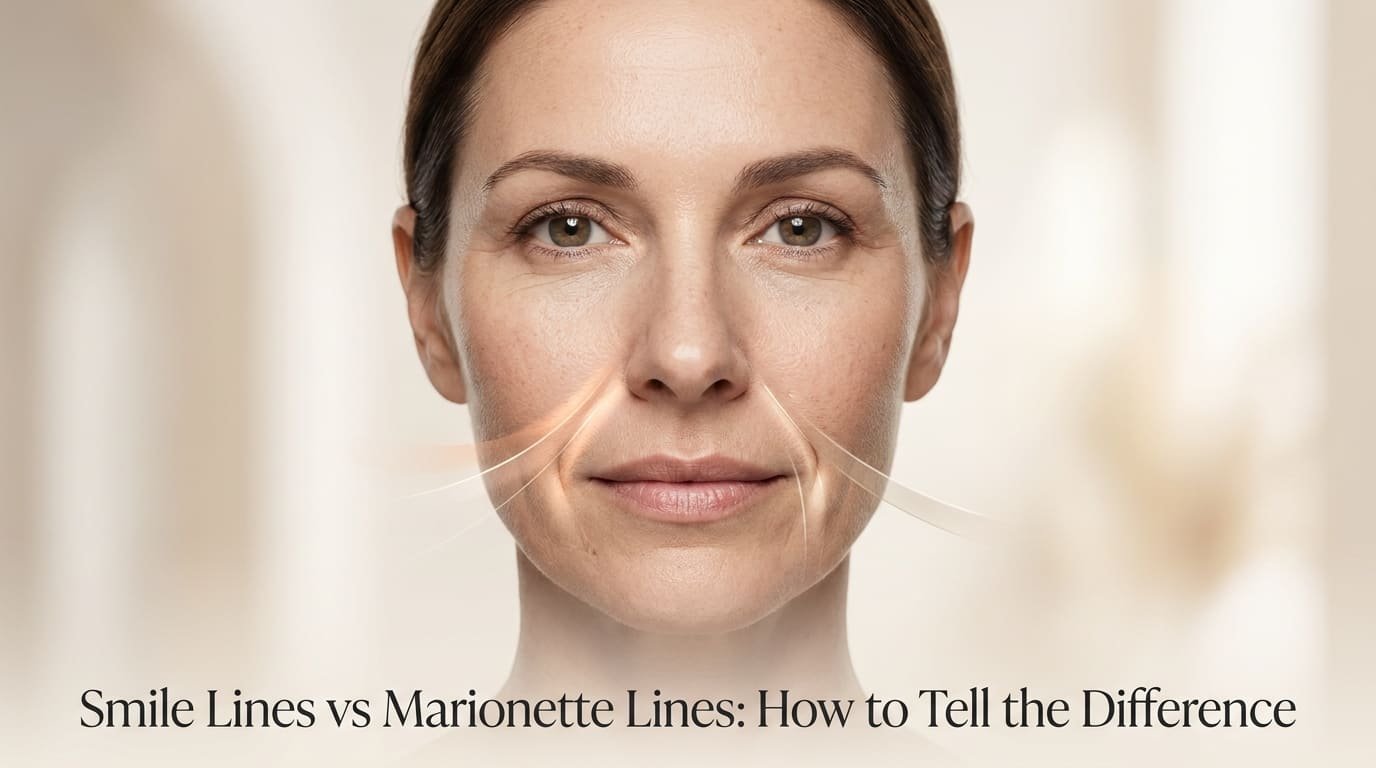
Smile lines usually run from the sides of the nose towards the corners of the mouth. Marionette lines extend downwards from the corners of the mouth towards the chin. Both can become more noticeable with age, but their appearance is influenced by facial structure, skin quality, changes in soft tissue and natural facial movement.
Understanding the difference is useful when exploring aesthetic treatment options. The right approach depends on what is causing the lines, how prominent they are and whether other changes in the surrounding face are contributing.
This guide explains how to identify each type of line, why they develop and what options may be considered during a professional assessment.
What Are Smile Lines?
Smile lines are commonly known as nasolabial folds. They are the creases that extend from the sides of the nose towards the corners of the mouth.
They are a normal part of facial anatomy. Most people have some degree of nasolabial folding, even when they are young.
These folds become more visible during smiling because the cheeks move upwards and the skin gathers along the natural crease. Over time, they may remain noticeable even when the face is relaxed.
The appearance of smile lines can vary considerably. Some people have deep folds from an early age due to their natural facial structure. Others develop more prominent lines as the skin and underlying tissues change.
Smile lines are not necessarily a sign of advanced ageing. Their depth is influenced by genetics, cheek shape, facial movement and the distribution of soft tissue.
What Are Marionette Lines?
Marionette lines are vertical or diagonal creases that extend from the corners of the mouth towards the chin.
Their name comes from the appearance of marionette puppets, which have visible lines running down from the mouth.
These lines can create a different facial appearance from smile lines. As they become more pronounced, the corners of the mouth may appear to turn downwards. Some people feel that this gives their face a tired, sad or stern expression, even when they are not experiencing those emotions.
Marionette lines are often associated with changes in the lower face. Reduced volume, skin laxity and changes in the supporting tissues can all contribute.
They may also become more noticeable alongside early jowling, where the contour around the jawline starts to soften.
Smile Lines vs Marionette Lines. The Main Differences
Although both concerns affect the area around the mouth, their location and appearance are different.
| Feature | Smile lines | Marionette lines |
| Common name | Nasolabial folds | Marionette folds |
| Location | From the sides of the nose to the mouth corners | From the mouth corners towards the chin |
| Direction | Diagonal | Mostly downward |
| Main area affected | Midface and lower cheek | Lower face and chin area |
| When visible | Often more noticeable when smiling | May remain visible when the face is relaxed |
| Contributing factors | Cheek structure, facial movement, tissue changes and skin ageing | Volume changes, skin laxity, tissue descent and lower face structure |
One important point is that these lines can occur together. A person may have prominent nasolabial folds as well as marionette lines. Treating one area does not automatically address the other.
A full facial assessment helps establish which changes are most relevant.
Why Do Smile Lines Develop?
Smile lines are influenced by several factors. Their appearance is not caused by one process alone.
Natural Facial Movement
Every time you smile, laugh or speak, the muscles around your mouth and cheeks move. The skin folds along natural expression lines.
This is normal. Repeated movement can contribute to the visibility of these creases over time, particularly when combined with changes in skin elasticity.
Changes in Cheek Volume
The cheeks provide support to the middle part of the face. As facial fat compartments change with age, the cheeks may appear flatter or less full.
This can make the transition between the cheek and the area beside the nose more noticeable. The nasolabial folds may therefore appear deeper, even if the skin directly within the fold has not changed significantly.
Reduced Skin Elasticity
Collagen and elastin help the skin maintain its structure and flexibility. Their production and organisation change with age.
When the skin becomes less firm, existing folds may become more noticeable and may take longer to smooth out after facial movement.
Genetics and Facial Anatomy
Some people naturally have deeper smile lines because of their cheek shape, facial proportions or inherited features.
This explains why two people of the same age can have very different nasolabial folds.
Why Do Marionette Lines Develop?
Marionette lines have their own set of contributing factors. They are often associated with changes in the lower face rather than the midface alone.
Loss of Lower Face Support
The soft tissues around the mouth and chin are supported by underlying structures. With age, changes in these tissues can affect the way the lower face sits.
Reduced volume in selected areas may make the mouth corners appear less supported. This can contribute to the downward appearance of marionette lines.
Skin Laxity
As skin elasticity changes, the lower face may become less firm. The skin around the mouth can begin to fold more noticeably, particularly when there are changes in the supporting tissues beneath it.
Changes Around the Jawline
Marionette lines may become more noticeable alongside early jowls. These are areas of soft tissue fullness that develop around the lower jawline.
The two concerns are related in some people, but they are not identical. A person can have marionette lines without significant jowling.
Our jowls and jawline treatment page provides further information about changes in this area and the treatment approaches that may be discussed.
Natural Facial Structure
The shape of the chin, position of the mouth corners and distribution of facial tissue can all influence the appearance of marionette lines.
Some people develop visible folds earlier than others. Age alone does not determine their severity.
Can Smile Lines and Marionette Lines Be Treated in the Same Way?
Not necessarily. Although both concerns involve folds around the mouth, their underlying causes may differ.
A treatment suitable for one area may not be appropriate for the other. The practitioner needs to consider the surrounding facial structures rather than focusing only on the visible crease.
For example, deeper nasolabial folds may be influenced by changes in cheek support. Marionette lines may be associated with lower face volume, skin laxity or tissue descent.
Adding volume directly into every visible line is not always the best approach. It can sometimes create an unnecessarily heavy appearance or fail to address the main cause.
A personalised treatment plan should consider facial balance, anatomy, skin condition and the patient's expectations.
Which Treatment Options May Help?
Several aesthetic approaches may be discussed depending on the type and severity of the concern. Not everyone needs injectable treatment, and no single option is suitable for every face.
1. Dermal Fillers
Hyaluronic acid dermal fillers may be considered when volume loss or reduced structural support contributes to the appearance of facial folds.
For smile lines, a practitioner may assess the cheeks and surrounding midface before deciding whether direct treatment of the fold is appropriate.
For marionette lines, the assessment may include the mouth corners, chin and lower face. The aim is to understand whether the lines are related to local volume changes or broader changes in facial support.
The product, placement and amount should be selected according to individual anatomy. More filler does not necessarily produce a better result.
Dermal fillers carry risks, including swelling, bruising, infection, lumps and, rarely, serious vascular complications. Patients should receive a clear explanation of these risks before treatment.
You can explore the dermal fillers treatment page to learn more about this treatment category.
2. Face Contouring
Face contouring may be considered when changes in facial proportions or definition are part of the concern.
Rather than focusing on a single crease, this approach considers how different facial areas relate to one another. Depending on the individual, assessment may include the cheeks, chin and jawline.
It is important to distinguish contouring from simply adding volume. The aim should be to maintain balanced proportions, not to create unnecessary fullness.
Find out more about face contouring at Angel White Aesthetics.
3. Liquid Facelift
A liquid facelift is a non-surgical approach that may use injectable treatments in selected areas to address facial volume and contour.
It may be discussed when several areas show age related changes rather than one isolated fold. The treatment plan depends on the patient's anatomy and suitability.
A liquid facelift is not the same as a surgical facelift. It cannot remove significant excess skin or provide the same degree of tissue repositioning as surgery.
Read more about the liquid facelift treatment to understand how this approach may be used in facial rejuvenation.
4. Treatments Focused on Skin Quality
Sometimes the main concern is not lost volume. It may be dryness, reduced hydration, fine lines or changes in skin texture.
Treatments such as Profhilo and skin boosters are designed to address aspects of skin quality. They may be considered when improving hydration and the overall appearance of the skin is the priority.
However, these treatments do not directly replace significant lost facial volume or remove established folds.
The Profhilo treatment page and skin boosters treatment page explain these treatment categories in more detail.
Can Skincare Reduce Smile Lines and Marionette Lines?
Skincare can support skin health and improve the appearance of surface changes. It cannot fully reverse deeper folds caused by changes in facial structure or volume.
A consistent routine can still make a difference to skin condition.
Daily broad spectrum sun protection helps reduce further ultraviolet damage. Moisturisers support the skin barrier and improve the appearance of dryness. Retinoids may help with fine lines and skin texture when suitable for the individual.
Avoiding smoking and maintaining a balanced lifestyle can also support general skin health.
It is important to keep expectations realistic. A skincare product cannot restore lost facial fat or reposition descended tissue.
When Should You Consider a Professional Assessment?
If smile lines or marionette lines have become more noticeable, a professional assessment can help clarify what is contributing to their appearance.
This is particularly useful when both areas are affected. The practitioner can assess the cheeks, mouth corners, chin and jawline together rather than recommending treatment based on one crease.
Before deciding on a procedure, ask about:
- The likely cause of the lines.
- Whether the concern is related to volume, skin quality or tissue laxity.
- Which treatment options are appropriate.
- The expected benefits and limitations.
- Possible complications and aftercare.
- Whether doing nothing is a reasonable option.
Choose an appropriately qualified and insured practitioner with relevant experience in facial anatomy and injectable treatments. You should have time to consider the information before making a decision.
Frequently Asked Questions
Are smile lines the same as marionette lines?
No. Smile lines, also called nasolabial folds, run from the sides of the nose towards the corners of the mouth. Marionette lines extend downwards from the mouth corners towards the chin.
Which lines usually appear first?
There is no fixed order. Some people have visible nasolabial folds from a young age due to their natural facial structure. Others notice marionette lines as lower face changes become more apparent.
Do marionette lines make the face look sad?
They can create the appearance of downward-turned mouth corners, which some people interpret as a sad or stern expression. This is a change in facial appearance and does not reflect how someone is actually feeling.
Can dermal fillers treat both types of lines?
Dermal fillers may be considered for selected patients, but the treatment approach can differ. A practitioner should assess the cause of each concern and determine whether direct treatment or support in another facial area is more appropriate.
Can smile lines and marionette lines disappear completely?
Treatment may soften their appearance in suitable patients, but complete removal is not a realistic expectation. Natural facial folds are part of normal anatomy, and results vary.
Does everyone need treatment for these lines?
No. Smile lines and marionette lines are normal facial features. Treatment is a personal choice, and there is no medical requirement to remove them.
Understanding the Difference Before Choosing Treatment
Smile lines and marionette lines may appear close together, but they affect different parts of the face. Smile lines are associated with the folds running from the nose towards the mouth. Marionette lines extend from the mouth corners towards the chin.
Their development can involve facial movement, changes in volume, skin elasticity and underlying support. This is why the same treatment is not necessarily suitable for both concerns.
The most useful starting point is a proper assessment of the whole area. Understanding the cause of the lines helps establish whether volume restoration, skin quality treatments or another approach may be appropriate.
At Angel White Aesthetics, an individual consultation can help you discuss your concerns, understand the available options and make an informed decision without feeling pressured to choose a procedure.