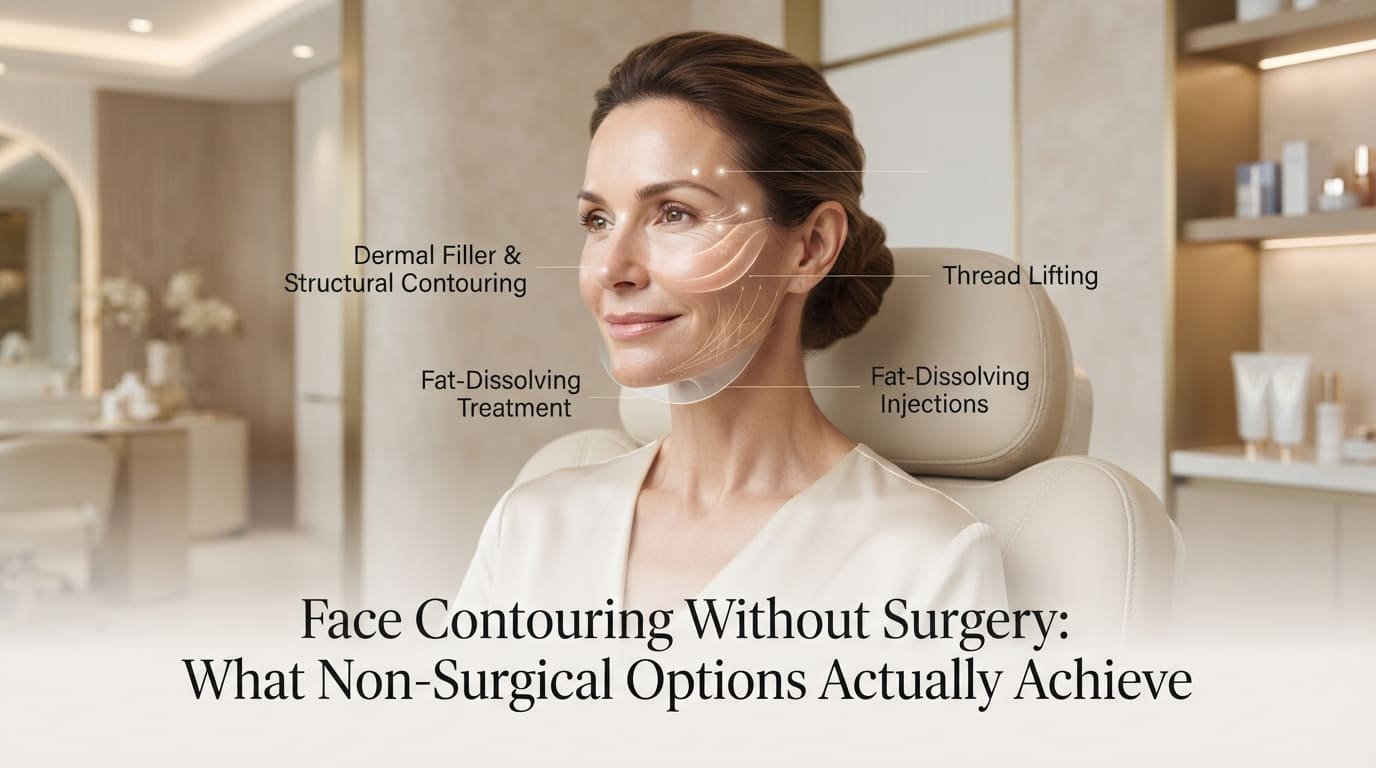
Most people who have researched non-surgical facial treatments are familiar with dermal filler. They understand the basic principle. A gel-like substance is injected into specific areas of the face to restore volume, define contour, or smooth lines. The results are visible quickly, and the treatment has a long track record in aesthetic practice.
Radiesse is injected similarly. It can be used for similar indications. In the hands of a practitioner describing the appointment to a patient who has not researched the difference, it might sound like the same thing.
It is not. Radiesse works through an entirely different biological mechanism from hyaluronic acid filler, produces a result that has a different quality and duration, and has a specific set of indications where it outperforms standard HA filler in a clinically meaningful way. Understanding those differences is what allows a patient to make an informed decision rather than assuming all injectable volume treatments are essentially equivalent.
What Standard Dermal Filler Is and How It Works
Standard dermal filler in UK aesthetic practice is almost always hyaluronic acid based. Hyaluronic acid is a substance naturally produced by the body that plays a central role in skin hydration and the structural integrity of connective tissue. The HA used in filler is manufactured through a fermentation process and cross-linked into a gel that holds its shape once injected.
The mechanism of HA filler is primarily physical. The gel occupies space in the tissue and provides volume, lift, or structural support at the injection site. It also attracts water molecules into the treated area through its osmotic properties, contributing to local hydration. Over time, enzymes in the body gradually break down the cross-linked HA and the volume effect reduces. The timeline varies by product, area, and individual, but most HA fillers in facial applications last somewhere between 6 and 18 months.
The immediate, predictable, and reversible nature of HA filler is a significant clinical advantage. Results are visible almost immediately after treatment. If a result is not as expected, hyaluronidase can dissolve the filler and allow the area to be reassessed. This combination of speed, predictability, and reversibility makes HA filler the most widely used injectable in aesthetic practice and the appropriate first choice for many indications.
The limitation of HA filler is also rooted in its mechanism. It provides volume and structure while it is present in the tissue. It does not stimulate meaningful collagen or elastin production in the surrounding tissue. When it breaks down, the tissue returns to where it was before treatment. HA filler maintains an appearance rather than improving the underlying biology of the skin.
What Radiesse Is and How It Works Differently
Radiesse is manufactured by Merz Aesthetics and is composed of calcium hydroxylapatite microspheres suspended in a carboxymethylcellulose gel carrier. Calcium hydroxylapatite is a bioceramic material. It is the same mineral compound that forms the natural structure of human bone and teeth, which gives it an exceptionally high biocompatibility. The body does not recognise it as foreign material in the way it might recognise a fully synthetic compound.
When Radiesse is injected, two distinct phases of activity begin immediately and simultaneously. The gel carrier provides immediate volume in the treated area, producing a result that is visible from the appointment itself. This is the phase that looks most similar to standard HA filler from the patient's perspective in the first days after treatment.
The second phase is where Radiesse becomes clinically distinct. The calcium hydroxylapatite microspheres remain in the tissue after the gel carrier has been metabolised and act as a scaffold around which the body initiates a regenerative response. Fibroblasts, the cells responsible for producing structural proteins, are activated by their physical interaction with the CaHA microspheres through a process called mechanotransduction. The fibroblasts begin producing new collagen and elastin in the surrounding tissue.
The clinical significance of this is substantial. Published research in the Aesthetic Surgery Journal has demonstrated that Radiesse treatment drives regeneration of collagens I and III, elastin, and proteoglycans, and promotes the formation of new tissue and vasculature. The collagen stimulation is not incidental to the treatment. It is a primary and documented effect that produces structural improvement in the tissue that persists beyond the breakdown of the product itself.
This is the fundamental difference. HA filler provides volume while it is present. Radiesse provides immediate volume and then leaves behind a genuinely improved tissue environment after the product itself has been absorbed. The tissue that replaces the Radiesse is not the same as the tissue that was there before treatment.
Radiesse as a Biostimulator: The Hyperdilute Protocol
One of the most significant developments in Radiesse clinical practice over the past several years is the hyperdilute protocol. When Radiesse is diluted significantly beyond its standard concentration, it loses its volumising function and becomes a pure biostimulator. The CaHA microspheres in the diluted form spread more broadly through the tissue, and the collagen-stimulating effect is distributed across a wider area rather than concentrated at a single injection point.
Hyperdilute Radiesse is used in areas where skin quality improvement and tissue regeneration are the primary goal rather than volume addition. The neck and décolletage, where skin laxity and crepiness develop significantly with age but where adding volume would not be appropriate, are among the most common applications. The backs of the hands, where skin thinning and the visibility of tendons and veins is a concern, also benefit from hyperdilute CaHA biostimulation.
The hyperdilute protocol sits in a different clinical category from standard filler entirely. It is being used as a regenerative tissue treatment rather than a volumising agent. Understanding that Radiesse exists in both standard and hyperdilute forms, serving different clinical purposes depending on how it is prepared and applied, is part of understanding why practitioners choose it for indications where HA filler would not be appropriate.
When Radiesse Is the Better Clinical Choice
There are specific clinical situations where Radiesse is the more appropriate recommendation than standard HA filler, and understanding why each applies helps a patient make sense of a practitioner's recommendation when it arrives.
Patients where collagen biostimulation is the primary treatment goal are better served by Radiesse than by HA filler because the mechanism directly addresses what they need. Where the tissue itself has deteriorated in quality and the goal is genuine structural improvement rather than temporary volume addition, a treatment that stimulates new collagen and elastin production produces a qualitatively different and more lasting result.
Areas requiring significant structural support and definition benefit from the firmer, more structured quality of standard Radiesse. The jawline and chin are examples where a treatment that provides both immediate structure and progressive tissue improvement is clinically valuable. The cheeks in patients where volume loss is accompanied by significant laxity respond well to a treatment that addresses both concerns simultaneously.
Patients who are concerned about the cumulative effect of repeated HA filler treatments over years and who want to move toward an approach that improves their tissue rather than repeatedly supplementing it are often well suited to Radiesse as part of a planned transition in their treatment approach.
Skin laxity of the neck, décolletage, and hands is a strong indication for hyperdilute Radiesse specifically. These areas develop significant age-related changes that respond well to CaHA biostimulation but where injecting volumising filler would be clinically inappropriate.
When Standard HA Filler Remains the Better Choice
Radiesse is not a universal replacement for HA filler and there are indications where HA filler remains the clearly superior option.
Reversibility is the most important clinical advantage HA filler holds. Because hyaluronidase can dissolve HA filler rapidly and completely, treatments using HA products carry a safety margin that Radiesse does not. In anatomically complex or higher-risk areas, the ability to reverse a result quickly and completely is a meaningful clinical consideration. Radiesse cannot be dissolved with hyaluronidase and is not reversible in the same way.
Lip treatment is an indication where HA filler is standard, and Radiesse is not appropriate. The lips require a soft, pliable product that integrates naturally with the delicate tissue and remains comfortable with normal lip movement. Radiesse is not formulated for use in the lips.
Patients seeking subtle, specific refinements rather than a broader tissue quality improvement are often better served by HA filler because the precise placement and reversibility allows for fine adjustments in a way that Radiesse does not.
First-time patients or those new to injectable treatments often benefit from starting with HA filler because the reversibility reduces the risk associated with an unknown individual response to treatment.
Longevity: How the Two Compare Over Time
Longevity is one of the most frequently asked questions when Radiesse and standard HA filler are being compared. The answer is more nuanced than a simple duration figure because the two treatments age differently in the tissue.
Standard HA filler at its peak provides its full volume effect and then gradually reduces as the HA is metabolised. By the time the effect is fully gone, the tissue is back to approximately where it started before treatment. The timeline from full result to none is typically 12 to 18 months for structural products in most facial areas.
Radiesse provides immediate volume through the gel carrier, which is typically metabolised within several months. During that initial period the visible result is comparable to HA filler. After the gel is absorbed, the CaHA microspheres continue to stimulate collagen production for several more months. The total duration of the treatment's influence on the tissue is longer than the initial volumising phase suggests, often reaching 12 to 18 months for the direct effect and with residual tissue quality improvement that persists beyond that point.
The result after Radiesse has been fully metabolised is not the same as the result after HA filler has been metabolised. The tissue in the treated area has been genuinely improved by the collagen stimulation that occurred. The patient does not return to exactly their pre-treatment baseline in the way they do with HA filler alone. This is the clinical distinction that makes Radiesse longevity difficult to capture in a simple duration comparison with HA products.
Radiesse Within a Broader Treatment Programme
Radiesse works particularly well as part of a multi-modal treatment programme rather than as a standalone treatment, which reflects how it is used in practice at Angel White Aesthetics.
Combined with polynucleotides, Radiesse biostimulation and polynucleotide fibroblast activation address the skin's regenerative capacity from two complementary biological pathways simultaneously. The cumulative collagen production from both mechanisms compounds in a way that neither treatment achieves alone.
Combined with HA filler used for specific areas where reversibility and precision matter, Radiesse provides the broader regenerative platform while HA filler addresses the specific volume or structural refinements that require its particular properties. Many comprehensive facial rejuvenation programmes use both within the same overall plan, each in the areas and for the purposes where its mechanism is most appropriate.
Frequently Asked Questions
Can Radiesse be dissolved if I do not like the result?
Radiesse cannot be dissolved with hyaluronidase the way HA filler can. The CaHA microspheres are gradually metabolised by the body over time, but there is no rapid reversal agent available for Radiesse. This is an important consideration and is discussed fully at consultation before treatment is recommended.
Does Radiesse hurt more than standard filler?
The treatment experience is similar to HA filler. The injection process uses comparable techniques and the addition of a local anaesthetic to the Radiesse solution before treatment is common practice that makes the appointment comfortable for most patients.
Is Radiesse suitable for all skin types and ages?
Radiesse is appropriate across a wide range of skin types and adult age groups. It is particularly well indicated in patients from their late thirties onward where collagen biostimulation addresses genuine tissue decline. The suitability for your specific situation is assessed at consultation.
How soon can I see results from Radiesse?
The immediate volumising effect of the gel carrier is visible from the appointment. The collagen stimulation results develop progressively over several weeks to months, and the full biostimulatory effect is typically most visible at three to four months after treatment.
Can I have Radiesse if I have previously had HA filler in the same area?
In many cases, yes, depending on how much residual HA filler is present and in which area. A detailed treatment history review at consultation is essential before Radiesse is placed in areas that have previously been treated with HA products.
Is the hyperdilute Radiesse protocol significantly different from standard treatment?
Yes. Hyperdilute Radiesse is prepared and applied using a different protocol from standard Radiesse and serves a different clinical purpose. It is used for skin quality regeneration across broader areas rather than for focal volumising. The result looks and feels completely different from standard Radiesse and is not visible as volume addition.
If you would like to understand whether Radiesse or standard dermal filler is the more appropriate choice for your specific concerns, book a consultation at our Littlehampton or Hove clinic. We will assess your face properly and explain the clinical reasoning behind any recommendation before anything is planned.
Book a Consultation in Littlehampton or Book a Consultation in Hove